
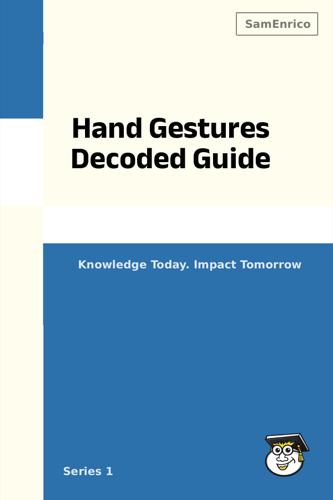
Hand Gestures Decoded Guide eBook
Explains what palm positions, finger pointing, and
by Otto Lacie
Explains what palm positions, finger pointing, and steepling communicate in different cultures.
Formats
Free sample
Chapter 1: The Limbic Leak--–- Most people watch the eyes. That is their first mistake.You have been taught, probably since childhood, that the eyes are the windows to the soul. Look someone in the eye when you speak to them, you were told. A shifty gaze means deception. Wide eyes mean honesty.
Eye contact builds trust. All of this is, at best, a half-truth. At worst, it is a dangerous distraction that has allowed you to miss the most honest part of the human body for your entire life.The hands never lie.Not because they are incapable of deception—hands can be trained, just as faces can be trained—but because the brain does not prioritize hiding their movements. When you feel a sudden spike of fear, excitement, or discomfort, your hands will respond before your conscious mind can intervene. The face has had thousands of years of social training to mask emotions.
The hands have had no such schooling. They are the raw, unfiltered broadcast of your limbic system, and once you learn to read them, you will realize that people have been telling you the truth—and the lies—with their fingers for as long as you have known them.This chapter is the foundation of everything that follows. It will explain why the hands are more honest than the face, how the brain’s ancient wiring betrays our true feelings through our fingers, and why your smartphone habit may be making you blind to the most important signals in human communication. By the end of this chapter, you will never look at a pair of hands the same way again.The Myth of the Honest Face Let us begin with a simple experiment that you can conduct within the next hour. Find a video online of a political press conference—any politician, any country, any controversy.
Watch the first two minutes with the sound off, focusing entirely on the speaker’s face. Notice the smiles, the frowns, the raised eyebrows, the steady eye contact. You will likely conclude that the speaker appears confident, sincere, and in control.Now watch the same two minutes again, this time focusing only on the hands. Watch what they do when the politician is asked a difficult question. Watch where they go when a topic changes from neutral to uncomfortable.
Watch for moments when the hands seem to move independently of the words being spoken. What you will see—if you have not been trained to see it before—is a second conversation happening below the table, in the lap, or at the podium’s edge. The face is performing. The hands are reacting.This is not because politicians are uniquely dishonest. It is because the human face has become extraordinarily skilled at social masking over millennia of evolution.
We learn to smile when we are unhappy, to maintain eye contact when we are afraid, and to nod when we disagree, all in the service of social harmony. The muscles of the face are under voluntary control. You can decide to smile. You can decide to look someone in the eye. You can decide to arrange your features into an expression of calm confidence even when your heart is racing.The hands are different.
The neural pathways that control hand movements are older, faster, and less subject to conscious override than the pathways that control facial expressions. This is because the hands evolved for survival—grasping, throwing, defending, building—before they evolved for communication. When your limbic system detects a threat, it mobilizes your hands for action before it consults your prefrontal cortex about whether that action is socially appropriate. By the time you decide to hide your discomfort, your hands have already revealed it.Consider the research of Dr. Paul Ekman, the psychologist whose work on micro-expressions inspired the television series Lie to Me.
Ekman famously demonstrated that facial expressions of emotion are universal across cultures, but he also discovered that most people cannot reliably detect deception from the face alone. In study after study, untrained observers performed barely better than chance when trying to spot a liar by watching their eyes and mouth. The face, it turns out, is a remarkably good liar. The hands are not.Joe Navarro, a former FBI counterintelligence officer and the author of What Every BODY is Saying, spent twenty-five years interrogating spies, criminals, and foreign agents. In his training, he was taught to ignore the face almost entirely.
“The face is the last place to look for the truth,” Navarro writes. “It has been trained since childhood to mask emotion. The hands, the feet, and the torso are far more reliable indicators of a person’s true feelings.” Navarro’s most famous cases were broken not by watching a suspect’s eyes, but by observing what their hands did when they thought no one was looking.The Limbic System: Your Emotional Broadcast Tower To understand why the hands are so honest, you need to understand a little brain anatomy. Do not worry—this will not be a lecture. You only need to remember three structures: the limbic system, the neocortex, and the pathways that connect them.The limbic system is the oldest part of your brain in evolutionary terms.
It is sometimes called the “emotional brain” because it generates fear, pleasure, anger, and excitement. The limbic system operates quickly, automatically, and below the level of conscious awareness. When you hear a sudden loud noise, your limbic system makes you flinch before you have identified the sound. When you see a snake-shaped stick on a hiking trail, your limbic system makes you jump back before your eyes have confirmed whether it is actually a snake. This speed is protective.
The limbic system prioritizes survival over accuracy.The neocortex, by contrast, is the newer, outer layer of the brain. It handles language, reasoning, planning, and conscious decision-making. The neocortex is slow, deliberate, and analytical. It is the part of your brain that says, “That stick only looked like a snake; we are safe now.” The neocortex is also the part of your brain that tries to control your facial expressions and your words when you want to present a particular image to the world.Here is the critical insight: the limbic system connects to the hands more directly and more quickly than it connects to the neocortex. When you feel a strong emotion, your hands receive the signal before your conscious brain has a chance to intercept and edit it.
This is why a person who is suddenly afraid might raise their hands in a defensive position before they have consciously registered the threat. This is why a person who is suddenly excited might rub their palms together before they have decided how to express that excitement. The hands are the limbic system’s preferred outlet.Neuroscientists have confirmed this through functional MRI studies. When a subject experiences a sudden emotional stimulus—a frightening image, an unexpected reward, a social rejection—the motor cortex that controls the hands activates within milliseconds, often before the prefrontal cortex (the seat of conscious control) has even begun to process the stimulus. Your hands know how you feel before you do.…
This is the end of the free sample. Get the eBook to keep going. Buy now
About this book
Details
- Author
- Otto Lacie
- Publisher
- SamEnrico
- Language
- English
- Genre
- Non-Fiction, Self-Help, Nonverbal Communication
- Released
- 2026-06-06
- Pages (approx.)
- 152
- Available as
- eBook, Audiobook

Read better in the ZLOADR app
Your eBooks on your phone or tablet. Sign in with your SamEnrico account and start reading.
More by Otto Lacie
 Food Addiction Support GroupsOtto Lacie$11.99
 Do Not Disturb SignalsOtto Lacie$11.99
 Collaborative Environment Design GuideOtto Lacie$11.99
 NVC for ArtistsOtto Lacie$11.99
 Migraine and Menstrual Cycle ManagementOtto Lacie$11.99
 Parental Anger Repair HandbookOtto Lacie$11.99
 Head and Neck SurvivorOtto Lacie$11.99
 Gary Coleman Diff'rentOtto Lacie$11.99
 Erasmus and the Republic of Letters: The Scholar Who United EuropeOtto Lacie$11.99
 The Cotton Kings: How Manchester Wove the Industrial RevolutionOtto Lacie$11.99
 The Last Play: How a Single Moment Ended a Legend's ReignOtto Lacie$11.99
 The Mineral Guide to Native CopperOtto Lacie$11.99
You may also like
 The Nonverbal Stress Signal GuideMackay Chin$11.99
 Silence Speaks LouderMoseley Latesha$11.99
 Eye Contact Communication GuideSchindler Estella$11.99
 Body Language for De escalationPeyton Lucius$11.99
 The Visual Interruption SignalBussey Verdell$11.99
 Mastering Eye Contact GuideKidwell Cathi$11.99
 Body Language for PresentersPinkerton Blaine$11.99
 Body Language For InfluenceCole Alfred$11.99
 The Deep Work Signaling ManualEarls Margarete$11.99
 Reading Emotions in OthersStaley Annabell$11.99
 Body Language For PresentationsLipscomb Marisha$11.99
 The Body Language Reading GuideTellez Rory$11.99