
Non-FictionInformativeEducational
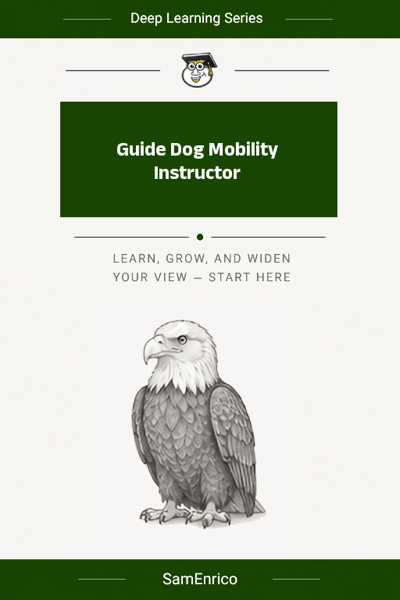
Guide Dog Mobility Instructor eBook
A Coursebook on Guide Dog Mobility Instructor
A Coursebook on Guide Dog Mobility Instructor
Formats
Free sample
Chapter 1: The Invisible Handshake–- The first time I watched a guide dog team fail, I was twenty-two years old, freshly hired at a training school in rural Oregon, and absolutely certain that I understood dogs. I had grown up with Labrador retrievers, trained my own hunting dogs, and read every book on canine behavior I could find. I thought I knew what a trained dog looked like. I was wrong.The team in question was a forty-seven-year-old woman named Diane, who had lost her vision gradually over a decade to retinitis pigmentosa, and a three-year-old black Labrador named Porter. Porter had passed every assessment.
He was steady in traffic, unflappable on escalators, and had demonstrated intelligent disobedience at a busy intersection during his final exam by refusing a “Forward” command when a delivery truck ran a red light. The instructors called him “bombproof.” Diane had waited eighteen months for this dog.They lasted three weeks.Diane returned Porter to the kennel on a Tuesday morning. She was crying, but the kind of crying that comes from exhaustion rather than sadness—the hollow, dry-eyed weeping of someone who has given up. “He won’t listen to me,” she said. “He pulls me toward every food smell on the sidewalk.
He stops at every curb like he’s waiting for permission, and I don’t know what permission he wants. I feel like I’m fighting him every step.”The senior instructor on staff, a woman named Margaret who had been training guide dogs since 1987, sat Diane down with a cup of tea and asked a single question: “When you give Porter a command, where are your shoulders pointing?”Diane blinked. “What do my shoulders have to do with anything?”That question—what do my shoulders have to do with anything—is the central mystery that this entire book exists to solve. Because the answer is: everything. Diane’s shoulders were rotated ten degrees to the left of her direction of travel, a habit she had developed over years of using a white cane.
With a cane, that rotation didn’t matter. With a guide dog, it told Porter to turn left every time Diane thought she was going straight. He wasn’t disobeying her. He was reading her body language more accurately than she was producing it.Margaret spent two hours retraining Diane’s posture. She walked the team through a simple drill: ten steps forward, stop, check shoulders, adjust, ten more steps.
By the end of the session, Porter was walking in a straight line. By the end of the week, Diane was laughing. By the end of the month, she had named him the best thing that had ever happened to her.Porter hadn’t changed. Diane hadn’t changed, not really. But the communication between them had transformed completely—because someone finally translated the invisible conversation that happens every second between a blind handler and a guide dog.That conversation is the subject of this chapter and, in many ways, the subject of this entire book.
I call it the invisible handshake.The Myth of the Self-Driving Dog Most people, when they imagine a guide dog, picture something like a furry autonomous vehicle. The dog knows the route. The dog avoids obstacles. The dog makes decisions. The handler holds the harness and follows along, a passive passenger in a canine-driven taxi.This is a beautiful fantasy and a dangerous lie.Guide dogs do not know where they are going.
They do not read street signs, interpret GPS coordinates, or understand the concept of “third street on the left.” What guide dogs do—what they are exquisitely trained to do—is navigate the immediate physical environment while responding to directional cues from the handler. The handler provides the destination and the macro-navigation (“we need to go north for three blocks”); the dog provides obstacle avoidance, traffic safety, and environmental interpretation (“there is a low-hanging branch, stop here”).This division of labor is the invisible handshake. It requires both parties to trust each other completely, but it also requires both parties to understand each other’s communication systems. The handler must learn to send clear, consistent signals through the harness. The dog must learn to read those signals and respond with predictable, safe behaviors.
And the instructor—the GDMI—must learn to see breakdowns in this communication before they become failures.What Is a Guide Dog Mobility Instructor?The term “Guide Dog Mobility Instructor” sounds straightforward, but it conceals a profession that exists at an unusual intersection. A GDMI is not simply a dog trainer who happens to work with blind people. Nor is a GDMI an Orientation & Mobility specialist who happens to use dogs. The GDMI is a distinct professional category that requires fluency in three domains that rarely overlap:Canine Science. The GDMI must understand learning theory, behavioral psychology, canine body language, and the developmental trajectory of working dogs.
This goes far beyond “positive reinforcement” and “clicker training.” A GDMI knows the difference between conditioned reinforcement and primary reinforcement, understands the role of negative reinforcement in harness work (the release of pressure as a reward), and can read a dog’s stress signals before the dog even knows it is stressed.Human O&M. The GDMI must understand how vision loss affects human movement, psychology, and communication. A GDMI knows the stages of adjustment to blindness, the mechanics of cane travel, and the specific challenges faced by clients with residual vision, Usher syndrome (deaf-blindness), or additional physical disabilities. More importantly, a GDMI understands that teaching a blind person to work with a dog is fundamentally different from teaching a sighted person to work with a dog—because the blind handler cannot see what the dog is doing.Instructional Design. The GDMI must know how to teach.
This sounds obvious, but it is the most commonly underestimated skill in the profession. You can understand dogs perfectly. You can understand blindness perfectly. If you cannot transfer that understanding to a client who is frightened, exhausted, and possibly skeptical, you will fail. The GDMI must break complex behaviors into teachable components, provide feedback without overwhelming the learner, and manage the emotional rollercoaster that is guide dog training.The International Guide Dog Federation (IGDF), which accredits guide dog schools worldwide, requires that a GDMI complete a minimum of three years of supervised fieldwork before independent certification.
During those three years, the trainee must successfully train a minimum of six guide dogs and graduate six human-dog teams under supervision. This is not a profession you enter casually. It is an apprenticeship that demands patience, humility, and a tolerance for failure.The Historical Roots of the Profession The modern guide dog movement began after World War I, when thousands of soldiers returned from the trenches blinded by gas, shrapnel, and disease. In Germany, Dr. Gerhard Stalling noticed that his own dog, a German Shepherd, seemed to naturally guide his blind father around obstacles.
Stalling opened the world’s first guide dog school in Oldenburg in 1916. By the 1920s, similar schools had appeared in Switzerland and England.The critical turning point came in 1927, when a blind American named Morris Frank traveled to Switzerland to…
This is the end of the free sample. Get the eBook to keep going. Buy now
About this book
Details
- Author
- Keefe Charlesetta
- Publisher
- SamEnrico
- Language
- English
- Genre
- Non-Fiction, Informative, Educational
- Released
- 2026-06-02
- Pages (approx.)
- 147
- Available as
- eBook, Audiobook

Read better in the ZLOADR app
Your eBooks on your phone or tablet. Sign in with your SamEnrico account and start reading.
More by Keefe Charlesetta
 Values And Mission Alignment Sales ProcessKeefe Charlesetta$11.99
 Breaking Compulsive Spending Cycle CourseKeefe Charlesetta$11.99
 Dream Sketching MethodKeefe Charlesetta$11.99
 Sugar Addiction Medication OptionsKeefe Charlesetta$11.99
 Loving Kindness StarterKeefe Charlesetta$11.99
 The Star Compass: Polynesian Navigation and the Ancient Pacific VoyagesKeefe Charlesetta$11.99
 The Day the Internet Stood Still: How a Single Bug Brought the Web to Its KneesKeefe Charlesetta$11.99
 How to Become a Change PersonKeefe Charlesetta$11.99
 Pre Seed Networking GuideKeefe Charlesetta$12.99
 Understanding Complex 3 Mitochondrial Respiratory Chain DeficiencyKeefe Charlesetta$17.99
You may also like
 Hong Kong Handover 1997Dunn Johnnie$11.99
 Zumba For Postnatal Recovery CourseNeal Christian$11.99
 Zumba for BeginnersLadner Nikia$11.99
 YouTube Comment Mining GuideHumes Pandora$12.99
 Worry Box MeditationCarlin Rudy$11.99
 Workplace Stress MeditationNguyen Lynn$11.99
 Workplace Stress and Sleep RepairHawley Ivory$11.99
 Workplace Perfectionism CureDelaney Jeffry$11.99
 Workplace Injustice Anger GuideWallen Isabelle$11.99
 Work Addiction and Burnout LinkGreenwood Ester$11.99
 Women in Yoga and WellnessBeattie Galina$11.99
 Women in Stand Up ComedyChun Evangeline$11.99