
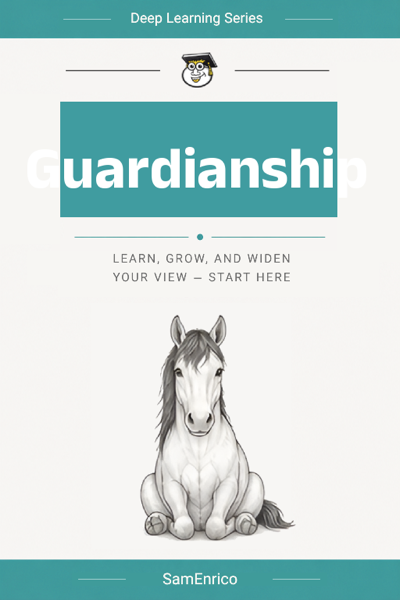
Non-FictionInformativeEducational
Guardianship eBook
A Coursebook on Guardianship
A Coursebook on Guardianship
Formats
Free sample
Chapter 1: The Quiet Crisis...–- Margaret never thought she would become her mother’s jailer. But that is exactly how she felt the first time she held the crisp, signed court order in her trembling hands. Her mother, Eleanor, a retired university professor who had once lectured on constitutional law, now sat in a memory care unit, unable to remember what she had eaten for breakfast. The psychiatrist’s report used clinical language—"severe cognitive decline, inability to manage finances, lack of capacity to make informed medical decisions"—but to Margaret, those words felt like a death sentence for her mother’s personhood. She had done everything right.
She had tried the durable power of attorney, but her mother had signed it years ago with a notary who barely asked any questions, and now the bank refused to honor it because the signature looked "off." She had attempted supported decision-making, but her mother’s "supporters"—a well-meaning neighbor and a cousin who lived three hours away—could not stop Eleanor from writing a $40,000 check to a man who called himself her "spiritual advisor." So Margaret filed for guardianship. And when the judge granted it, she walked out of the courthouse with the legal authority to control where her mother lived, what medical care she received, and every dollar she had saved over a lifetime. "I feel like I just erased her," Margaret whispered to herself in the parking lot. "And I don't know if I can live with that."This book is for everyone who has ever stood in that parking lot.Whether you are an adult child watching a parent fade into dementia, a spouse trying to protect a partner from financial predators, a social worker navigating a system that seems designed to frustrate you, or a professional guardian who has seen too many families break under the weight of this responsibility—this book is your companion, your manual, and your ethical compass. Guardianship is one of the most powerful legal tools in American civil law.
It can strip a person of nearly every right we hold dear: the right to choose where to live, the right to refuse medical treatment, the right to marry, the right to vote, the right to spend one’s own money. And yet, it is also a necessary shield for millions of vulnerable adults who cannot protect themselves. The crisis is quiet because it happens behind closed doors—in nursing homes, in probate courtrooms, in the exhausted midnight conversations of family caregivers. But it is a crisis nonetheless.The Hidden Epidemic: Numbers That Should Startle You Let us begin with the raw mathematics of guardianship in America because numbers have a way of cutting through sentimentality. According to the most reliable estimates from the National Center for State Courts and the Government Accountability Office, there are between one and two million active adult guardianships in the United States at any given time.
That range—a full million-person margin of error—tells you something important about how poorly we track this system. No national database exists. No federal agency comprehensively audits guardianship outcomes. In most states, if a guardian files an annual report, it sits in a courthouse basement, unread unless someone complains. The assets managed by guardians and conservators exceed fifty billion dollars annually.
That is billion with a B. To put that in perspective, it is roughly equivalent to the gross domestic product of Luxembourg or the entire annual budget of the National Park Service.But statistics, no matter how staggering, cannot capture human cost. Every year, an estimated 1.3 million Americans turn 65, and the fastest-growing segment of the population is those over 85—the age group most likely to experience cognitive decline. Dementia alone affects more than six million Americans, a number projected to nearly triple by 2060. Add to that adults with intellectual and developmental disabilities, traumatic brain injury survivors, individuals with severe mental illness, and those suffering from strokes or other neurological events, and the pool of potentially incapacitated adults swells to tens of millions.
Most will never need guardianship because they have families, trusts, powers of attorney, or sufficient wealth to afford private solutions. But a significant minority will. And when they do, they enter a system that most people know nothing about until they are drowning in it.The Fundamental Tension: Liberty Versus Protection At the heart of every guardianship proceeding lies an irresolvable philosophical conflict. On one side stands the principle of autonomy—the deeply rooted American conviction that adults have the right to make their own choices, even bad ones. This principle draws from English common law, from the due process clauses of the Fifth and Fourteenth Amendments, and from a cultural DNA that prizes individual liberty above almost all other values.
The Supreme Court has repeatedly affirmed that a person has a constitutional right to refuse medical treatment, to live in squalor if they choose, to give away their money to charlatans, and to make decisions that others might consider unwise or even self-destructive. As Justice Benjamin Cardozo wrote in a famous 1914 opinion, "Every human being of adult years and sound mind has a right to determine what shall be done with his own body."On the other side stands the doctrine of parens patriae—Latin for "parent of the nation." This ancient principle, imported from English chancery courts, holds that the state has not only the right but the duty to protect those who cannot protect themselves. It is the legal justification for everything from child welfare laws to civil commitment for the mentally ill. Under parens patriae, the state can step in when a person’s incapacity renders them vulnerable to harm—not because the state knows better, but because the individual has lost the capacity to know better for themselves.Guardianship sits at the collision point of these two principles. A guardianship proceeding asks one question: has this person lost the capacity to make decisions to such a degree that the state’s duty to protect outweighs their right to autonomy?
The answer is never simple, never permanent, and never free from the risk of error.A Brief History: From Roman Law to Modern Probate The roots of guardianship stretch back to Roman law, where the paterfamilias—the male head of household—had absolute authority over his children and wife. When the father died or became incapacitated, Roman law appointed a tutor to manage the affairs of minors and a curator to manage the affairs of adults with mental disabilities. This distinction between guardianship of the person (tutela) and guardianship of property (cura) persists to this day, though the terminology has shifted.English common law inherited and refined these Roman concepts. The Court of Chancery—England’s court of equity—developed the parens patriae power as a mechanism for protecting those deemed "lunatics" or "idiots" (the clinical, if offensive, terms of the era). A "lunatic" was someone who had lost their reason but had once possessed it—what we might call dementia or traumatic brain injury today.
An "idiot" was someone who had never possessed reason—what we now call intellectual disability. The distinction mattered because a lunatic could have lucid intervals during which they…
This is the end of the free sample. Get the eBook to keep going. Buy now
About this book
Details
- Author
- Hamblin Patrica
- Publisher
- SamEnrico
- Language
- English
- Genre
- Non-Fiction, Informative, Educational
- Released
- 2026-05-11
- Pages (approx.)
- 151
- Available as
- eBook, Audiobook

Read better in the ZLOADR app
Your eBooks on your phone or tablet. Sign in with your SamEnrico account and start reading.
More by Hamblin Patrica
 Genetic Testing for Male InfertilityHamblin Patrica$11.99
 Workplace Esteem for New GradsHamblin Patrica$11.99
 The Hot Air Balloon GuideHamblin Patrica$11.99
 Pitching To Micro VCs And Seed Funds GuideHamblin Patrica$11.99
 Foreign Advisors Meiji Japan GuideHamblin Patrica$11.99
 The Silent Siege: The USS Scorpion's Last TransmissionHamblin Patrica$11.99
 The Jade Serpent's Curse: A Dragon's Vow of VengeanceHamblin Patrica$11.99
 How to Start a Catgut and Similar Materials (wholesale) Business (Beginners Guide)Hamblin Patrica$11.99
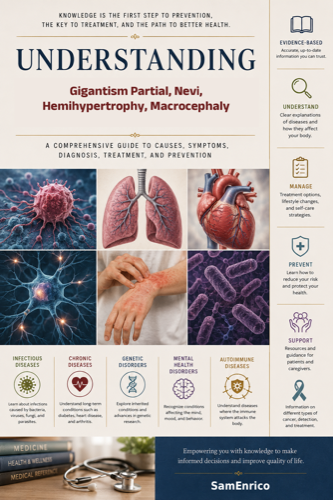 Understanding Gigantism Partial, Nevi, Hemihypertrophy, MacrocephalyHamblin Patrica$17.99
 Coco Chanel Cash Reinvestment WorkbookHamblin Patrica$12.99
 French Duty of Care GuideHamblin Patrica$12.99
You may also like
 Hong Kong Handover 1997Dunn Johnnie$11.99
 Zumba For Postnatal Recovery CourseNeal Christian$11.99
 Zumba for BeginnersLadner Nikia$11.99
 YouTube Comment Mining GuideHumes Pandora$12.99
 Worry Box MeditationCarlin Rudy$11.99
 Workplace Stress MeditationNguyen Lynn$11.99
 Workplace Stress and Sleep RepairHawley Ivory$11.99
 Workplace Perfectionism CureDelaney Jeffry$11.99
 Workplace Injustice Anger GuideWallen Isabelle$11.99
 Work Addiction and Burnout LinkGreenwood Ester$11.99
 Women in Yoga and WellnessBeattie Galina$11.99
 Women in Stand Up ComedyChun Evangeline$11.99