
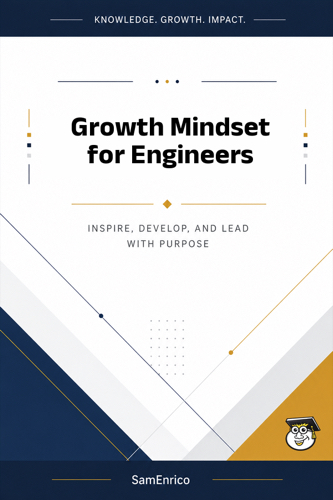
Non-FictionSelf-HelpEngineering
Growth Mindset for Engineers eBook
Views structural failures as design lessons.
by Dion Rheba
Views structural failures as design lessons.
Formats
Free sample
Chapter 1: The Perfection Trap--The young structural engineer stared at the crack in the weld. It was small—maybe two millimeters at its widest point—running along the interior flange of a pedestrian bridge support. The bridge was scheduled to open in three weeks. The mayor had already announced the ribbon-cutting ceremony. The local news had filmed a cheerful segment about "modern infrastructure connecting our community."The engineer's name was Priya.
She had been on the job for fourteen months. She had learned, in those fourteen months, that there were two versions of engineering: the one they taught in university, where problems had clear solutions and failures were case studies from a safe distance, and the one that happened on actual construction sites, where concrete arrived late, budgets shrank, and the person who found a problem was often treated worse than the person who caused it.Priya took a photograph of the crack. She documented its location, orientation, and approximate dimensions in her notebook. Then she walked to the site trailer, where the project manager, a man named Carver who had been building bridges for thirty years, was eating a sandwich and reviewing the opening ceremony seating chart."There's a crack in the north flange weld," Priya said. "Interior face.
About two millimeters."Carver did not look up from the seating chart. "Is it in the tolerance?""I don't know yet. I need to measure it properly. But it looks like it might propagate.""Propagate." Carver said the word like it was a foreign language he had no interest in learning. "Priya, we've got three weeks.
The steel supplier is already paid. The welder is gone. We're not tearing apart a weld for a two-millimeter crack that might be nothing.""What if it's not nothing?"Carver finally looked up. He had the expression of a man who had been asked this question a thousand times by a thousand young engineers, each one convinced they were the first to discover that the world was imperfect. "Then we'll catch it in the five-year inspection.
That's what inspections are for."Priya stood in the doorway of the trailer. The afternoon sun was hot. She could hear the distant sound of a jackhammer from another part of the site. She thought about the crack. She thought about the families who would walk across this bridge.
She thought about the news segment, the cheerful reporter, the ribbon.She also thought about what happened to the last person on this crew who had escalated a concern. His name was Marcus. He had found a batch of bolts that did not meet the specified grade. He had filed a formal report. Three weeks later, he was assigned to a different project—one with less responsibility, less visibility, and, as everyone knew, no path to promotion.
The message was clear: find problems at your own risk.Priya looked at Carver. "I want to file a formal observation."Carver sighed. He set down his sandwich. "You want to file a formal observation for a two-millimeter crack that might be nothing.""I want to document it.""Document it in your notebook. Keep it to yourself.
If it turns out to be something, you'll have the record. But if you file a formal observation, I have to report it to the client. The client will ask questions. The questions will slow down the schedule. The schedule will slip.
The mayor will be angry. Do you understand the chain reaction you're talking about?"Priya understood. She also understood that the chain reaction she was imagining—the one where the crack grew, the weld failed, the bridge collapsed—was statistically unlikely. The safety factor on the design was generous. The bridge would probably be fine.
Probably.She filed the observation anyway.Three weeks later, the bridge opened. The ribbon was cut. The mayor smiled. The news segment aired. The crack was never mentioned.Six months later, a routine inspection found that the two-millimeter crack had grown to fourteen millimeters.
A forensic analysis determined that the weld had been cold during application—a subtle temperature deviation that had compromised the bond at a microscopic level. The crack had been the first visible symptom of a deeper problem.The bridge was closed for repairs. The repairs cost four times what it would have cost to fix the weld before opening. The project manager, Carver, was reassigned. Priya was called into a conference room with three senior engineers and a lawyer from the client's office."Did you know about this crack before opening?" the lawyer asked.Priya said yes."Do you have documentation?"Priya opened her notebook.
She showed them the photograph, the measurements, the date. She showed them the formal observation she had filed, with Carver's signature acknowledging receipt.The lawyer looked at Carver. Carver looked at the table.Priya kept her job. Carver did not. But the story that circulated through the company was not about Carver's mistake.
It was about Priya's ambition. She had gone around the chain of command. She had made her manager look bad. She was not a team player. She was not invited to the next major project.
She was, in the quiet language of engineering firms, "managed out" over the following year.The crack was fixed. The lesson, as far as the company was concerned, was not about better weld inspections or more rigorous temperature control. The lesson was about managing junior engineers who filed uncomfortable observations.This is the engineering culture we have inherited. And it is killing us.The Sink-or-Swim Delusion Engineering has a mythology about itself. The mythology goes like this: engineering is a profession of precision, logic, and rigorous standards.
Engineers calculate loads, test materials, and verify every assumption. Mistakes are rare, and when they occur, they are tragic anomalies caused by individual incompetence or negligence. The solution to failure is better training, better oversight, and the swift removal of the engineers who failed.This mythology is comforting. It is also wrong.The reality is that engineering, like every human endeavor, is shot through with error, uncertainty, and compromise. Every bridge, every building, every airplane, every dam is a monument not to perfection but to managed imperfection.
Engineers make assumptions about material properties that are never perfectly uniform. They apply safety factors that are, ultimately, educated guesses about the gap between what they know and what they don't know. They design within budgets and schedules that have nothing to do with physics and everything to do with politics, finance, and human psychology.The difference between a great engineer and a mediocre one is not that the great engineer makes fewer mistakes. The difference is that the great engineer finds their mistakes earlier, shares them more openly, and learns from them more systematically than the mediocre engineer, who hides errors, blames others, and repeats the same failures across project after project.This is the central argument of this book: the engineering mindset is, at its core, a growth mindset—but engineering culture has become a fixed mindset machine that punishes error, rewards concealment, and treats failure as a verdict rather than a lesson.Two Mindsets, Two Engineering Careers The psychologist Carol Dweck spent decades studying how people respond to challenge…
This is the end of the free sample. Get the eBook to keep going. Buy now
About this book
Details
- Author
- Dion Rheba
- Publisher
- SamEnrico
- Language
- English
- Genre
- Non-Fiction, Self-Help, Engineering
- Released
- 2026-06-05
- Pages (approx.)
- 139
- Available as
- eBook, Audiobook

Read better in the ZLOADR app
Your eBooks on your phone or tablet. Sign in with your SamEnrico account and start reading.
More by Dion Rheba
 Self Esteem for Union WorkDion Rheba$11.99
 DoorDash Delivery EfficiencyDion Rheba$11.99
 The Tool Library CreatorDion Rheba$11.99
 Roblox Parental Control GuideDion Rheba$11.99
 The Next Level After Death ClaimDion Rheba$11.99
 The Codebreaker's Labyrinth: Alan Turing and the Enigma of TimeDion Rheba$11.99
 Silent Echoes: The Unseen Artistry of Latin America's Mime RevolutionDion Rheba$11.99
 Service Providers Guide to Delivery ServiceDion Rheba$11.99
 How to Produce a JetheadDion Rheba$11.99
 A Collector's Handbook to the Jensen 541sDion Rheba$11.99
 Venture Debt for BootstrappedDion Rheba$12.99
 Batch Processing API BlueprintDion Rheba$12.99
You may also like
 Hong Kong Handover 1997Dunn Johnnie$11.99
 Zumba For Postnatal Recovery CourseNeal Christian$11.99
 Zumba for BeginnersLadner Nikia$11.99
 YouTube Comment Mining GuideHumes Pandora$12.99
 Worry Box MeditationCarlin Rudy$11.99
 Workplace Stress MeditationNguyen Lynn$11.99
 Workplace Stress and Sleep RepairHawley Ivory$11.99
 Workplace Perfectionism CureDelaney Jeffry$11.99
 Workplace Injustice Anger GuideWallen Isabelle$11.99
 Work Addiction and Burnout LinkGreenwood Ester$11.99
 Women in Yoga and WellnessBeattie Galina$11.99
 Women in Stand Up ComedyChun Evangeline$11.99