
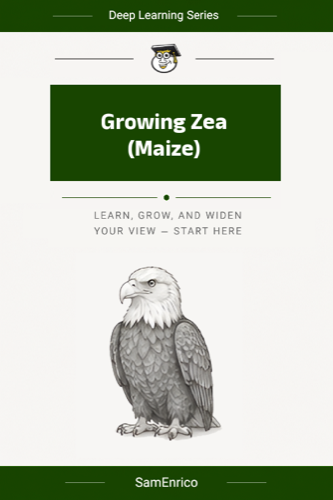
Growing Zea (Maize)
This publication, published by SamEnrico, covers G
by Sam Kennith
This publication, published by SamEnrico, covers Growing Zea (Maize)
Formats
About this book
Free sample
Chapter 1: The Grass That Conquered Earth--Step into a cornfield in July, and you enter a cathedral of green. Stalks rise in regimented rows, each leaf a solar panel angled toward the sky, the air thick with humidity and the faint sweet smell of growing things. At the edge of the field, the plants are shoulder-high. Fifty yards in, they tower overhead. At the center, you disappear entirely, swallowed by a forest that did not exist ninety days ago and will be brown stubble in ninety more.This is the most successful grass on Earth.
Not the prettiest. Not the oldest. Not the most beloved. But by any measure of biological and economic dominance—tons produced, acres planted, calories delivered, wealth generated—Zea mays has no equal among the world's crops. Wheat has more acreage globally, but maize produces more grain.
Rice feeds more people directly, but maize feeds more animals, which feed more people indirectly. Soybeans have more industrial uses, but maize has more total uses. The numbers are staggering: nearly 1.2 billion metric tons harvested annually, covering roughly 200 million hectares (nearly 500 million acres), providing roughly 30% of all human calories when processed through meat, eggs, dairy, and direct consumption.This book is the manual for growing that grass. Not as a museum specimen or a botanical curiosity, but as a disciplined, high-yielding, profitable crop. Whether you farm forty acres or forty thousand, whether you plant yellow dent for the ethanol plant or white corn for tortillas or sweet corn for the farmers' market, the principles that follow apply to you.But before we talk about planting depths and nitrogen rates and harvest timing—before we get into the dirt of it—we need to understand what this plant is, why it matters, and why the next thirty years will demand more from it than any period in human history.The Plant That Refused to Stay Wild Let us begin with a paradox.
Maize cannot survive without humans. Drop an ear of modern corn on the ground in autumn, and the kernels will either rot or be eaten by wildlife. They will…
This is the end of the free sample. Get the eBook to keep going. Buy now
Contents
- Chapter 1
- Chapter 2
- Chapter 3
- Chapter 4
- Chapter 5
- Chapter 6
- Chapter 7
- Chapter 8
- Chapter 9
- Chapter 10
- Chapter 11
- Chapter 12
Details
- Author
- Sam Kennith
- Publisher
- SamEnrico
- Language
- English
- Genre
- Non-Fiction, Informative, Educational
- Released
- 2026-05-25
- Pages (approx.)
- 131
- Available as
- eBook, Audiobook

Read better in the ZLOADR app
Your eBooks on your phone or tablet. Sign in with your SamEnrico account and start reading.
More by Sam Kennith
 Dolphin Swim CompanionSam Kennith$11.99
 Growth Equity TermsSam Kennith$11.99Growth Equity TermsSam Kennith$11.99
 The Road WarriorSam Kennith$11.99
 Feedback Integration GuideSam Kennith$11.99
 Caregiver Communication SkillsSam Kennith$11.99
 Trance for Chemotherapy Side EffectsSam Kennith$11.99
 Pet Loss For Pet SittersSam Kennith$11.99
 Fibromyalgia Pain Management GuideSam Kennith$11.99
 Tenant Communication GuideSam Kennith$11.99
 The Deluge Unleashed: Sobieski's Charge at Vienna (1683)Sam Kennith$11.99
 The Silk Road Skies: How a Forgotten Aviator Conquered Central Asia’s Deadliest AirspaceSam Kennith$11.99