
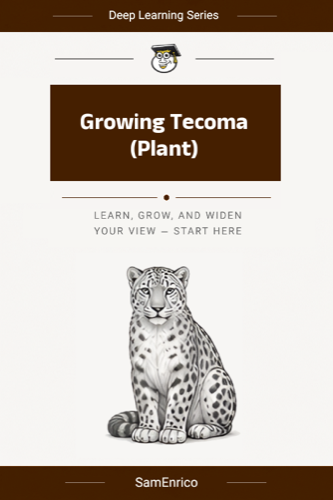
Non-FictionInformativeEducational
Growing Tecoma (Plant) Audiobook
This publication, published by SamEnrico, covers G
by Luna Clifton
This publication, published by SamEnrico, covers Growing Tecoma (Plant)
Formats
Free sample
Chapter 1: The Facultative Secret--Every great grower knows that a plant’s behavior is not a mystery but a conversation—a dialogue of light, temperature, and time. Tecoma, whether you call it Yellow Bells, Esperanza, or Trumpet Flower, speaks a language that, once understood, unlocks an almost unfair advantage in the greenhouse and the landscape. Before you ever fill a tray with soil or pinch a single stem, you must grasp one counterintuitive truth: this plant is not lazy about flowering, nor is it demanding in the way of a poinsettia or a chrysanthemum. It occupies a fascinating middle ground known as a facultative long-day plant, and that single fact will determine every major decision you make, from pruning schedules to fertilizer timing to overwintering strategies.This chapter lays the botanical and physiological foundation for the entire book. By the time you finish, you will understand not just what to do with your Tecoma but why it responds the way it does.
You will be able to diagnose poor flowering, predict growth habits, and select the right cultivar for your specific climate and market. Let us begin with the engine room of the plant: its response to light.The Photoperiodic Engine: Day Length and Light Intensity Most gardeners assume that all flowering plants simply bloom when they are “ready” or when temperatures warm sufficiently. Tecoma is more sophisticated than that. It reads the calendar through the lens of day length—a phenomenon called photoperiodism. Botanists classify flowering plants into three rough categories: short-day plants (chrysanthemums, poinsettias), which flower when nights are long; long-day plants (spinach, lettuce), which flower when days are long; and day-neutral plants (tomatoes, cucumbers), which flower regardless of day length.
Tecoma refuses to fit neatly into any single box. It is a facultative long-day plant, meaning it prefers long days and will flower more abundantly under them, but it does not require them to initiate flowering altogether.What does this mean in practical terms? In the high summer months of June and July, when day length stretches to fourteen or fifteen hours, a healthy Tecoma will produce an almost absurd cascade of trumpet-shaped blooms. The plant is operating at peak photoperiodic efficiency. However, in the shorter days of spring (April) or early autumn (September), the same plant will still flower—just at perhaps sixty to seventy percent of its summer abundance.
This is the “facultative” nature in action: flowering is not an all-or-nothing switch but a dimmer that moves with the…
This is the end of the free sample. Get the Audiobook to keep going. Buy now
About this book
Details
- Author
- Luna Clifton
- Publisher
- SamEnrico
- Language
- English
- Genre
- Non-Fiction, Informative, Educational
- Released
- 2026-06-02
- Pages (approx.)
- 151
- Available as
- eBook, Audiobook

Listen in the VoxFlicks app
Audiobooks and audio dramas wherever you go. Sign in with your SamEnrico account and press play.
More by Luna Clifton
 Gluten And Diarrhea ManagementLuna Clifton$11.99
 Divorce and Children's DreamsLuna Clifton$11.99
 Postpartum Psychosis Safety GuideLuna Clifton$11.99
 Transcendental Meditation for ArtistsLuna Clifton$11.99
 Bipolar in WomenLuna Clifton$11.99
 Dental Office Mercury GuideLuna Clifton$11.99
 Investment Banker PressureLuna Clifton$11.99
 Botulinum Toxin Wrinkle Prevention GuideLuna Clifton$11.99
 Stretching For ArthritisLuna Clifton$11.99
 The Day the Internet Broke: How a Single Tweet Toppled a Fortune 500 CompanyLuna Clifton$11.99
 Mirrored: The Double Life of Anna AndersonLuna Clifton$11.99
 Caesar's Shadow: The Rise and Fall of Pompey the GreatLuna Clifton$11.99
You may also like
 Hong Kong Handover 1997Dunn Johnnie$11.99
 Zumba For Postnatal Recovery CourseNeal Christian$11.99
 Zumba for BeginnersLadner Nikia$11.99
 YouTube Comment Mining GuideHumes Pandora$12.99
 Worry Box MeditationCarlin Rudy$11.99
 Workplace Stress MeditationNguyen Lynn$11.99
 Workplace Stress and Sleep RepairHawley Ivory$11.99
 Workplace Perfectionism CureDelaney Jeffry$11.99
 Workplace Injustice Anger GuideWallen Isabelle$11.99
 Work Addiction and Burnout LinkGreenwood Ester$11.99
 Women in Yoga and WellnessBeattie Galina$11.99
 Women in Stand Up ComedyChun Evangeline$11.99