
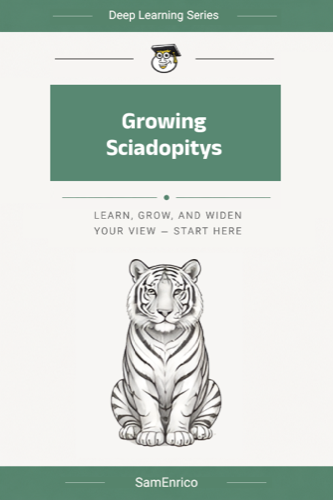
Growing Sciadopitys
This publication, published by SamEnrico, covers G
by Mercier Joye
This publication, published by SamEnrico, covers Growing Sciadopitys
Formats
About this book
Free sample
Chapter 1: The Last Stand...--It begins, as all great stories of survival do, with an ending.Picture a world 120 million years ago. Dinosaurs still walk the Earth—not the late-stage Tyrannosaurus of Hollywood, but earlier giants like Iguanodon and the long-necked Sauroposeidon. Flowering plants are a new and untested experiment. The supercontinent Pangaea has fragmented into Laurasia in the north and Gondwana in the south, and the climate is warm, wet, and uniformly green. Across this landscape, vast forests stretch from what will one day become Alaska down through Europe and across Asia.
In these forests grows a tree. It is not yet called Sciadopitys—no human exists to name it—but its needles spiral in distinctive whorls, its bark exfoliates in strips, and its cones stand upright on the branches like tiny sentinels. It is one of the dominant conifers of the Mesozoic.Now fast-forward through the next hundred million years. The dinosaurs vanish. Mammals rise.
Continents drift. Glaciers advance and retreat. And one by one, the relatives of that ancient tree disappear from the fossil record. First they vanish from North America, sometime in the late Cretaceous. Then from Europe, during the Oligocene epoch, as the climate cooled and dried.
Finally, from mainland Asia, driven southward by advancing ice sheets and competing vegetation. By the time the first humans walk out of Africa, Sciadopitys verticillata survives in exactly one place on Earth: the misty, high-rainfall mountains of Japan's Honshu, Shikoku, and Kyushu islands.This is not hyperbole. This is botany.The Japanese Umbrella Pine—a misleading name, as you will learn—is a living fossil. It is the sole surviving species in its entire botanical family, Sciadopityaceae. To put that in perspective: redwoods have three surviving species in their family (Sequoia, Sequoiadendron, Metasequoia).
Ginkgo has one surviving species but a handful of relatives in the fossil record. Sciadopitys stands entirely alone. Its nearest living relatives are not pines or firs or spruces, but a strange group of conifers including the umbrella aril tree (Cephalotaxus) and the plum yew (Amentotaxus). Even those are distant cousins, separated by tens of…
This is the end of the free sample. Get the eBook to keep going. Buy now
Contents
- Chapter 1
- Chapter 2
- Chapter 3
- Chapter 4
- Chapter 5
- Chapter 6
- Chapter 7
- Chapter 8
- Chapter 9
- Chapter 10
- Chapter 11
- Chapter 12
Details
- Author
- Mercier Joye
- Publisher
- SamEnrico
- Language
- English
- Genre
- Non-Fiction, Informative, Educational
- Released
- 2026-05-08
- Pages (approx.)
- 160
- Available as
- eBook, Audiobook

Read better in the ZLOADR app
Your eBooks on your phone or tablet. Sign in with your SamEnrico account and start reading.
More by Mercier Joye
 Collaborative Assumption MapMercier Joye$11.99
 Greta Thunberg School StrikeMercier Joye$11.99
 Mid Career Professional StressMercier Joye$11.99
 Nicotine Withdrawal Headache ReliefMercier Joye$11.99
 Google Ads Validation TestMercier Joye$11.99
 War Zone Dream ProcessingMercier Joye$11.99
 Singaporean Green IncentivesMercier Joye$11.99
 Medical Resident Burnout GuideMercier Joye$11.99
 Identity Based HabitsMercier Joye$11.99
 The Phoenix and the Moon: A Love That Defied Fire and NightMercier Joye$11.99
 The Last Navigator: A Polynesian Odyssey Through TimeMercier Joye$11.99
 Silicon Secrets: The Hidden Chips That Rigged the RaceMercier Joye$11.99