
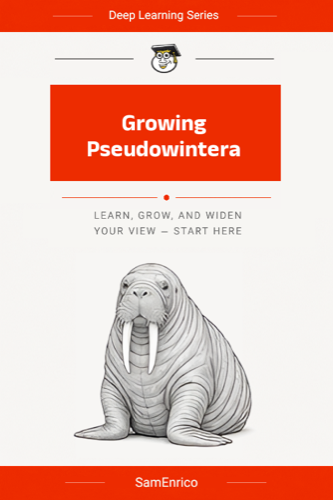
Growing Pseudowintera Audiobook
This publication, published by SamEnrico, covers G
by Shank Heike
This publication, published by SamEnrico, covers Growing Pseudowintera
Formats
Free sample
Chapter 1: The Last Pepper...–- In the temperate rainforests of New Zealand’s mountains, where mist curls through ancient podocarps and the forest floor sponges with moss, a shrub grows that remembers a world without flowers. Its leaves are leathery, speckled with crimson like drops of dried blood, and when crushed between thumb and forefinger, they release a heat that lingers—not the sharp bite of black pepper, but a slow, creeping warmth that spreads across the tongue and settles deep in the throat. This is Horopito. Botanists call it Pseudowintera. And it is, quite literally, a living fossil.The first time most gardeners encounter Pseudowintera, they do so by accident.
It appears in the back corner of a specialty nursery, tucked between rhododendrons and camellias, its tag faded and its price remarkably low for such an unusual specimen. The leaves catch the eye—those red blotches are unlike anything else in the temperate garden—but it is the story behind the plant that captures the imagination. This shrub, barely knee-high in its nursery pot, shares more DNA with the first flowering plants than it does with most modern garden shrubs. It has no veins in the conventional sense. Its flowers are primitive, lacking petals and sepals, appearing instead as tiny clusters of stamens and carpels that seem almost accidental.
And it produces a chemical compound found nowhere else in the plant kingdom, a compound that has kept herbivores at bay for eighty million years.This chapter is not merely an introduction to Pseudowintera. It is an origin story. To understand how to grow this plant—to truly master its quirks, its preferences, and its astonishing resilience—you must first understand where it came from, how it survived, and why it looks and behaves so differently from the roses, hydrangeas, and tomatoes that fill most gardening guides. The ancient lineage of Pseudowintera explains almost everything about its modern cultivation: its need for acidic soil, its intolerance of drying winds, its slow growth, and its remarkable freedom from pests. By the end of this chapter, you will see this plant not as a difficult specimen, but as a survivor—one that merely asks you to replicate, in your garden, the conditions of the ancient forests that birthed it.The Gondwanan Inheritance To speak of Pseudowintera is to speak of Gondwana.
This was the great southern supercontinent, a landmass that began to break apart 180 million years ago, scattering fragments that…
This is the end of the free sample. Get the Audiobook to keep going. Buy now
About this book
Details
- Author
- Shank Heike
- Publisher
- SamEnrico
- Language
- English
- Genre
- Non-Fiction, Informative, Educational
- Released
- 2026-06-02
- Pages (approx.)
- 147
- Available as
- eBook, Audiobook

Listen in the VoxFlicks app
Audiobooks and audio dramas wherever you go. Sign in with your SamEnrico account and press play.
More by Shank Heike
 Task Assignment FrameworkShank Heike$11.99
 Gacy's Phone Calls from PrisonShank Heike$11.99
 TM And Other Spiritual PracticesShank Heike$11.99
 Anxiety Disorder at Work GuideShank Heike$11.99
 HIV Mental Health Integration Poor NationsShank Heike$11.99
 The Catholic Restoration DramaShank Heike$11.99
 Prescription Sleep Aid MemoryShank Heike$11.99
 Overcoming Pay Per View PornShank Heike$11.99
 Pattern Recognition PuzzlesShank Heike$11.99
 Neon Shadows: The Rise and Fall of the First AI PresidentShank Heike$11.99
 Grimalkin's Cunning: The Witch's Familiar Who Outwitted KingsShank Heike$11.99
 The Jade Serpent’s Vow: A Dragon’s Oath in the Forbidden MountainsShank Heike$11.99