
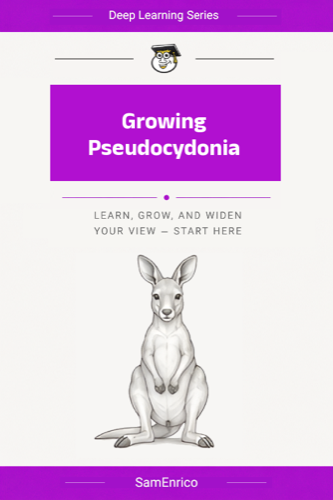
Growing Pseudocydonia
This publication, published by SamEnrico, covers G
This publication, published by SamEnrico, covers Growing Pseudocydonia
Formats
About this book
Free sample
Chapter 1: The Orphaned Apple...--–- The first time I saw a Pseudocydonia tree, I didn't know what I was looking at. It was November in the Hudson Valley, and the homeowner had called me—a young, overconfident horticultural consultant—to identify a "mystery tree" in her backyard. She had bought the property three years earlier from the estate of a botanist who had traveled extensively in East Asia. The tree stood about fifteen feet tall, its branches heavy with large, yellow, pear-shaped fruits that had begun to wrinkle and soften. The bark peeled away in thin, puzzle-piece plates, revealing a patchwork of gray, green, brown, and cream—like a sycamore dressed for a masquerade.
The leaves had mostly fallen, but those that remained burned in shades of amber and crimson.–- "It's beautiful," she said, "but what is it? And can I eat these?" She held up one of the fruits, which was as hard as a baseball and covered in a faint fuzz. I had no answer. My four years of horticultural study had covered everything from grafting techniques to pest life cycles, from soil microbiology to the taxonomy of the Rose family. But nowhere—not in a single lecture, not in a single textbook, not in a single field guide—had anyone mentioned Pseudocydonia sinensis.
The Chinese quince, as it turned out, was the forgotten child of the Rosaceae clan, overshadowed by its flashier siblings: the apple, the pear, the common quince, and the ornamental flowering quince that filled nursery catalogs every spring.–- That encounter changed the trajectory of my career. I became obsessed with this orphaned fruit tree. I tracked down specimens in botanical gardens, corresponded with rare fruit collectors across three continents, and eventually planted my own grove of Pseudocydonia on a small acreage in western Oregon. Over the following fifteen years, I learned that this tree is not merely a botanical curiosity—it is one of the most forgiving, versatile, and rewarding trees a home grower can plant. It tolerates neglect that would kill an apple tree.
It produces fruit that transforms, through cooking, into something transcendent. It offers beauty in every season, from winter bark to…
This is the end of the free sample. Get the eBook to keep going. Buy now
Contents
- Chapter 1
- Chapter 2
- Chapter 3
- Chapter 4
- Chapter 5
- Chapter 6
- Chapter 7
- Chapter 8
- Chapter 9
- Chapter 10
- Chapter 11
- Chapter 12
Details
- Author
- Fitzsimmons Mirella
- Publisher
- SamEnrico
- Language
- English
- Genre
- Non-Fiction, Informative, Educational
- Released
- 2026-05-11
- Pages (approx.)
- 159
- Available as
- eBook, Audiobook

Read better in the ZLOADR app
Your eBooks on your phone or tablet. Sign in with your SamEnrico account and start reading.
More by Fitzsimmons Mirella
 Radio Based Therapy For Remote AreasFitzsimmons Mirella$11.99
 CBD Sleep Memory GuideFitzsimmons Mirella$11.99
 The Gacy Property DemolitionFitzsimmons Mirella$11.99
 Chunking for StudentsFitzsimmons Mirella$11.99
 LTC Insurance For AccountantsFitzsimmons Mirella$11.99
 The Sobriety Values WorkbookFitzsimmons Mirella$11.99
 The Oath of SupremacyFitzsimmons Mirella$11.99
 Self Talk For AbortionFitzsimmons Mirella$11.99
 TM For LongevityFitzsimmons Mirella$11.99
 Lancelot and the Enchanted Mirror: A Knight’s Forbidden ReflectionFitzsimmons Mirella$11.99
 Golden Shadows: The Untold Saga of the Forgotten OlympianFitzsimmons Mirella$11.99
 The Dancer's Guide to GotipuaFitzsimmons Mirella$11.99