
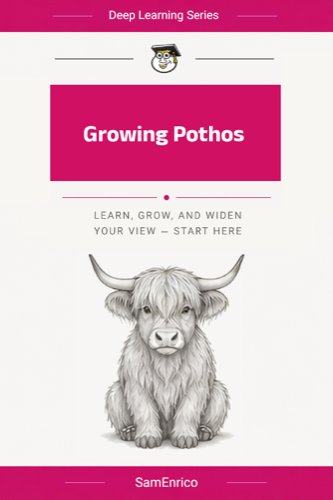
Non-FictionInformativeEducational
Growing Pothos eBook
This publication, published by SamEnrico, covers G
by Emery Amada
This publication, published by SamEnrico, covers Growing Pothos
Formats
Free sample
Chapter 1: The Unkillable Survivor...--Every plant parent has a ghost story. Not the supernatural kind, but the quieter, more embarrassing kind: the shriveled corpse of a fern bought on a whim, the brown crisp of a succulent that was supposed to be “impossible to kill,” the slow, tragic decline of a peace lily that simply gave up after six months of tap water and dim light. If you are reading this book, chances are good that you have accumulated at least one such ghost. Perhaps you have told yourself the story that many plant lovers eventually internalize: I just don’t have a green thumb.Stop right there.That story is a lie. And the proof is sitting in a four-inch plastic pot on a shelf somewhere in the world right now, growing in a dark corner of a doctor’s office, trailing from a hanging basket in a drafty coffee shop, or climbing up a moss pole in a humid bathroom where the owner has never once checked the p H of their soil.
That proof is Epipremnum aureum, known to millions simply as Pothos, known to the devoted as the plant that refuses to die.This chapter is not about how to keep Pothos alive. That would be too easy, too obvious, and frankly, a waste of your time. This chapter is about why Pothos has earned its reputation as the ultimate accessible houseplant, why it has become the most popular houseplant on Earth, and why the skills you will learn from this single species will transform every other plant you will ever own. By the time you finish reading these pages, you will understand something that most plant owners never realize: there is no such thing as a green thumb. There is only understanding, observation, and the willingness to let a plant teach you how it wants to be cared for.
And Pothos is the most generous teacher in the botanical world.The Journey from Solomon Islands to Your Living Room To understand why Pothos thrives where other plants perish, you must first understand where it came from. Epipremnum aureum is native to the Solomon Islands, a nation of nearly a thousand islands northeast of Australia, where the climate is relentlessly tropical—warm, humid, and covered in dense rainforest canopy. In its natural habitat, Pothos is a ground-creeping and tree-climbing vine that has evolved over millions of years to survive under conditions that would kill most ornamental houseplants.Consider the forest floor of the Solomon Islands. Sunlight is scarce, filtered through multiple layers of leaves before it reaches the ground. Rainfall is abundant but erratic; the soil can go from soggy to nearly dry within days depending on the season.
Pests are everywhere. Competition for resources is fierce. In this environment, a plant that cannot tolerate low light, cannot survive intermittent drought, and cannot defend itself against insects would simply vanish.Pothos did not vanish. It adapted. And those adaptations—developed over evolutionary timescales—are precisely what make it so forgiving in our homes.The plant developed broad, waxy leaves that maximize light capture in dim conditions.
It developed the ability to enter a state of metabolic slowdown when water is scarce, essentially waiting out dry spells without dying. It developed aerial roots that allow it to attach to tree trunks and absorb moisture from the air, freeing it from dependence on soil moisture alone. And it developed chemical compounds—specifically calcium oxalate crystals—that make its leaves mildly toxic to many herbivores, reducing the likelihood of being eaten.These are not the traits of a delicate diva. These are the traits of a survivor.When Pothos was first introduced to the global horticultural trade in the late 19th century, it arrived with a different name: Pothos aureus, later reclassified as Epipremnum aureum. Somewhere along the way, the original genus name stuck in popular usage, and “Pothos” became the common name for a plant that would eventually outsell every other houseplant on the planet.
By the 1950s, it was a staple of American living rooms. By the 1990s, it was everywhere. Today, it is estimated that more than half of all households in developed nations contain at least one Pothos plant, whether the owner knows its name or not.And yet, despite its ubiquity, most people have no idea what Pothos is capable of. They see a trailing vine in a hanging basket and assume that is all it will ever be. They have no idea that with the right conditions and the right support, a Pothos can grow leaves as large as a dinner plate—or larger.
They have no idea that the “boring green plant” in the corner of the dentist’s waiting room is actually a biological marvel, capable of adapting to conditions that would kill a monstera, a fiddle leaf fig, or nearly any other “trendy” houseplant.This book is going to change that. But before we get to the advanced techniques, the propagation secrets, and the moss pole magic, we need to establish something fundamental: your relationship with this plant is not a test of your innate ability. It is a conversation. And Pothos is fluent in a language you already understand, even if you do not know it yet.Why “Easy” Is Not the Same as “Indestructible”Let us address the elephant in the room—or rather, the Pothos in the corner. You have probably heard that Pothos is “easy.” You may have been told that it is “impossible to kill.” You might have bought one precisely because you have a history of plant homicide and you wanted a specimen that would survive your neglect.Here is the truth: Pothos is not indestructible.
It is, however, exceptionally resilient. There is a difference, and understanding that difference is the first step toward becoming a confident plant caregiver.An indestructible plant would survive anything: total darkness, months without water, freezing temperatures, pest infestations. No such plant exists. A resilient plant, on the other hand, can survive a wide range of suboptimal conditions and can recover from significant mistreatment. That is what Pothos is: resilient.
And resilience is far more useful to a plant owner than indestructibility, because resilience buys you time.When you forget to water your Pothos for two weeks, it will not die overnight. It will droop. Its leaves will become soft and limp. The plant is not dying; it is communicating. It is telling you, in the clearest language it has, that it needs water.
When you water it, within hours—sometimes minutes—the leaves will perk back up as if nothing happened. The plant has forgiven you.When you overwater your Pothos repeatedly, it will not die immediately either. It will develop yellow leaves, starting with the oldest ones near the base of the vine. The soil will smell musty. The roots will begin to rot.
But even then, the plant is not gone. As you will learn in Chapter 7, you can perform “rescue surgery” on a root-rotted Pothos, cutting away the dead tissue and replanting the healthy remnants, and the plant will regrow.This communication—this clear, unmistakable signaling of needs—is what makes Pothos the ultimate teacher. It does…
This is the end of the free sample. Get the eBook to keep going. Buy now
About this book
Details
- Author
- Emery Amada
- Publisher
- SamEnrico
- Language
- English
- Genre
- Non-Fiction, Informative, Educational
- Released
- 2026-05-08
- Pages (approx.)
- 146
- Available as
- eBook, Audiobook

Read better in the ZLOADR app
Your eBooks on your phone or tablet. Sign in with your SamEnrico account and start reading.
More by Emery Amada
 LTC Insurance For Childless PeopleEmery Amada$11.99
 Police Interview with GacyEmery Amada$11.99
 Meth Relapse Emergency KitEmery Amada$11.99
 Insomnia and Recall IssuesEmery Amada$11.99
 Breath Awareness for OCDEmery Amada$11.99
 The Sobriety Pillow MethodEmery Amada$11.99
 Chunking Memory GuideEmery Amada$11.99
 TM For ParentingEmery Amada$11.99
 Rewiring Divorce ShameEmery Amada$11.99
 The Nautical Alchemists: How Western Navigators Brewed the Age of DiscoveryEmery Amada$11.99
 The Pick That Changed the Game: How One Draft Choice Reshaped the NBAEmery Amada$11.99
 The Iron Spires: How Gothic Architects Defied GravityEmery Amada$11.99
You may also like
 Hong Kong Handover 1997Dunn Johnnie$11.99
 Zumba For Postnatal Recovery CourseNeal Christian$11.99
 Zumba for BeginnersLadner Nikia$11.99
 YouTube Comment Mining GuideHumes Pandora$12.99
 Worry Box MeditationCarlin Rudy$11.99
 Workplace Stress MeditationNguyen Lynn$11.99
 Workplace Stress and Sleep RepairHawley Ivory$11.99
 Workplace Perfectionism CureDelaney Jeffry$11.99
 Workplace Injustice Anger GuideWallen Isabelle$11.99
 Work Addiction and Burnout LinkGreenwood Ester$11.99
 Women in Yoga and WellnessBeattie Galina$11.99
 Women in Stand Up ComedyChun Evangeline$11.99