
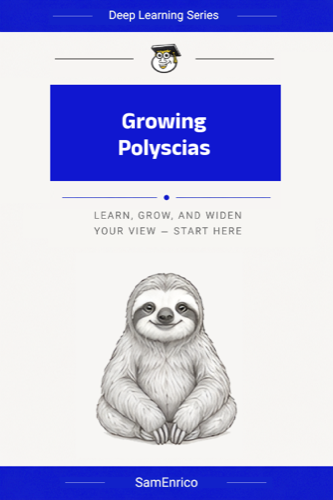
Non-FictionInformativeEducational
Growing Polyscias eBook
This publication, published by SamEnrico, covers G
by Huff Lois
This publication, published by SamEnrico, covers Growing Polyscias
Formats
Free sample
Chapter 1: The Plant That Hates You...--I killed my first Ming Aralia in eleven days.It arrived from the nursery as a perfect little tree—lacy, layered, architectural. I placed it on my brightest windowsill, watered it on a Tuesday because that felt responsible, and watched with genuine confusion as every single leaf turned yellow, then brown, then fell onto my floor like miniature accusations. By day eleven, I had a leafless stick in a pretty pot. I told myself the plant was defective. I told myself it was impossible.
What I did not tell myself—what I could not have known—was that I had just murdered one of the most communicative plants on earth, and I had ignored every single warning it sent me.This book exists because that Ming Aralia deserved better, and so do you.If you are reading these words, chances are good that you have either (a) just bought your first Polyscias and want to keep it alive, (b) watched one die and want to understand why, or (c) managed to keep one alive but cannot figure out why it looks perpetually disappointed in you. Welcome to all three camps. I have lived in each of them.The Polyscias genus—pronounced poh-LISS-see-as—is one of the most misunderstood, underappreciated, and unfairly maligned groups of houseplants in cultivation. Walk into any plant forum, and you will find threads titled “Why does my Ming hate me?” and “My Fabian is committing slow-motion suicide.” Search You Tube, and you will find dozens of videos with titles like “How to Keep Polyscias Alive (Maybe).” The plant has a reputation. It is known as a diva, a drama queen, the houseplant equivalent of a Victorian child who wilts at the slightest draft.Here is the truth that most of those forums and videos miss: the Polyscias is not fragile.
It is honest.Most houseplants are liars. A pothos will sit in a dark corner for six months, slowly losing leaves, looking generally fine until the day it suddenly collapses. A snake plant will tolerate every kind of abuse—overwatering, underwatering, no light, too much light—without telling you anything is wrong until the roots have completely rotted and the leaves flop over like defeated soldiers. These plants are survivors, yes, but they are also terrible communicators. They suffer in silence.The Polyscias does not suffer in silence.
The Polyscias screams.When a Polyscias is unhappy, you will know immediately. Leaves will droop. Edges will crisp. Color will fade. Whole branches will shed their foliage as if the plant is saying, “I have told you three times that the humidity is too low, and you have ignored me, so I am going to bed.” This is not fragility.
This is feedback. And once you learn to read that feedback—once you understand what each yellow leaf, each dropped branch, each crispy edge is actually telling you—the Polyscias transforms from a frustrating diva into one of the most rewarding houseplants you will ever grow.What Exactly Is a Polyscias?Before we dive into care, we need to understand what we are actually dealing with. The Polyscias genus belongs to the Araliaceae family, which includes familiar plants like ivy (Hedera), schefflera (umbrella tree), and fatsia. But where those relatives have adapted to a range of conditions, Polyscias evolved in a very specific environment: the humid, stable understories of tropical forests stretching from Madagascar through Southeast Asia and across the Pacific Islands.This origin story explains everything about what the plant needs.In its native habitat, a Polyscias never experiences direct, scorching sunlight. It grows beneath a canopy of taller trees, receiving dappled light that shifts gently throughout the day.
It never experiences dry air—tropical humidity stays consistently between 60 and 80 percent year-round. It never experiences temperature swings: days are warm, nights are slightly cooler but never cold, and there is no such thing as winter. The soil stays evenly moist but never waterlogged, fed by regular rainfall and excellent drainage from the forest floor.The Polyscias did not evolve to adapt. It evolved to thrive in one very specific set of conditions. When you bring one into your home, you are not asking it to adapt to you.
You are asking it to survive conditions that are fundamentally different from everything its genetics expect. And when it fails—when it drops leaves or turns yellow or simply gives up—that failure is not a sign that the plant is “difficult.” It is a sign that the gap between your home and a tropical forest is wider than you realized.The good news is that you can close that gap. You do not need a greenhouse or a humidifier the size of a refrigerator. You just need to understand what the plant is asking for and learn to translate its feedback into action.The Many Personalities of Polyscias: Species and Cultivars One of the most confusing things about Polyscias is that the genus includes plants that look almost nothing alike. A beginner might buy a Ming Aralia, then buy a ‘Fabian’ a month later, not realizing they are cousins with completely different care personalities.
This section profiles the most common species and cultivars you will encounter, along with notes on how their care might differ.Polyscias fruticosa – The Ming Aralia This is the classic, the one most people picture when they hear “Polyscias.” The Ming Aralia has finely divided, feathery leaves that give it a soft, lacy appearance. The leaflets are arranged along the stem like tiny ferns, creating a layered, almost cloud-like silhouette. Mature specimens develop woody, gnarled trunks that make them popular for bonsai (more on that in Chapter 8). Of all the Polyscias species, fruticosa is the most common in cultivation and the most forgiving—which is not to say it is easy, only that it will give you more warnings before it dies.Polyscias scutellaria – The Shield Aralia If Ming Aralia is delicate and lacy, Shield Aralia is bold and dramatic. The leaves are rounded, almost coin-shaped, and can grow quite large.
The most famous cultivar is ‘Fabian’, which produces deep purple to nearly black foliage that looks almost velvety in the right light. ‘Fabian’ has a reputation for being even more sensitive than other Polyscias species, particularly when it comes to humidity. If you are growing a ‘Fabian’, pay extra attention to Chapter 5.Polyscias balfouriana – The Balfour Aralia This species is known for its variegated forms, particularly ‘Marginata’, which features dark green leaves edged in creamy white. The contrast is striking, making this a favorite for interior designers. However, variegated plants have less chlorophyll than their all-green counterparts, which means they need more light to produce the same amount of energy.
If you grow a ‘Marginata’, expect to give it brighter conditions than you would a standard green Polyscias. The variegation can also revert if the plant is stressed or if light is insufficient, so watch for all-green leaves as a sign that something is wrong.Polyscias guilfoylei – The Wild Coffee Less common in standard houseplant collections but beloved by collectors, Polyscias guilfoylei has larger, more elongated leaves with dramatic white or cream variegation along the margins. The…
This is the end of the free sample. Get the eBook to keep going. Buy now
About this book
Details
- Author
- Huff Lois
- Publisher
- SamEnrico
- Language
- English
- Genre
- Non-Fiction, Informative, Educational
- Released
- 2026-06-02
- Pages (approx.)
- 140
- Available as
- eBook, Audiobook

Read better in the ZLOADR app
Your eBooks on your phone or tablet. Sign in with your SamEnrico account and start reading.
More by Huff Lois
 The Killer Clown PsychologyHuff Lois$11.99
 Mental Health Stigma Reduction Campaign GuideHuff Lois$11.99
 Forgetting and Sleep DeprivationHuff Lois$11.99
 Sleepiness During Breath MeditationHuff Lois$11.99
 LTC Insurance For Small BusinessHuff Lois$11.99
 Eat That Frog ParentingHuff Lois$11.99
 Overcoming Compulsive MasturbationHuff Lois$11.99
 Srebrenica BoyHuff Lois$11.99
 Self Talk For Dissertation StressHuff Lois$11.99
 The Last Broadcast of the Titanic: A Voice RecoveredHuff Lois$11.99
 Echoes of the Cosmic Dawn: The Fermi Paradox and Time's Missing Billion YearsHuff Lois$11.99
 Shadows of the Silk Road: The Phantom Spy Who Vanished in the SandsHuff Lois$11.99
You may also like
 Hong Kong Handover 1997Dunn Johnnie$11.99
 Zumba For Postnatal Recovery CourseNeal Christian$11.99
 Zumba for BeginnersLadner Nikia$11.99
 YouTube Comment Mining GuideHumes Pandora$12.99
 Worry Box MeditationCarlin Rudy$11.99
 Workplace Stress MeditationNguyen Lynn$11.99
 Workplace Stress and Sleep RepairHawley Ivory$11.99
 Workplace Perfectionism CureDelaney Jeffry$11.99
 Workplace Injustice Anger GuideWallen Isabelle$11.99
 Work Addiction and Burnout LinkGreenwood Ester$11.99
 Women in Yoga and WellnessBeattie Galina$11.99
 Women in Stand Up ComedyChun Evangeline$11.99