
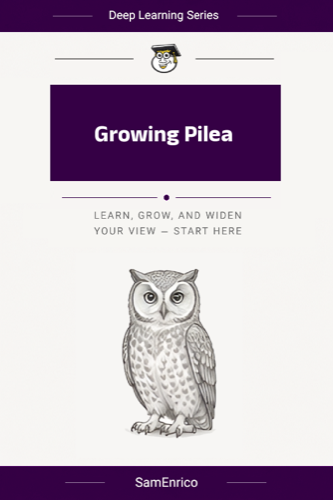
Growing Pilea
This publication, published by SamEnrico, covers G
This publication, published by SamEnrico, covers Growing Pilea
Formats
About this book
Free sample
Chapter 1: The Friendship Network...–- In the spring of 1946, a Norwegian missionary named Agnar Espegard walked away from a collapsing mission station in Yunnan Province, China, with little more than the clothes on his back and a small, unremarkable plant tucked into his luggage. He did not know that this plant—a cluster of round, coin-shaped leaves rising on thin stems from a single central root—would, seventy-five years later, become an international sensation, a social media darling, and the subject of this book. He did not know that the plant had no formal botanical name at the time, that it would baffle taxonomists for decades, or that it would eventually be traded among plant lovers in a global network of generosity that defied commercial markets. He only knew that he liked the way its leaves looked like small, green pancakes, and that the Chinese families he had lived among kept it on their windowsills for good fortune.That single act of preservation—one man saving one plant from an uncertain fate—launched a living chain of connection that now spans continents, generations, and millions of windowsills. The plant Agnar carried out of China was Pilea peperomioides, known today as the Chinese Money Plant, the Friendship Plant, the Pass-It-On Plant, and, affectionately, the Pancake Plant.
And its story is unlike that of any other houseplant in cultivation.This is not a book about keeping a plant alive. This is a book about becoming part of a living network—one where each pup you propagate carries not just genetic material but a story, a relationship, and a responsibility. Before we discuss soil, light, water, or pruning—before we get our hands dirty at all—we must understand what makes the Pilea culturally unique. Because once you understand that, every subsequent chapter will make deeper sense. You will not be merely following instructions; you will be participating in a tradition.The Botanical Identity: What We Actually Know Let us begin with the science, because the story is more interesting when we understand what was hidden for so long.Pilea peperomioides belongs to the Urticaceae family—the nettle family—which surprises…
This is the end of the free sample. Get the eBook to keep going. Buy now
Contents
- Chapter 1
- Chapter 2
- Chapter 3
- Chapter 4
- Chapter 5
- Chapter 6
- Chapter 7
- Chapter 8
- Chapter 9
- Chapter 10
- Chapter 11
- Chapter 12
Details
- Author
- Mclaughlin Audrey
- Publisher
- SamEnrico
- Language
- English
- Genre
- Non-Fiction, Informative, Educational
- Released
- 2026-05-11
- Pages (approx.)
- 154
- Available as
- eBook, Audiobook

Read better in the ZLOADR app
Your eBooks on your phone or tablet. Sign in with your SamEnrico account and start reading.
More by Mclaughlin Audrey
 Diarrhea Research ReviewMclaughlin Audrey$11.99
 Success Attribution ImposterMclaughlin Audrey$11.99
 Contract Abstraction API IntegrationMclaughlin Audrey$11.99
 School Year Time ManagementMclaughlin Audrey$11.99
 Creativity Unblock GuideMclaughlin Audrey$11.99
 Zwingli Zurich ReformationMclaughlin Audrey$11.99
 Email Listening SignalsMclaughlin Audrey$11.99
 Power Animal Retrieval GuideMclaughlin Audrey$11.99
 Affirmations For Invisible IllnessMclaughlin Audrey$11.99
 Velvet Shadows: The Unseen Life of Billie HolidayMclaughlin Audrey$11.99
 The Diamond Conspiracy: The Queen Who Sold Her Crown for LoveMclaughlin Audrey$11.99
 Whispers in the Wind: The Star-Crossed Love of White Buffalo Calf Woman and the ThunderbirdMclaughlin Audrey$11.99