
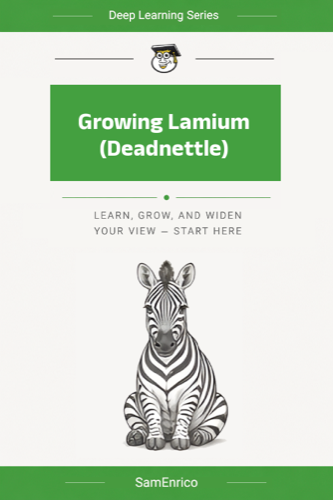
Non-FictionInformativeEducational
Growing Lamium (Deadnettle) eBook
This publication, published by SamEnrico, covers G
This publication, published by SamEnrico, covers Growing Lamium (Deadnettle)
Formats
Free sample
Chapter 1: The $2,000 Mistake--– I was standing in my own backyard, holding a dead hose, staring at a slope that had cost me two thousand dollars and seventeen weekends of my life.The slope was fifteen feet wide, shaded by a massive red maple, and utterly barren. Not a single blade of grass had survived its third summer. Every time it rained, rivulets of muddy water carved new gullies through the exposed soil, washing away what little topsoil remained. I had tried everything. I had seeded shade-tolerant fescue—twice.
I had laid sod, which turned brown within six weeks. I had installed a dry creek bed with river rock, which looked beautiful for exactly one season before filling with leaves and becoming a mosquito nursery. I had even paid a landscaper eight hundred dollars to install a retaining wall and drainage system, which failed during the first spring thaw when frost heaved the blocks out of alignment.That was the $2,000 mistake. Not the retaining wall, though that was certainly part of it. The real mistake was believing that every part of a garden should be forced into submission.
The real mistake was thinking that grass was the default, and everything else was a compromise. The real mistake was not knowing that a single, unassuming plant—one I had walked past a thousand times without really seeing it—could have solved every single one of my problems for less than the cost of a medium pizza.That plant was Lamium. Deadnettle. The most underrated, misunderstood, and unfairly maligned ground cover in American horticulture.Before we go any further, let me address the name. Deadnettle.
It sounds like something you would find in a medieval plague doctor’s satchel, not something you would willingly plant next to your petunias. The name is unfortunate, and I will not pretend otherwise. It conjures images of stinging leaves, irritating rashes, and weeds that should be pulled rather than propagated. But here is the truth that the name conceals: Lamium does not sting. It has never stung anyone.
It is, in fact, one of the gentlest, most forgiving, and most useful plants you can introduce to a troubled garden.The confusion dates back centuries. True nettles belong to the genus Urtica, and they are armed with hollow, hair-like trichomes that inject histamine and other irritants when touched. Brushing against a stinging nettle is an unforgettable experience—a burning, itching sensation that can last for hours. Deadnettle, by contrast, belongs to the Lamiaceae family, the mints. Its leaves are soft, often fuzzy, and completely harmless.
The “dead” in deadnettle simply means “resembling but lacking the sting of.” It is a linguistic fossil, a warning label from an era when people named plants by their similarities and differences. But the name stuck, and for generations of gardeners, it has been a barrier to discovery.I want you to set aside the name. Set aside any preconceptions you have about ground covers, about shade plants, about the kinds of greenery that belong in a “respectable” garden. What I am about to show you is not a weed, not a compromise, and not a plant you settle for because nothing else will grow. Lamium is a plant you choose because it outperforms almost everything else in its class.
It is a plant that blooms for months, feeds pollinators when food is scarce, suppresses weeds without toxic chemicals, stabilizes eroded slopes, and requires so little maintenance that you might forget you planted it at all.I spent seven years ignoring Lamium. Seven years of fighting my shady slope, of watching grass die and soil wash away, of writing checks to landscapers and dragging hoses across my yard. Seven years of believing that the problem was me—that I was not watering enough, not fertilizing correctly, not trying hard enough. And then, on a visit to a public garden in Pennsylvania, I saw a hillside that stopped me in my tracks.It was late April, still chilly, and most of the garden was waking up slowly. But this hillside—this north-facing, maple-shaded, steep slope that should have been a mess of mud and exposed roots—was covered in a shimmering carpet of silver and green, punctuated by hundreds of small, hooded pink flowers.
The effect was not just beautiful. It was triumphant. It looked like the hillside was wearing a bespoke suit. And when I knelt down to touch the leaves, I found them soft, cool, and utterly harmless. No sting.
No irritation. Just a quiet, competent plant doing exactly what it was supposed to do.I found a garden staff member and asked what it was. “Lamium,” she said. “Deadnettle. ‘Beacon Silver,’ I think.
It’s practically indestructible.”Practically indestructible. Those two words changed everything.The Plant That Does Not Ask Permission Let me be precise about what Lamium is and what it is not. Lamium is a genus of flowering plants in the mint family, comprising approximately 40 to 50 species distributed across Europe, Asia, and North Africa. The species you will encounter most frequently in North American gardens fall into three categories, and understanding the differences between them is the first step toward using Lamium as a problem-solving tool rather than simply another plant in your collection.The first category is Lamium maculatum, the spotted deadnettle. This is the workhorse of the group, the one you will find in garden centers under names like ‘White Nancy,’ ‘Beacon Silver,’ ‘Purple Dragon,’ and ‘Shell Pink.’ It is a low-growing perennial, typically reaching four to eight inches in height but spreading horizontally to three feet or more over time.
The leaves are opposite, toothed, and often marked with a silver stripe down the center or variegated silver across most of the leaf surface. The flowers are hooded and tubular, resembling small orchids, and appear in whorls around the stem. Bloom time is late spring to early summer, with a second flush in late summer or early autumn if you shear the plant back after the first bloom—a technique I will cover in detail in Chapter 7.Lamium maculatum is native to Europe and western Asia, from the British Isles eastward to Iran, but it has naturalized widely in North America without becoming invasive in most regions. That distinction—naturalized versus invasive—matters greatly. A naturalized plant is one that has established self-sustaining populations outside its native range but does not cause ecological or economic harm.
An invasive plant, by contrast, spreads aggressively, displaces native species, and alters ecosystem function. In the vast majority of North America, L. maculatum falls firmly into the naturalized category. It spreads, yes. It fills available space, yes.
But it does not climb trees, smother shrubs, or form monocultures that exclude all other plants. It is vigorous but mannered.The second category is Lamium galeobdolon, the yellow archangel. This species is the troublemaker in the family. It is undeniably beautiful: the leaves are typically variegated with silver blotches, and the flowers are a cheerful, buttery yellow that appears in late spring. The problem is not its appearance but its ambition.
L. galeobdolon spreads aggressively via stolons—above-ground runners that root at nodes—and can cover large areas in a single season. In the…
This is the end of the free sample. Get the eBook to keep going. Buy now
About this book
Details
- Author
- Kauffman Eilene
- Publisher
- SamEnrico
- Language
- English
- Genre
- Non-Fiction, Informative, Educational
- Released
- 2026-05-06
- Pages (approx.)
- 152
- Available as
- eBook, Audiobook

Read better in the ZLOADR app
Your eBooks on your phone or tablet. Sign in with your SamEnrico account and start reading.
More by Kauffman Eilene
 Tension Headache Physical TherapyKauffman Eilene$11.99
 Phosphorus Bone Teeth GuideKauffman Eilene$11.99
 NVC for Customer SupportKauffman Eilene$11.99
 Creative Flow ProtectionKauffman Eilene$11.99
 The Stress and Eczema GuideKauffman Eilene$11.99
 Vehicle Dream Symbol GuideKauffman Eilene$11.99
 Cancer and PregnancyKauffman Eilene$11.99
 Dakota Fanning AlienKauffman Eilene$11.99
 Cross Cultural Body LanguageKauffman Eilene$11.99
 The Last Broadcast: The Mysterious Fate of Flight 19Kauffman Eilene$11.99
 The Emperor and the Architect: Frederick II and the Gothic Revival of SicilyKauffman Eilene$11.99
 The Bone Carvers of Troy: A Forgotten Field HospitalKauffman Eilene$11.99
You may also like
 Hong Kong Handover 1997Dunn Johnnie$11.99
 Zumba For Postnatal Recovery CourseNeal Christian$11.99
 Zumba for BeginnersLadner Nikia$11.99
 YouTube Comment Mining GuideHumes Pandora$12.99
 Worry Box MeditationCarlin Rudy$11.99
 Workplace Stress MeditationNguyen Lynn$11.99
 Workplace Stress and Sleep RepairHawley Ivory$11.99
 Workplace Perfectionism CureDelaney Jeffry$11.99
 Workplace Injustice Anger GuideWallen Isabelle$11.99
 Work Addiction and Burnout LinkGreenwood Ester$11.99
 Women in Yoga and WellnessBeattie Galina$11.99
 Women in Stand Up ComedyChun Evangeline$11.99