
Non-FictionInformativeEducational
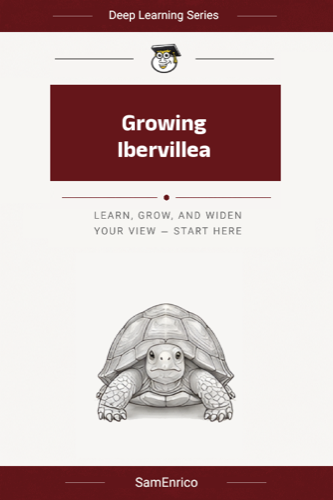
Growing Ibervillea
This publication, published by SamEnrico, covers G
This publication, published by SamEnrico, covers Growing Ibervillea
Formats
About this book
Free sample
Chapter 1: The Strangest Relatives...-- Every time a gardener first encounters an Ibervillea, they make the same mistake. They stare at the bulbous, fissured, stone-gray caudex sitting on the soil surface like a discarded meteorite, and they assume it must be related to other slow-growing, water-hoarding succulents. Perhaps a relative of the elephant's foot (Beaucarnea), they guess. Or a peculiar form of Adenium, the desert rose. This assumption is rational, reasonable, and entirely wrong.The truth is far stranger and, once understood, far more useful to the successful grower.The genus Ibervillea belongs to the Cucurbitaceae—the gourd family.
Its closest cultivated relatives are not sculptural succulents but the sprawling, thirsty, fast-growing vines that fill vegetable gardens across the world. Watermelon. Cucumber. Pumpkin. Squash.
These are the cousins of your stone-like Ibervillea. This family connection explains almost everything about the plant's behavior: its aggressive vining habit, its tendrils that grip any available support, its unisexual flowers (male and female blooms on the same plant), and its production of fleshy berries rather than dry seed capsules.Understanding this botanical kinship is not merely an academic exercise. It is the foundation upon which all successful cultivation rests. When you know that your Ibervillea is, at its genetic core, a gourd that adapted to desert extremes, you stop treating it like a typical succulent and start treating it like what it truly is: a survivor that never forgot its vining origins.The Gourd Family: A Surprising Lineage The Cucurbitaceae family comprises approximately 965 species across 95 genera, distributed throughout tropical and subtropical regions worldwide. The family is characterized by several shared features that are readily observable in Ibervillea.
First, nearly all cucurbits produce tendrils—modified stems or leaves that coil around supports. In Ibervillea, these tendrils emerge opposite the leaves and are highly sensitive to contact, curling around trellises, neighboring plants, or even the caudex itself if no other support is available.Second, cucurbits produce unisexual flowers. Male flowers appear first, typically on longer pedicels (stems), and produce pollen. Female flowers appear slightly later, distinguished by the swollen ovary at their base that resembles a tiny, immature…
This is the end of the free sample. Get the eBook to keep going. Buy now
Contents
- Chapter 1
- Chapter 2
- Chapter 3
- Chapter 4
- Chapter 5
- Chapter 6
- Chapter 7
- Chapter 8
- Chapter 9
- Chapter 10
- Chapter 11
- Chapter 12
Details
- Author
- Fairbanks Evelynn
- Publisher
- SamEnrico
- Language
- English
- Genre
- Non-Fiction, Informative, Educational
- Released
- 2026-06-02
- Pages (approx.)
- 139
- Available as
- eBook, Audiobook

Read better in the ZLOADR app
Your eBooks on your phone or tablet. Sign in with your SamEnrico account and start reading.
More by Fairbanks Evelynn
 Hands Only vs Full CPRFairbanks Evelynn$11.99
 Persuasive Proposal Writing BlueprintFairbanks Evelynn$11.99
 Fibromyalgia Breath RegulationFairbanks Evelynn$11.99
 Gratitude for Public ServicesFairbanks Evelynn$11.99
 LinkedIn Thought LeaderFairbanks Evelynn$11.99
 The Outcome AttachmentFairbanks Evelynn$11.99
 Pirates of the Indian OceanFairbanks Evelynn$11.99
 Post Lunch Nap ProductivityFairbanks Evelynn$11.99
 Jim Moran Automotive EmpireFairbanks Evelynn$11.99
 Love in the Laboratory: The Secret Affair of the First Atomic PioneersFairbanks Evelynn$11.99
 The Silent War: How the NSA’s XKeyscore Program Spied on the WorldFairbanks Evelynn$11.99
 The Mind of the Monster: Unraveling the Psychology of the Zodiac KillerFairbanks Evelynn$11.99
You may also like
 Hong Kong Handover 1997Dunn Johnnie$11.99
 Zumba For Postnatal Recovery CourseNeal Christian$11.99
 Zumba for BeginnersLadner Nikia$11.99
 YouTube Comment Mining GuideHumes Pandora$12.99
 Worry Box MeditationCarlin Rudy$11.99
 Workplace Stress MeditationNguyen Lynn$11.99
 Workplace Stress and Sleep RepairHawley Ivory$11.99
 Workplace Perfectionism CureDelaney Jeffry$11.99
 Workplace Injustice Anger GuideWallen Isabelle$11.99
 Work Addiction and Burnout LinkGreenwood Ester$11.99
 Women in Yoga and WellnessBeattie Galina$11.99
 Women in Stand Up ComedyChun Evangeline$11.99