
Non-FictionInformativeEducational
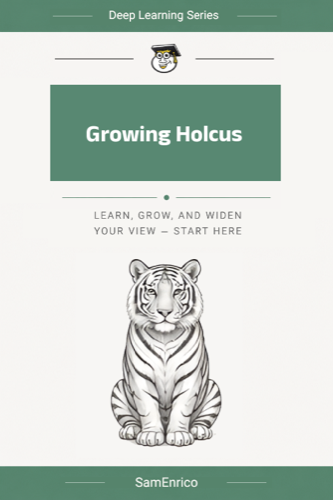
Growing Holcus eBook
This publication, published by SamEnrico, covers G
by Gray Allen
This publication, published by SamEnrico, covers Growing Holcus
Formats
Free sample
Chapter 1: The Velvet Revolution--–- It began, as most garden revelations do, not with a moment of triumph but with a failure. I had spent seven years and roughly two thousand pounds trying to cultivate the perfect lawn. I had aerated in autumn, scarified in spring, applied moss killer with the precision of a pharmacist, and watered during drought with the devotion of a monk tending sacred ground. The lawn rewarded my efforts by dying in patches, yellowing at the edges, and sprouting mushrooms every autumn as if mocking my ambition. It was only when I stopped caring—when work deadlines and family obligations pried the hose from my hand and the spreader from my grip—that I noticed what had moved into the neglected corner near the compost heap.A soft, grey-green tuft had appeared, perhaps six inches across, with leaves so velvety they seemed to absorb light rather than reflect it.
In June, slender stems rose from the clump, each topped with a seed head the color of lavender fading into rose-pink. When the wind moved through it, the whole plant shivered like something alive and aware. I did not plant it. I did not water it. I certainly did not fertilize it.
And yet there it stood, thriving in the very spot where my expensive fescue lawn had surrendered and died.I looked it up in my dog-eared copy of the RHS Encyclopedia. Holcus lanatus. Common name: Yorkshire Fog. Also known, less kindly, as Velvetgrass. Also known, in every lawn care forum I had ever visited, as a weed to be killed.But here was the question that lodged in my mind like a splinter: if this plant required nothing from me—no money, no time, no expertise—and if it provided softness, movement, color, and the quiet hum of pollinators in summer, then what exactly made it a weed?
The dictionary definition told me that a weed was simply a plant growing where it was not wanted. But who, exactly, had decided I should not want this? And why had I believed them without question?This book is the answer to that question, written after a decade of intentional Holcus cultivation and countless conversations with gardeners who had been told the same lies I had. The Velvet Revolution—and I use that term deliberately—is the quiet, ongoing, grassroots movement of gardeners who have decided to stop fighting nature and start collaborating with it. It begins with a single plant, the one that asks for nothing and gives everything.
It ends with a garden that feeds pollinators, prevents erosion, requires almost no work, and looks, in the words of one visitor to my own garden, "like something from a painting."If you have ever killed a houseplant, if you have ever looked at your lawn with something approaching hatred, if you have ever spent money on a plant that died within weeks—this chapter, and this book, is for you.The Confession of a Reformed Lawn Obsessive Let me be precise about my former condition, because recognition is the first step toward recovery. I was the gardener who read soil p H reports for pleasure. I owned three different types of rake. I knew the difference between pre-emergent and post-emergent herbicide, a piece of knowledge that has never brought me joy and has certainly never brought me peace. I believed, with the fervor of a convert, that a garden was something you imposed upon the land rather than something you discovered within it.My lawn was my greatest shame and my greatest obsession.
I had chosen a mix of fine fescues and perennial ryegrass, believing that the phrase "fine" indicated quality rather than simply describing the width of the leaf blade. I mowed at the recommended height of 4 centimeters, never removing more than one third of the blade in a single session. I watered deeply and infrequently, as the experts instructed, training the roots to reach down into the soil. I did everything right, and the lawn failed anyway. The patches of moss expanded like a slow-motion invasion.
The bare soil between grass clumps became a nursery for dandelions and plantains. And then the drought came.For six weeks, the temperature hovered above 30 degrees Celsius, and the rain did not come. I watered with a sprinkler for an hour every evening, watching the water bill climb with each passing week. The lawn turned brown anyway. It crunched underfoot.
It looked, in the brutal honesty of August light, like a corpse. And in the corner, that Holcus tuft—the one I had never watered, never fed, never even acknowledged—turned a deeper shade of grey-green and continued to grow. When the rain finally returned, the Holcus sent up fresh leaves within days. The fescue took months to recover, and even then, it never regained the ground it had lost. The Holcus expanded into the gap, quietly, politely, as if apologizing for its own success.I did what any reasonable gardener would do.
I reached for the glyphosate.And then I stopped.Something had shifted in me during that drought. I had watched the garden transform from a controlled space into a battlefield, and I had lost. But the Holcus had won without fighting. It had simply persisted. It had asked for nothing and continued to live.
I realized, standing there with the herbicide bottle in my hand, that I was about to kill a plant for the crime of thriving in conditions that killed everything else. That made no sense. That was the logic of a tyrant, not a gardener.I put the bottle back on the shelf. I decided, for one season, to do nothing. To watch.
To learn.What I Learned by Doing Nothing The first thing I noticed was the texture. Run your fingers across a Holcus leaf, and you will understand immediately why it is called Velvetgrass. The entire plant is covered in soft, downy hairs—technically called trichomes—that give it a tactile quality unlike any other grass in the British Isles. These hairs are not decorative. They serve multiple functions that explain, in part, why Holcus thrives where other grasses fail.The hairs reflect excess light, protecting the plant from sun damage.
They trap a thin layer of humid air against the leaf surface, reducing water loss during drought. They make the leaves unpalatable to many insects and grazing animals. They even help the plant absorb water from fog and dew, a process called foliar uptake that allows Holcus to hydrate itself without rain. In the early morning, when the garden is still and the light is low, each Holcus leaf is tipped with a row of water droplets, silver and perfect, as if the plant had decorated itself.The second thing I noticed was the color. Holcus does not shout.
It does not produce the screaming yellows or electric purples of cultivated ornamentals. Instead, it offers a palette of subtle shifts: grey-green in spring, flushed with purple as the seed heads emerge in June, warming to pink and then to straw-gold as autumn advances. Even in winter, when the leaves have died back, the standing stems catch the low sun…
This is the end of the free sample. Get the eBook to keep going. Buy now
About this book
Details
- Author
- Gray Allen
- Publisher
- SamEnrico
- Language
- English
- Genre
- Non-Fiction, Informative, Educational
- Released
- 2026-06-02
- Pages (approx.)
- 141
- Available as
- eBook, Audiobook

Read better in the ZLOADR app
Your eBooks on your phone or tablet. Sign in with your SamEnrico account and start reading.
More by Gray Allen
 Bipolar Prodrome RecognitionGray Allen$11.99
 Listening For Detectives GuideGray Allen$11.99
 Entrepreneur Distraction GuideGray Allen$11.99
 The Stress Reset Couples RetreatGray Allen$11.99
 Gratitude Letter Writing WorkshopGray Allen$11.99
 Traditional Healer CollaborationGray Allen$11.99
 Kobe Bryant MambaGray Allen$11.99
 Dream Theme Tracking GuideGray Allen$11.99
 The Fisherman's NetGray Allen$11.99
 The Black Eagle’s Gambit: Habsburg Espionage in the Thirty Years' WarGray Allen$11.99
 The Great Penguin Highway: How Birds Crossed the OceanGray Allen$11.99
 The Alchemist of Timbuktu: The Golden Secrets of Muhammad al-MaghiliGray Allen$11.99
You may also like
 Hong Kong Handover 1997Dunn Johnnie$11.99
 Zumba For Postnatal Recovery CourseNeal Christian$11.99
 Zumba for BeginnersLadner Nikia$11.99
 YouTube Comment Mining GuideHumes Pandora$12.99
 Worry Box MeditationCarlin Rudy$11.99
 Workplace Stress MeditationNguyen Lynn$11.99
 Workplace Stress and Sleep RepairHawley Ivory$11.99
 Workplace Perfectionism CureDelaney Jeffry$11.99
 Workplace Injustice Anger GuideWallen Isabelle$11.99
 Work Addiction and Burnout LinkGreenwood Ester$11.99
 Women in Yoga and WellnessBeattie Galina$11.99
 Women in Stand Up ComedyChun Evangeline$11.99