
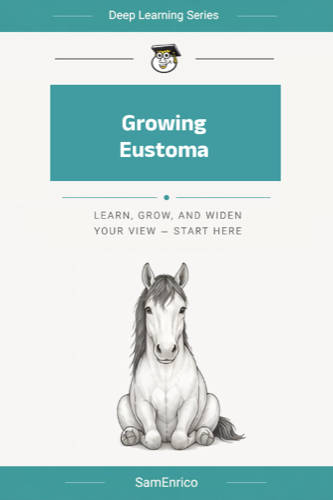
Growing Eustoma eBook
This publication, published by SamEnrico, covers G
This publication, published by SamEnrico, covers Growing Eustoma
Formats
Free sample
Chapter 1: The Prairie Paradox...--–- The first time I killed a Eustoma seedling, I thought I had made a simple mistake. The tenth time, I began to question my sanity. The fiftieth time, standing in a greenhouse filled with 847 flat, lifeless rosettes that refused to grow upward, I nearly quit gardening forever.That was seven years ago. Today, I harvest over 3,000 stems per season from the same small plot of land, and I sell every single one before it is even cut. The difference between those two outcomes is not luck, not expensive equipment, and certainly not natural talent.
It is understanding one simple truth about this flower: Eustoma grandiflorum does not want to be loved. It wants to be understood.This book exists because no one handed me a guide that explained that truth. Instead, I read conflicting advice online, watched You Tube videos filmed in climates nothing like mine, and spent hundreds of dollars on seeds that germinated beautifully only to stall into green pincushions that never produced a single flower. I am writing this so you do not have to repeat my mistakes.The Flower That Breaks Hearts Eustoma, known commercially as Lisianthus or Prairie Gentian, holds a peculiar reputation in the horticultural world. Florists adore it.
Gardeners fear it. Brides request it by name, often without knowing that the delicate, rose-like blooms in their bouquets required nearly six months of precise environmental manipulation to produce. Walk into any high-end flower auction in Holland or Japan, and you will see Eustoma stems selling for two to three times the price of standard chrysanthemums or carnations. Walk into a suburban garden center, and you will struggle to find Eustoma seedlings at all.This gap between market demand and home grower success is not accidental. Eustoma has earned its reputation as a difficult plant, but for reasons that most guides get completely wrong.
The common narrative blames the grower: you overwatered, you underwatered, you used the wrong fertilizer, you did not give enough light. And certainly, those factors matter. But they are not the root cause of most failures.The root cause – and I use that term deliberately – is a physiological quirk that Eustoma evolved over millions of years on the North American prairie. And understanding that quirk is the single most important factor in your success as a grower.Where This Flower Came From Before Eustoma became a global cut flower, before Japanese breeders spent decades perfecting double blooms, before Dutch auction houses built entire logistics networks around its delicate stems, this plant was a wildflower. Its native range stretched from the Great Plains of Nebraska and Kansas down through Texas and into northern Mexico.
In those landscapes, Eustoma grew as a biennial or short-lived perennial in warm, dry grasslands, often in low-lying areas that flooded in spring and baked dry in summer.This evolutionary history explains nearly everything about why Eustoma behaves the way it does in cultivation.Consider the seed. Wild Eustoma produces tiny, dust-like seeds that require light to germinate – a common adaptation in plants that evolved in open grasslands where seeds land on bare soil, not beneath a canopy of leaves. This is why you will never succeed by covering Eustoma seeds with soil, as you would with tomatoes or beans. The seed is telling you something: I need to see the sky.Consider the seedling. In its native habitat, Eustoma germinates in spring when temperatures are moderate and moisture is abundant.
But then something remarkable happens. If the young plant experiences warm nights – and the prairie can produce nights above 70°F (21°C) even in spring – the plant enters a holding pattern. It refuses to elongate its stem. It stays low to the ground, a tight cluster of leaves that hugs the soil surface like a defensive crouch.Botanists call this condition rosette, from the French word for "little rose," because the plant resembles a flat, rose-shaped cluster of leaves. But here is what most guides do not tell you: rosette is not a disease.
It is not a nutrient deficiency. It is not a watering problem. Rosette is an evolutionary strategy.The Rosette Strategy Explained On the prairie, a young Eustoma plant that bolts upward during a warm spring risks certain death. The summer heat that follows will scorch its tender stem, and the dry conditions will pull water from its tissues faster than its shallow roots can replace it. So the plant has developed a survival mechanism: it waits.When night temperatures exceed approximately 20°C (72°F), the plant suppresses the production of gibberellins – the hormones responsible for stem elongation.
Instead of growing upward, it puts energy into root development and leaf production, building a strong foundation while staying safely low to the ground. It is essentially saying, "It is too warm to flower now. I will wait for cooler weather."The problem is that Eustoma was not designed for the way humans want to grow it. We want predictable flowering on a commercial schedule. We want tall, straight stems that can be bundled into bouquets.
We want the plant to ignore its evolutionary programming and perform for us. And when it refuses – when it stays stubbornly in rosette form for weeks or months – we blame ourselves.Here is what I learned after my 847 dead seedlings: rosette is not a failure. It is communication. The plant is telling you exactly what it needs. And what it needs is not more fertilizer, more water, or more desperate prayers.
It needs cooler nights during a specific window of its development.The Critical Window Through years of trial and error, and through reading research that spans from Japanese agricultural universities to Dutch commercial breeding programs, I have identified what I call the Critical Window. This is the period from transplanting to approximately four weeks after transplant – the first month the plant spends in its final growing location.During these four weeks, Eustoma is making a decision that will determine its entire future. If night temperatures remain below 20°C (72°F), the plant will produce gibberellins normally. It will elongate its stem, develop nodes, and eventually produce flowers on tall, marketable stems. If night temperatures exceed that threshold for even a few nights during this window, the plant may lock into rosette form.
And once locked, it is extremely difficult to rescue.I have seen growers lose entire commercial crops because they transplanted during a warm week in May, assuming that "warm is good for plants." They watched their Eustoma stay flat and green for eight weeks while neighboring fields of zinnias and sunflowers shot upward. They tried more fertilizer. They tried more water. They tried everything except the one thing that would have worked: cooling the plants during that first month.Why Most Guides Get This Wrong The gardening world is filled with advice that assumes all plants operate on similar principles. Tomatoes want warmth.
Peppers want heat. Basil wants sun. So when a home gardener applies the same logic to Eustoma, disaster follows.I have lost count of how many online forums contain desperate posts with titles like "My Lisianthus won't grow!" The replies typically suggest more light, better soil, or different fertilizer. Rarely does anyone…
This is the end of the free sample. Get the eBook to keep going. Buy now
About this book
Details
- Author
- Honeycutt Waltraud
- Publisher
- SamEnrico
- Language
- English
- Genre
- Non-Fiction, Informative, Educational
- Released
- 2026-06-02
- Pages (approx.)
- 146
- Available as
- eBook, Audiobook

Read better in the ZLOADR app
Your eBooks on your phone or tablet. Sign in with your SamEnrico account and start reading.
More by Honeycutt Waltraud
 Active Listening Validation GuideHoneycutt Waltraud$11.99
 Clinical Microbiome TestingHoneycutt Waltraud$11.99
 Therapy Hesitant Partner GuideHoneycutt Waltraud$11.99
 Chemotherapy Sleep SupportHoneycutt Waltraud$11.99
 Sleep Apnea Fatigue GuideHoneycutt Waltraud$11.99
 Pomodoro For Exam PrepHoneycutt Waltraud$11.99
 TM for Decision FatigueHoneycutt Waltraud$11.99
 Egypt Remote Tax GuideHoneycutt Waltraud$11.99
 Fincher Se7enHoneycutt Waltraud$11.99
 The Last Dance of the Blue Angels: How One Ceremony Redefined CourageHoneycutt Waltraud$11.99
 The Jade Phoenix’s Last Flight: A Dragon Sage’s WisdomHoneycutt Waltraud$11.99
 Spears and Silver: The Battle of Marathon and the Birth of DemocracyHoneycutt Waltraud$11.99