
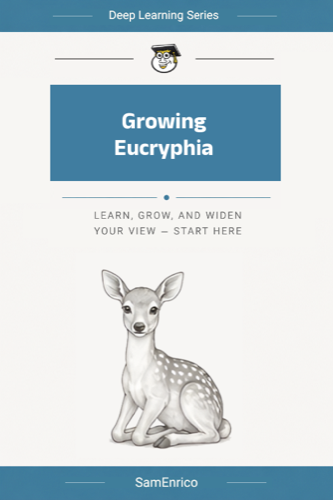
Non-FictionInformativeEducational
Growing Eucryphia eBook
This publication, published by SamEnrico, covers G
This publication, published by SamEnrico, covers Growing Eucryphia
Formats
Free sample
Chapter 1: The Hidden Giant–In the cool, misty mountains of Tasmania and the rain-soaked valleys of Chile, there grows a tree that most gardeners have never heard of—and yet, those who discover it become obsessed. Its flowers arrive in late summer, just when most gardens are fading, and they explode in a cloud of white that bees can detect from a mile away. Its foliage is elegant, its form is statuesque, and its story spans continents and millions of years. This tree is Eucryphia, and this chapter is your invitation to uncover the hidden giant of the flowering tree world.If you have picked up this book, you are likely one of three kinds of people. First, you may be a curious gardener who has glimpsed a Eucryphia in a botanic garden or a neighbor’s landscape and been stopped in your tracks by its late-summer profusion of blooms.
Second, you might be a collector of rare trees, always hunting for the next specimen that will set your garden apart. Third, you could be a beekeeper or a conservationist, drawn by the promise of honey and pollinators. Whatever brought you here, you are about to enter a world that is remarkably under-documented in mainstream gardening literature—a world that deserves a definitive guide.This chapter, and this entire book, exists because Eucryphia is one of the most rewarding, resilient, and underappreciated genera in temperate horticulture. It is not difficult to grow once you understand its few non-negotiable requirements. It is not prone to the pests and diseases that plague so many ornamentals.
And it offers a gift that few other flowering trees can match: a spectacular, bee-covered bloom in the dreaded "late summer lull," when roses are tired, hydrangeas are browning, and the garden cries out for a showstopper.But before we dig into planting, pruning, and propagation—before we talk soil p H and hardiness zones—we must first understand what Eucryphia is, where it came from, and why it has remained a hidden giant for so long. This chapter unveils the genus: its name, its ancient origins, its dramatic discovery by Western botanists, and its slow rise to cult status among those in the know. By the end, you will not only know the story of Eucryphia—you will feel a personal stake in growing it.The Meaning Behind the Name: "Well-Hidden"Every plant has a story encoded in its scientific name, and Eucryphia is no exception. The name comes from two Greek words: eu, meaning "good" or "well," and kryptos, meaning "hidden." Put together, Eucryphia translates to "well-hidden." At first glance, this seems an odd choice for a tree that produces thousands of conspicuous white flowers. But the name, bestowed by the French botanist Louis Claude Richard in the early 19th century, refers not to the flowers but to the plant's reproductive structures.When Richard examined the genus, he was struck by the way the floral parts—specifically the sepals and petals—are arranged in a manner that conceals the inner reproductive organs.
In botanical terms, the flower has a form that is "cryptic" or "hidden" at certain stages of development. But there is a deeper irony here. The name "well-hidden" proved prophetic in another sense: Eucryphia remained largely hidden from mainstream horticulture for over a century after its discovery. Even today, in an age of instant information and global plant trade, Eucryphia is far less known than it deserves to be.The common names attached to various species are more descriptive, if less poetic. In Tasmania, Eucryphia lucida is called "Leatherwood"—a reference to its tough, leathery leaves that withstand the island's fierce winds.
In Chile, Eucryphia cordifolia is known as "Ulmo," a name derived from the indigenous Mapuche language, who have long valued the tree for its timber and its honey. And Eucryphia moorei, found in the cool temperate rainforests of southeastern Australia, goes by the unflattering but unforgettable name "Stinkwood"—a nod to the pungent aroma released when its leaves are crushed.These names, whether poetic or practical, hint at the diversity and character of the genus. But the scientific name remains our starting point: a tree that is well-hidden, waiting to be discovered by gardeners like you.The Gondwana Mystery: A Genus Split by Continents One of the most extraordinary facts about Eucryphia—and one that never fails to captivate botanists and gardeners alike—is its disjunct biogeography. In plain English, this means that the same genus of plants is found naturally in two widely separated regions of the world, with no obvious way for seeds to have traveled between them. For Eucryphia, those two regions are the temperate rainforests of southern South America (specifically Chile and Argentina) and the cool, wet forests of eastern Australia (including Tasmania).How is this possible?
The answer lies in deep time—specifically, in the supercontinent of Gondwana.Gondwana was a massive landmass that existed hundreds of millions of years ago, encompassing what are now South America, Africa, India, Antarctica, and Australia. During the Cretaceous period, roughly 80 to 100 million years ago, Gondwana began to break apart due to tectonic forces. South America and Africa separated first, followed by the split between South America and Antarctica, and finally the separation of Antarctica from Australia.As these landmasses drifted apart, they carried with them the plants and animals that had evolved on Gondwana. Some groups went extinct. Others adapted to their new, isolated environments and evolved into distinct species.
Eucryphia belongs to the latter category. The ancestral Eucryphia population was present on Gondwana before the breakup. When the supercontinent fragmented, populations were stranded on the future continents of South America and Australia. Isolated from each other for tens of millions of years, these populations evolved separately, giving rise to the distinct South American and Australian species we see today.This is why you can travel to the Valdivian temperate rainforest of Chile—a misty, fern-draped landscape that feels like a living relic of the age of dinosaurs—and find Eucryphia cordifolia growing alongside the monkey puzzle tree (Araucaria araucana) and the southern beech (Nothofagus). And why, halfway around the world, you can hike through the cool, mossy forests of Tasmania's Tarkine wilderness and encounter Eucryphia lucida, its close cousin.The disjunct distribution of Eucryphia is not just a botanical curiosity; it is a living testament to the history of our planet.
Every time you plant a Eucryphia in your garden, you are participating in a story that began when continents were joined and dinosaurs roamed.The Chilean Lineage: Rainforest Giants Let us travel first to South America, to the Valdivian temperate rainforest of southern Chile and Argentina. This is one of the rarest and most ancient forest types on Earth, a green cathedral of towering trees, sprawling ferns, and creeping vines, all draped in mist and moss. Annual rainfall in this region can exceed 2,000 millimeters (nearly 80 inches), and temperatures are mild year-round—rarely freezing in winter, rarely hot in summer. It is a land of cool, wet, and consistent conditions.In this primeval landscape, Eucryphia cordifolia—the Ulmo—reaches its full glory. This is a massive tree, capable of growing 30 to 40 meters (100 to 130 feet) tall in its…
This is the end of the free sample. Get the eBook to keep going. Buy now
About this book
Details
- Author
- Landrum Hortencia
- Publisher
- SamEnrico
- Language
- English
- Genre
- Non-Fiction, Informative, Educational
- Released
- 2026-05-11
- Pages (approx.)
- 156
- Available as
- eBook, Audiobook

Read better in the ZLOADR app
Your eBooks on your phone or tablet. Sign in with your SamEnrico account and start reading.
More by Landrum Hortencia
 Thryve Test Report GuideLandrum Hortencia$11.99
 TM for Migraine PreventionLandrum Hortencia$11.99
 Men Sleep Apnea CourseLandrum Hortencia$11.99
 Housing Insecurity SleepLandrum Hortencia$11.99
 Childrens Bedtime Meditation GuideLandrum Hortencia$11.99
 Boundary Setting Under StressLandrum Hortencia$11.99
 Children Method of Loci GuideLandrum Hortencia$11.99
 Pomodoro For WritersLandrum Hortencia$11.99
 Indonesia Remote Tax GuideLandrum Hortencia$11.99
 The Ballad of the Bionic Woman: The Untold Story of Claudia MitchellLandrum Hortencia$11.99
 Tokyo 1964: The Ceremony That Defied the OddsLandrum Hortencia$11.99
 The Alchemist of Timbuktu: Ibn al-Shatir and the Secrets of the UniverseLandrum Hortencia$11.99
You may also like
 Hong Kong Handover 1997Dunn Johnnie$11.99
 Zumba For Postnatal Recovery CourseNeal Christian$11.99
 Zumba for BeginnersLadner Nikia$11.99
 YouTube Comment Mining GuideHumes Pandora$12.99
 Worry Box MeditationCarlin Rudy$11.99
 Workplace Stress MeditationNguyen Lynn$11.99
 Workplace Stress and Sleep RepairHawley Ivory$11.99
 Workplace Perfectionism CureDelaney Jeffry$11.99
 Workplace Injustice Anger GuideWallen Isabelle$11.99
 Work Addiction and Burnout LinkGreenwood Ester$11.99
 Women in Yoga and WellnessBeattie Galina$11.99
 Women in Stand Up ComedyChun Evangeline$11.99