
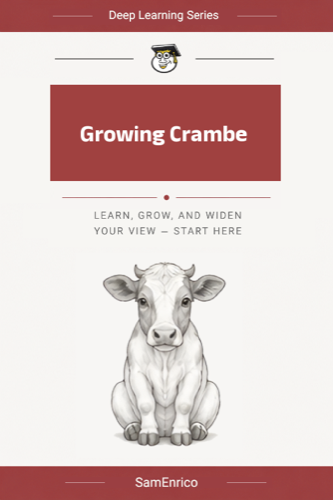
Non-FictionInformativeEducational
Growing Crambe eBook
This publication, published by SamEnrico, covers G
This publication, published by SamEnrico, covers Growing Crambe
Formats
Free sample
Chapter 1: The Plant That Time Forgot...--–- On a windswept hillside in the Ethiopian highlands, where the soil is thin and the rain comes only when it pleases, a strange plant has been minding its own business for nearly three thousand years. It asks for nothing—no pampering, no perfect p H, no farmer hovering over it with prayers and fertilizer. It simply grows. And then it waits. It waits for someone to notice what it can do.For most of human history, no one did.
Crambe—known to botanists as Crambe abyssinica and Crambe cordifolia, depending on which version you meet—lived in peaceful obscurity. It was a weed to some, a curiosity to others, and a famine food for the desperate. Its seeds were too small to bother with. Its leaves were too bitter for salads. Its stalks grew too tall to ignore but not tall enough to build with.
In the grand hierarchy of useful plants, crambe sat somewhere below dandelions and above poisonous nightshade—which is to say, nowhere at all.Then came the twentieth century, and with it, a peculiar habit that would change everything: humans fell in love with machines. Not the machines themselves, exactly, but the fluids that made them run. Oils. Lubricants. Coatings that could keep a ship's hull clean without poisoning every fish in the harbor.
And suddenly, that forgotten plant with the tiny seeds contained something the industrial world desperately wanted: erucic acid, a long-chain fatty acid that could do things soybean oil and canola oil could only dream of.This book is the story of that rediscovery. But more than that, it is a practical guide for two very different kinds of people. The first is the commercial farmer or homesteader who sees in crambe a chance to grow something profitable on marginal land that corn and soybeans have abandoned. The second is the gardener who simply wants to stand in awe of a six-foot perennial that explodes into a cloud of white flowers every June, making the neighbors wonder what sorcery you've discovered.Both of you are right to be curious. Both of you will find what you need in these pages.
But before we dig a single hole or calibrate a single seed drill, you need to understand what crambe actually is—not just botanically, but historically, culturally, and economically. Because this is not a plant that reveals its secrets easily. And that, as you will learn, is exactly its genius.The Family Tree: Why Crambe Is Not Your Grandmother's Cabbage Crambe belongs to the Brassicaceae family, which you probably know as the mustard family. This is the same botanical clan that gave us cabbage, kale, broccoli, cauliflower, Brussels sprouts, canola, turnips, radishes, horseradish, and wasabi. If you have ever eaten a salad, stirred a stir-fry, or suffered through a bland steamed vegetable medley at a relative's Thanksgiving dinner, you have encountered the Brassicaceae.
They are everywhere. They are inescapable. And for the most part, they are delicious.Crambe is not delicious.This is the first thing you need to know, and it is important enough to put in bold: Crambe leaves are bitter. Not spinach-bitter or arugula-bitter, but aggressively, almost offensively bitter. The kind of bitter that makes you wonder if the plant is trying to tell you something.
And it is. The bitterness is a chemical defense mechanism, a way of saying to every hungry insect and grazing animal: "Move along. Nothing tasty here."This bitterness is why crambe never became a food crop. In an era when every edible plant was tested, tasted, and either cultivated or discarded, crambe failed the taste test spectacularly. But that same bitterness gives crambe a remarkable advantage in the field: significantly lower pest pressure than its brassica cousins.
While your canola field is being devoured by flea beetles and your kale is turning into lace under a cloud of aphids, crambe sits there, ignored, its bitter leaves an unappealing meal.Let me be precise about this, because the original version of this book made a mess of the pest question. Crambe is not pest-proof. No plant is. Flea beetles will occasionally sample crambe seedlings. Aphids may land on crambe stalks.
Alternaria leaf spot can appear under humid conditions. But the pressure is dramatically lower—some studies suggest 60-80% less damage than canola under identical conditions. For the commercial farmer, this means fewer pesticide applications. For the home gardener, it means you can walk away and trust the plant to defend itself.The second thing you need to know about the Brassicaceae family is that crambe shares its cousins' preference for cool weather. It germinates eagerly when soil temperatures hover between 8 and 10 degrees Celsius (46-50°F).
It bolts—that is, sends up its flowering stalk—happily between 15 and 20°C (59-68°F). But when temperatures climb above 30°C (86°F), crambe sulks. Flowers abort. Seeds fail to fill. The plant goes into survival mode, which for crambe means shutting down reproduction and focusing entirely on that deep taproot we will discuss in Chapter 2.If you live in Texas, Arizona, or the Deep South in July, you have been warned: crambe is not for you, at least not as a summer crop.
But if you live in the northern United States, Canada, the British Isles, Scandinavia, or any region with cool summers and cold winters, crambe may be the most forgiving crop you have ever grown.Two Species, Two Lifespans, Two Purposes Here is where most crambe guides—and there are very few of them—make a catastrophic mistake. They treat Crambe abyssinica and Crambe cordifolia as interchangeable. They are not. They are not even close. Confusing them would be like confusing a tomato plant with a potato plant.
Both are in the nightshade family. Both produce edible parts. But try to harvest potatoes from a tomato vine and you will be disappointed.Crambe abyssinica (pronounced a-bih-SIN-ih-kuh) is an annual plant. You plant it in the spring or fall. It grows, flowers, sets seed, and dies—all within a single growing season.
Its life mission is to produce as many seeds as possible, because those seeds contain the high-erucic acid oil that industry wants. If you are reading this book because you want to make money growing crambe for oil, this is your species. Its seeds are small—about 6-8 grams per thousand seeds—and they shatter easily at maturity, meaning they will literally explode off the plant if you touch them at the wrong time. This is a headache at harvest, but it is also the plant's evolutionary strategy for spreading its offspring far and wide.Crambe cordifolia (pronounced kor-dih-FOH-lee-uh) is a perennial plant. Once established, it will come back year after year, growing larger and more spectacular each season.
It does not care about erucic acid. It does not care about industrial lubricants. Its entire existence is geared toward producing a massive basal rosette of leaves—some reaching two feet across—and then, in early summer, hurling up a flower stalk that can reach two meters (six feet) or more, covered in thousands of tiny, fragrant, white flowers. If you are reading this book because you want to stop traffic with…
This is the end of the free sample. Get the eBook to keep going. Buy now
About this book
Details
- Author
- Charles Amberly
- Publisher
- SamEnrico
- Language
- English
- Genre
- Non-Fiction, Informative, Educational
- Released
- 2026-05-18
- Pages (approx.)
- 152
- Available as
- eBook, Audiobook

Read better in the ZLOADR app
Your eBooks on your phone or tablet. Sign in with your SamEnrico account and start reading.
More by Charles Amberly
 Beard Stroking as ContemplationCharles Amberly$11.99
 Athletic Body Image And Self Worth ManualCharles Amberly$11.99
 Nobel Laureates In Game TheoryCharles Amberly$11.99
 Healthcare Power of AttorneyCharles Amberly$11.99
 Chaco Culture DisappearancesCharles Amberly$11.99
 Across Patagonia Ice FieldCharles Amberly$11.99
 Workaholics Anonymous StepsCharles Amberly$11.99
 Mindful Teeth BrushingCharles Amberly$11.99
 The Steam and Steel Prophets: A World Forged by Industrial VisionariesCharles Amberly$11.99
 Shogun's Gambit: The Siege of Osaka and the Fall of the Toyotomi (1614-1615)Charles Amberly$11.99
 Gaseous State JEE Main GuideCharles Amberly$12.99
 Tsinghua University Application GuideCharles Amberly$12.99
You may also like
 Hong Kong Handover 1997Dunn Johnnie$11.99
 Zumba For Postnatal Recovery CourseNeal Christian$11.99
 Zumba for BeginnersLadner Nikia$11.99
 YouTube Comment Mining GuideHumes Pandora$12.99
 Worry Box MeditationCarlin Rudy$11.99
 Workplace Stress MeditationNguyen Lynn$11.99
 Workplace Stress and Sleep RepairHawley Ivory$11.99
 Workplace Perfectionism CureDelaney Jeffry$11.99
 Workplace Injustice Anger GuideWallen Isabelle$11.99
 Work Addiction and Burnout LinkGreenwood Ester$11.99
 Women in Yoga and WellnessBeattie Galina$11.99
 Women in Stand Up ComedyChun Evangeline$11.99