
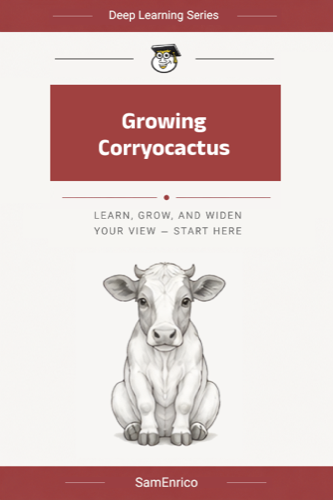
Non-FictionInformativeEducational
Growing Corryocactus eBook
This publication, published by SamEnrico, covers G
This publication, published by SamEnrico, covers Growing Corryocactus
Formats
Free sample
Chapter 1: The Railway’s Legacy...--The first time I saw a Corryocactus in habitat, I almost walked past it.That is not hyperbole. It was midday in the Marañón River canyon of northern Peru, the sun hammering down at an angle that made the rocks shimmer, and I was looking for anything tall, anything obvious, anything that screamed “cactus” the way a saguaro screams in a Western film. The canyon walls were steep, terraced with ancient agricultural plots long abandoned, and the Andean dust had turned my water bottle into a warm, gritty disappointment. I had been hiking for three hours. My guide, a soft-spoken agronomist named Carlos who had grown up in these valleys, kept pausing to point at things I could not see.“Alli,” he would say.
“There.”And I would squint at a cliff face that looked like every other cliff face—brown, fractured, hostile—and see nothing.Then he took out his walking stick and pointed at a specific crack in the rock, maybe fifteen feet above the trail. The crack was no wider than my wrist. And wedged inside it, so perfectly camouflaged against the grey-green limestone that it seemed to have grown out of the stone itself, was a column of flesh the color of dusty jade. It was perhaps two feet tall, no thicker than my forearm, and its spines were not the dramatic, menacing needles I expected from a high-Andes cactus. They were short, reddish-brown, pressed flat against the ribs like a secret the plant was keeping from the sun.“Corryocactus,” Carlos said.
“Brevistylus. The short-styled one.”I knew the name from field guides, but seeing it changed everything. The plant was not displaying itself. It was not posing for a photograph. It was hiding in plain sight, clinging to a vertical rock face with roots that I could not even see, surviving on fog drip and the rare flash flood that would send water cascading down the stone for perhaps ten minutes before vanishing.
This was not a garden plant. This was a survivor.That moment—squinting at a cactus that seemed determined not to be seen—is why this book exists. Because Corryocactus is not a genus that announces itself. It does not have the charisma of a golden barrel, the flirtatiousness of a blooming Christmas cactus, or the pop-culture fame of the San Pedro. It is a plant for people who have grown bored of the predictable, who have kept a Trichocereus alive for five years and found themselves wondering, “What next?” It is the holy grail for serious collectors precisely because it asks more of you: more patience, more attention to detail, more willingness to understand a place—the high Andes—that most of us will never visit.This chapter is the story of that place and the plant that calls it home.
We will trace the unlikely history of how a railway engineer gave this genus its name, untangle the taxonomic confusion that has dogged it for over a century, map the remote and punishing geography that shaped its evolution, and arm you with the visual tools to distinguish Corryocactus from its look-alike cousins. By the end of this chapter, you will understand why this humble, cliff-clinging cactus deserves a second look—and a place in your collection.The Man Behind the Name Every genus has a story, but the story of Corryocactus is unusually strange. It begins not with a botanist in a herbarium, but with a railway engineer named Thomas Corry—and the fact that he was not even looking for cacti.Thomas Corry was a British engineer working in Peru and Bolivia during the late nineteenth century, a time when the Andes were being carved up by railroad companies eager to connect the Pacific coast to the inland silver mines. The terrain was brutal: sheer canyons, unstable slopes, and weather that swung from scorching sun to freezing rain in a matter of hours. Building railways in that environment required more than engineering skill.
It required obsession.Corry had that obsession. He spent years surveying routes through the Marañón canyon system, cutting paths into cliffs that had never seen a wheel, let alone a train. And in the course of that work, he began collecting plants. Not as a scientist—he had no formal botanical training—but as a man who could not help noticing the strange, stubborn life that thrived where he was blasting rock.Among the specimens he sent back to England were several columnar cacti that did not match any known genus. They were passed to the Royal Botanic Gardens at Kew, where a young botanist named Nathaniel Britton (who would later go on to co-author the monumental The Cactaceae) recognized them as something new.
Britton named the genus Corryocactus in 1920, honoring the engineer who had dragged specimens out of a canyon most botanists would never visit.There is something fitting about this origin. Corryocactus is not a plant that reveals itself to people who stay on the trail. It takes a certain stubbornness to find it—the same stubbornness that Thomas Corry brought to his railway work, and the same stubbornness you will need to grow it successfully.The Erdisia Confusion (And Why It Matters)If you have ever tried to research Corryocactus online, you have almost certainly run into the name Erdisia. You may have seen the same plant listed under both genera. You may have wondered if you were losing your mind.You were not.The confusion dates back to 1919, one year before Britton published the name Corryocactus.
A botanist named Nathaniel Lord Britton (the same Britton, working with his colleague Joseph Rose) had described a new genus called Erdisia based on specimens collected in Peru. The differences they cited were subtle: spine morphology, flower structure, the shape of the fruit. For the next several decades, some taxonomists recognized Erdisia as a distinct genus, while others folded it into Corryocactus.Modern molecular analysis has largely settled the debate. Most botanists now treat Erdisia as a synonym of Corryocactus. The genetic differences between the so-called Erdisia species and the core Corryocactus group are no greater than the differences within other cactus genera.
In plain English: they are the same thing, and the split was a mistake.Why does this matter to you, the grower? Because if you buy a plant labeled “Erdisia” from an old-school nursery or a private collector, you are buying a Corryocactus. The care instructions are identical. The taxonomy is for the botanists to argue over. For our purposes, all species previously classified as Erdisia are now considered part of the Corryocactus genus, and this book treats them as such.That said, a word of warning: you will still encounter the name Erdisia in older field guides, online forums, and seed lists.
Do not let it throw you. Think of it as a historical footnote—interesting, but not essential to keeping your plant alive.The Geography of Extremes To understand Corryocactus, you must understand where it lives. Not in a vague, “somewhere in South America” sense, but in a visceral, bone-deep appreciation for the places that shaped it.Take a map of western South America. Draw a line…
This is the end of the free sample. Get the eBook to keep going. Buy now
About this book
Details
- Author
- Brittain Mozell
- Publisher
- SamEnrico
- Language
- English
- Genre
- Non-Fiction, Informative, Educational
- Released
- 2026-05-11
- Pages (approx.)
- 142
- Available as
- eBook, Audiobook

Read better in the ZLOADR app
Your eBooks on your phone or tablet. Sign in with your SamEnrico account and start reading.
More by Brittain Mozell
 Body Scan For Sleep InsomniaBrittain Mozell$11.99
 Drug Dependency Recovery Coaching GuideBrittain Mozell$11.99
 The Physics Nobel ExoplanetsBrittain Mozell$11.99
 Nobel Prize Insulin Discovery StoryBrittain Mozell$11.99
 Supplier Client Bankruptcy GuideBrittain Mozell$11.99
 Adjusting Clothing as DiscomfortBrittain Mozell$11.99
 Gates of Arctic VanishedBrittain Mozell$11.99
 Beginner Loving Kindness For SelfBrittain Mozell$11.99
 The Hollow Crown of the Tuatha Dé DanannBrittain Mozell$11.99
 The Alchemy of Light: The Black Inventors Who Illuminated the WorldBrittain Mozell$11.99
 How to Produce Bubble ToysBrittain Mozell$11.99
 How to Start a Plate Setting for Letterpress Processes Business (Beginners Guide)Brittain Mozell$11.99
You may also like
 Hong Kong Handover 1997Dunn Johnnie$11.99
 Zumba For Postnatal Recovery CourseNeal Christian$11.99
 Zumba for BeginnersLadner Nikia$11.99
 YouTube Comment Mining GuideHumes Pandora$12.99
 Worry Box MeditationCarlin Rudy$11.99
 Workplace Stress MeditationNguyen Lynn$11.99
 Workplace Stress and Sleep RepairHawley Ivory$11.99
 Workplace Perfectionism CureDelaney Jeffry$11.99
 Workplace Injustice Anger GuideWallen Isabelle$11.99
 Work Addiction and Burnout LinkGreenwood Ester$11.99
 Women in Yoga and WellnessBeattie Galina$11.99
 Women in Stand Up ComedyChun Evangeline$11.99