
Non-FictionInformativeEducational
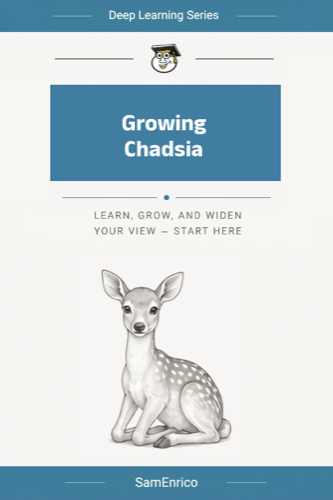
Growing Chadsia eBook
This publication, published by SamEnrico, covers G
This publication, published by SamEnrico, covers Growing Chadsia
Formats
Free sample
Chapter 1: The Seed That Found Me...–- It began not with a plan, not with a research grant, and certainly not with any sensible gardener’s intention. It began with a failure.I had spent the better part of a decade convincing myself that I knew something about plants. My reputation—such as it was—rested on a collection of orchids that refused to die, a fiddle-leaf fig that reached my ceiling, and a small but respectable library of horticultural manuals that I had read with the fervor of a convert. I was, by any reasonable measure, a competent gardener. Perhaps even a good one.But competence, I have since learned, is the enemy of discovery.
Comfort is the soil in which curiosity goes to rot. And I was very, very comfortable.The trouble arrived in the form of a cardboard box, the kind that holds nothing of value—creased, stained, addressed to me in handwriting I did not recognize. Inside, wrapped in newspaper that had yellowed at the edges, were twelve small, black seeds. They were the color of charcoal after rain, each one no larger than a lentil, with a surface so hard and smooth that they seemed less like seeds and more like polished stones. A single index card accompanied them, typed in a font that belonged to a typewriter from the 1970s:Chadsia versicolor.
Madagascar. Dry forest. Scarify before sowing. Good luck.No name. No return address.
No explanation.I should have thrown them away. Any rational person would have. Seeds arriving unsolicited, from an unknown source, with no documentation—this is how invasive species find new homes, how pathogens travel continents, how good intentions become ecological disasters. I knew this. I had written about this.
And yet, I did not throw them away.Instead, I did something far more dangerous. I became curious.The Geography of Ignorance Let me be honest with you: I had never heard of Chadsia. Not once. Not in a decade of obsessive plant collecting, not in the pages of any catalog, not whispered in the backrooms of botanical gardens where rare-plant dealers trade secrets like contraband. The name meant nothing to me.So I did what any self-respecting plant nerd would do.
I went to my books.My library contains over three hundred volumes on botany, horticulture, and plant taxonomy. I have field guides to the flora of Madagascar, monographs on the Fabaceae family, and proceedings from symposia so obscure that the only attendees were the authors themselves. Surely, I thought, somewhere in these pages, Chadsia would reveal itself.It did not.I searched for an hour. Then two. Then four.
The genus appeared exactly once, in a footnote of a 1987 revision of Madagascan legumes, where it was described as "poorly understood" and "in need of further study." That was all. No cultivation notes. No habitat description beyond "dry deciduous forest." No mention of its flowers, its growth habit, its tolerance for frost or drought or the clumsy hands of an overly confident gardener in the American Midwest.I was, for the first time in years, completely ignorant.And that, I would come to understand, was exactly the point.What We Lose When We Only Grow What We Know The modern gardening world is a triumph of convenience. Walk into any nursery in any city in North America or Europe, and you will find the same fifty plants: monstera, fiddle-leaf fig, snake plant, pothos, philodendron, a handful of succulents, and perhaps—if you are lucky—something slightly unusual like a Peperomia or a Calathea. These plants are everywhere because they are easy.
They tolerate our forgetful watering, our dim apartments, our dry winter air. They do not punish us for our mediocrity.This is not gardening. This is decoration.I do not say this to shame anyone. I have owned every single one of those plants, and I have loved them. But somewhere along the way, we have mistaken convenience for skill, survival for thriving, and the presence of green leaves for the practice of horticulture.A true gardener—and I use the term not as a credential but as a disposition—seeks the difficult.
The rare. The plant that requires something of us. Because it is in the struggle that we learn. It is in the failure that we grow. And it is in the mystery that we find the joy that no supermarket succulent can ever provide.Chadsia, I would discover, is the opposite of easy.
It is the anti-monstera. It does not want your kindness. It does not want your regular watering schedule or your expensive fertilizer or your climate-controlled living room. It wants what it has always wanted: the harsh sun of a Madagascan dry forest, the grinding poverty of rocky, nutrient-poor soil, the long, cruel drought of the austral winter, and the sudden, explosive relief of the rainy season.It wants to be left alone, but not forgotten. Ignored, but not abandoned.
Challenged, but not killed.This is a difficult balance. And that, I realized, is why I had to try.The Practical Reality of Growing Chadsia Before we go any further, let me give you the cold, hard facts about what you are getting into. I wish someone had given them to me.Hardiness. Chadsia is not frost-tolerant. At all.
If the temperature drops below 25°F (-4°C) for more than a few hours, your plant will die. Not struggle, not go dormant, not recover in the spring. Dead. This means that for most of North America and Europe, Chadsia must be grown in a container that can be moved indoors during winter, or in a greenhouse. There is no middle ground.
If you live in USDA Zone 9b or warmer (think southern Florida, coastal California, or the Mediterranean), you may be able to grow it in the ground with winter protection. Everyone else needs a pot.Sunlight. This is not a shade plant. It is not even a partial-shade plant, despite what some optimistic sources may claim. Chadsia wants full sun—six hours or more of direct, unfiltered sunlight every day.
If you give it less, it will survive, but it will not thrive. The stems will become leggy, stretching toward whatever light they can find. The leaves will be smaller and paler. And the flowers—the reason many of us are here—will be sparse or nonexistent. In extremely hot climates (deserts, for example, or regions where summer temperatures regularly exceed 95°F/35°C), a few hours of afternoon shade is acceptable, but morning sun is essential.
Less than three hours of direct sun per day, and you might as well be growing a plastic plant.Water. This is where most people fail. I failed here. Several times. Chadsia is a legume from a dry forest, not a rainforest, not a swamp, not a typical garden border.
It has evolved to survive months of drought followed by weeks of heavy rain. In cultivation, this means you must mimic that rhythm: regular but not constant moisture during active growth (spring and summer), followed by a sharp reduction in water during dormancy (late fall and winter). The single most common cause of death in Chadsia…
This is the end of the free sample. Get the eBook to keep going. Buy now
About this book
Details
- Author
- Clemons Raven
- Publisher
- SamEnrico
- Language
- English
- Genre
- Non-Fiction, Informative, Educational
- Released
- 2026-05-11
- Pages (approx.)
- 141
- Available as
- eBook, Audiobook

Read better in the ZLOADR app
Your eBooks on your phone or tablet. Sign in with your SamEnrico account and start reading.
More by Clemons Raven
 Sugar Addiction And PCOS GuideClemons Raven$11.99
 Cannabis Use Disorder Cheat SheetClemons Raven$11.99
 Key Employee Sudden Departure Drill ManualClemons Raven$11.99
 Caffeine Curfew ProtocolClemons Raven$11.99
 Loving Kindness Chronic Pain WorkbookClemons Raven$11.99
 Social Media and Sexual AddictionClemons Raven$11.99
 Spouse Death and PurposeClemons Raven$11.99
 Bid Rigging Enforcement RecordClemons Raven$11.99
 Pre Presentation Sleep ProtocolClemons Raven$11.99
 Jutland: Love and Loss in the North SeaClemons Raven$11.99
 The Visionary Streets of Haussmann: Paris RebornClemons Raven$11.99
 AI Masters Recommendation LettersClemons Raven$12.99
You may also like
 Hong Kong Handover 1997Dunn Johnnie$11.99
 Zumba For Postnatal Recovery CourseNeal Christian$11.99
 Zumba for BeginnersLadner Nikia$11.99
 YouTube Comment Mining GuideHumes Pandora$12.99
 Worry Box MeditationCarlin Rudy$11.99
 Workplace Stress MeditationNguyen Lynn$11.99
 Workplace Stress and Sleep RepairHawley Ivory$11.99
 Workplace Perfectionism CureDelaney Jeffry$11.99
 Workplace Injustice Anger GuideWallen Isabelle$11.99
 Work Addiction and Burnout LinkGreenwood Ester$11.99
 Women in Yoga and WellnessBeattie Galina$11.99
 Women in Stand Up ComedyChun Evangeline$11.99