
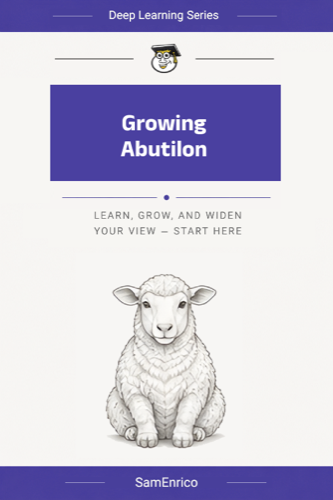
Non-FictionInformativeEducational
Growing Abutilon Audiobook
This publication, published by SamEnrico, covers G
This publication, published by SamEnrico, covers Growing Abutilon
Formats
Free sample
Chapter 1: The Maple Lie--–- The first thing you need to know about Abutilon is that it is not a maple. The leaves look like maple leaves. The growth habit vaguely resembles a small maple tree. Garden centers have been selling it as "Flowering Maple" for over a century. But calling Abutilon a maple is like calling a tomato a vegetable – technically wrong, practically useful, and hiding a much more interesting truth.The lie, however well-intentioned, has caused more confusion than clarity.
True maples (genus Acer) are temperate trees that go dormant in winter, drop their leaves, and require a cold period to thrive. Abutilon is a subtropical evergreen shrub that blooms when temperatures stay moderate and sulks when they drop. Treat Abutilon like a maple and you will water it incorrectly, overwinter it improperly, and wonder why your "maple" refuses to behave like one.This chapter cuts through the botanical misinformation. You will learn what Abutilon actually is, where it came from, why it matters for your specific growing conditions, and how to choose the right variety for your space. By the end, you will understand this plant well enough to anticipate its needs rather than constantly reacting to problems.The Genus That Refuses to Be Pigeonholed Abutilon belongs to the Malvaceae family, which includes hibiscus, hollyhock, and okra.
If you have grown any of those plants, you already have a head start. The family is characterized by showy, five-petaled flowers with a prominent central column of stamens – a structure botanists call a staminal column. In Abutilon, this column protrudes like a small brush from the center of each bell-shaped bloom, giving the flower its characteristic lantern appearance.The genus name comes from the Arabic aubutilun, a name given by medieval botanists to a similar-looking plant they encountered in trade routes. There are approximately 150 recognized species, plus hundreds of hybrids and cultivars. Their natural range spans the subtropical and tropical regions of South America, Africa, and Australia.
This wide distribution explains much of the plant's adaptability. Populations that evolved in the cloud forests of the Andes developed tolerance for cooler temperatures and higher humidity. Those from the Australian outback learned to survive periodic drought. The Abutilon you buy at a garden center carries the genetic memory of all these environments, which is why it can thrive indoors in Minnesota and outdoors in Southern California.What makes Abutilon distinctive within the…
This is the end of the free sample. Get the Audiobook to keep going. Buy now
About this book
Details
- Author
- Roche Maryland
- Publisher
- SamEnrico
- Language
- English
- Genre
- Non-Fiction, Informative, Educational
- Released
- 2026-06-02
- Pages (approx.)
- 128
- Available as
- eBook, Audiobook

Listen in the VoxFlicks app
Audiobooks and audio dramas wherever you go. Sign in with your SamEnrico account and press play.
More by Roche Maryland
 Memory Palace for MedicineRoche Maryland$11.99
 Pandemic Vendor Payment DelayRoche Maryland$11.99
 Growth Hormone and Insulin Like Growth Factor 1Roche Maryland$11.99
 Gig Economy Retirement GuideRoche Maryland$11.99
 Foster Care Reunification HopeRoche Maryland$11.99
 Polish Home Army RisingRoche Maryland$11.99
 Burnout Nutrition EssentialsRoche Maryland$11.99
 Teen Child Death SupportRoche Maryland$11.99
 The Art of War and the West: Julius Caesar's Military GeniusRoche Maryland$11.99
 The Phantom of the Seine: Paris' First Express KidnappingRoche Maryland$11.99
 How to Produce Mattocks and PickaxesRoche Maryland$11.99
 OKR vs MBO ComparisonRoche Maryland$12.99
You may also like
 Hong Kong Handover 1997Dunn Johnnie$11.99
 Zumba For Postnatal Recovery CourseNeal Christian$11.99
 Zumba for BeginnersLadner Nikia$11.99
 YouTube Comment Mining GuideHumes Pandora$12.99
 Worry Box MeditationCarlin Rudy$11.99
 Workplace Stress MeditationNguyen Lynn$11.99
 Workplace Stress and Sleep RepairHawley Ivory$11.99
 Workplace Perfectionism CureDelaney Jeffry$11.99
 Workplace Injustice Anger GuideWallen Isabelle$11.99
 Work Addiction and Burnout LinkGreenwood Ester$11.99
 Women in Yoga and WellnessBeattie Galina$11.99
 Women in Stand Up ComedyChun Evangeline$11.99