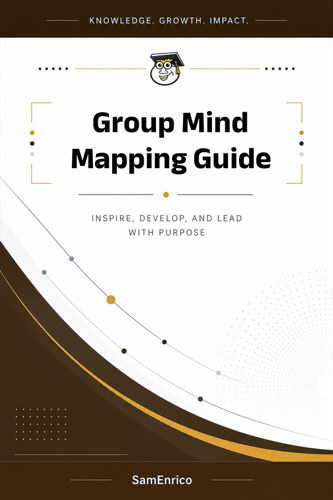
Group Mind Mapping Guide Audiobook
Builds shared visual maps that grow as each partic
Builds shared visual maps that grow as each participant adds branches.
Formats
Free sample
Chapter 1: The Meeting That Died--–- The conference room smelled of stale coffee and regret. Twelve people sat around a polished table, each holding a printed agenda that none of them had read. The facilitator, a well-meaning director named Sarah, stood at the whiteboard with a blue marker poised like a weapon. "Let's brainstorm our Q3 strategy," she said. For the next ninety minutes, three people talked.
Two of them argued. One scrolled through emails under the table. Seven said nothing at all. The whiteboard ended up looking like a crime scene—disconnected words, arrows pointing nowhere, a sad star drawn next to someone's pet idea. Sarah took a photo with her phone, promising to "type this up and send it around." That photo now sits in a folder called "Old Meetings," alongside four hundred similar photos from the past three years.
Nothing changed. Nothing grew. The meeting died, and no one even noticed.This scene repeats itself thousands of times every day, in every industry, on every continent. Teams gather to solve problems. They leave with the same problems, plus a fresh layer of frustration.
The tragedy is not that these meetings fail. The tragedy is that they fail in predictable, preventable ways, and yet we keep running them exactly the same way, expecting different results. That is the definition of organizational insanity.But here is the truth that changes everything: the problem is not your team. It is not your facilitator. It is not the intelligence or creativity of the people in the room.
The problem is the container you are using to hold the conversation. You are trying to capture a three-dimensional, branching, associative, networked conversation inside a one-dimensional, linear, sequential container. You are trying to pour a river into a garden hose.This chapter is about why that container is broken, what your brain actually needs to think together with other humans, and how a different kind of container—a living, growing, shared visual map—can resurrect meetings that died before they ever began.The Hidden Cost of Linear Thinking Most business communication relies on two linear formats: the bullet-point list and the numbered agenda. Both share the same fatal flaw. They force the brain to process information in a single sequence, one idea after another, with no room for the natural associations that actually constitute human thought.Consider what happens when you read a bullet-point list:• Increase brand awareness• Launch…
This is the end of the free sample. Get the Audiobook to keep going. Buy now
About this book
Details
- Author
- Minter Roberto
- Publisher
- SamEnrico
- Language
- English
- Genre
- Non-Fiction, Self-Help, Visual Collaboration
- Released
- 2026-06-06
- Pages (approx.)
- 136
- Available as
- eBook, Audiobook

Listen in the VoxFlicks app
Audiobooks and audio dramas wherever you go. Sign in with your SamEnrico account and press play.
More by Minter Roberto
 Non Striving for PeaceMinter Roberto$11.99
 De escalation for RetailMinter Roberto$11.99
 London Foot Traffic AnalysisMinter Roberto$11.99
 Morning Deep Work BlockMinter Roberto$11.99
 Millennial Automobile TrendsMinter Roberto$11.99
 Workplace Humor ToolboxMinter Roberto$11.99
 Grit for New ParentsMinter Roberto$11.99
 The Battle of Bosworth Field: The Last Plantagenet FallsMinter Roberto$11.99
 The Architects of Eternity: The Great Pyramid HeistMinter Roberto$11.99
 Service Providers Guide to Firewood SupplyMinter Roberto$11.99
 How to Produce ViolasMinter Roberto$11.99
 How to Produce a Lawn SweeperMinter Roberto$11.99