
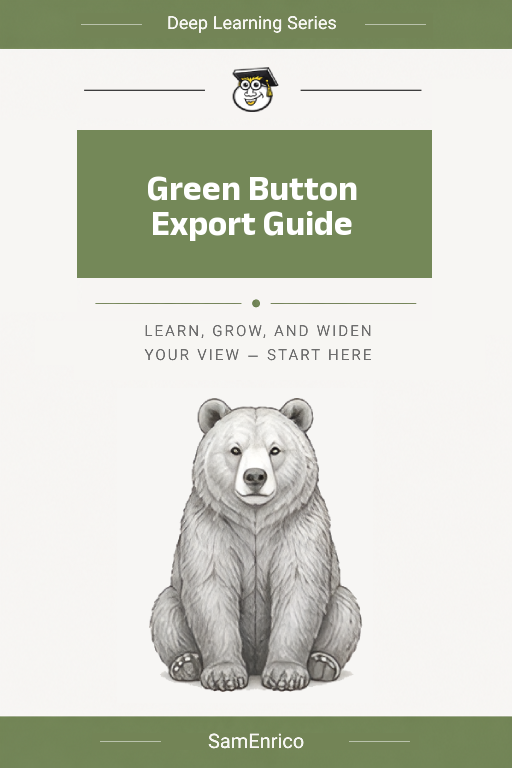
Non-FictionBusiness BriefGreen Button
Green Button Export Guide eBook
Certify textile exports with German Green Button f
Certify textile exports with German Green Button for government procurement and sustainable brands.
Formats
Free sample
Chapter 1: The Meta-Label Trap–- When Amina Rahman, the export director of a mid-sized garment factory in Dhaka, first heard about the German Green Button, she almost dismissed it as yet another eco-label. Her factory already held GOTS, Oeko-Tex, Fairtrade, and BSCI certifications. The walls of her conference room were a patchwork quilt of logos. “Another badge to sew into a shirt collar,” she told her compliance officer. “What difference will this one make?” Eight months later, after failing a critical tender for 2.5 million euros worth of police uniforms, Amina learned the difference.
The German buyer did not ask for GOTS or Fairtrade. They asked for one thing only: proof of Green Button certification. Amina had none. Her competitors did. And in the ruthless world of German public procurement, “almost certified” is the same as being invisible.This is the meta-label trap.
Most textile exporters assume that collecting more certifications is a game of addition: more logos, more trust, more sales. But the Green Button reverses that logic. It does not add another certification to your product. Instead, it certifies that your company has a functioning, audited, and transparent management system for social and environmental risk across your entire supply chain. In other words, the Green Button is not a label for your T-shirt.
It is a label for your business. And that distinction changes everything.Why This Chapter Exists Before you invest time and money in the Green Button certification process, you must understand what it actually is and—equally important—what it is not. This chapter provides the foundational framework for the entire book. By the end of this chapter, you will be able to:Distinguish the Green Button from every other textile label you have encountered.Explain why the German government created a state-backed label rather than adopting an existing one.Understand the “meta-label” logic and how it requires you to combine existing certifications.Identify whether your current certifications put you in a strong starting position or whether you need to upgrade them first.Recognize the commercial value of the Green Button in German public procurement and brand supply chains.This chapter contains no application forms, no audit checklists, and no technical standards. Those come later.
First, you need a map of the territory. Let us begin by clearing away the most dangerous misconception.The Most Dangerous Misconception Ask most textile exporters what the Green Button certifies, and they will say: “It certifies that my product is sustainable.” Wrong. Deeply, expensively wrong.The Green Button does not certify that a specific T-shirt, pair of trousers, or bedsheet is organic, recycled, or fair trade. It certifies that the manufacturing company has implemented a due diligence system that meets 46 binding social and environmental criteria across its supply chain. The product itself is not the unit of certification.
The company is.Consider the difference between a driver’s license and a car safety rating. A car safety rating (like Euro NCAP) tells you that a specific vehicle model is crashworthy. That is how most textile labels work: GOTS tells you that this specific cotton shirt was grown without pesticides and sewn under fair conditions. Oeko-Tex tells you that this specific fabric contains no harmful substances. But the Green Button is more like a driver’s license.
It tells a German buyer that your company knows the rules of the road, has passed a driving test, and carries insurance. The buyer can then trust that whatever product you ship—whether cotton, polyester, or a blend—was produced under a responsible management system.This distinction has three immediate consequences for exporters.First, you cannot simply label a single “green” product line with the Green Button while leaving the rest of your factory uncertified. The Green Button applies to your entire company’s operations for all textile products you export to Germany. If you have two production lines—one GOTS-certified organic cotton and one conventional polyester—both must be covered by your due diligence system. The auditor will check both.Second, your existing product certifications are not replaced by the Green Button.
They become the evidence that supports your Green Button application. Think of your GOTS certificate as a brick, your Fairtrade certificate as another brick, and the Green Button as the mortar that holds the bricks together into a credible wall. Without the bricks, the mortar is useless. Without the mortar, the bricks may still stand, but a German buyer cannot be sure they are properly aligned.Third, because the Green Button certifies your company, the certification travels with you across customers and contracts. Once you hold it, you can supply any German buyer—public or private—without repeating the due diligence exercise for each tender.
This is where the commercial leverage lies.The Birth of the Green Button: Why Germany Built Its Own Label In 2019, the German Federal Ministry for Economic Cooperation and Development (BMZ) did something unusual. Instead of endorsing an existing sustainable textile label—of which there were already dozens—it created an entirely new one. The Grüner Knopf (Green Button) was launched with a small budget, a lean secretariat, and a radical proposition: a government-backed label that would be stricter than any purely private certification.Why did Germany take this route? The answer lies in three failures of the existing certification landscape.Failure One: Fragmentation. A single cotton T-shirt traveling from farm to factory to port can accumulate up to seven different certifications: organic for the cotton, fair trade for the farming cooperative, Oeko-Tex for the dye house, BSCI for the sewing factory, GRS for recycled thread, and so on.
Each certification covers a slice of the supply chain. None covers the whole. German buyers, particularly public procurement officers, found it impossible to verify that a product met all their legal and ethical requirements without hiring an army of auditors.Failure Two: Voluntary Self-Declaration. Many popular initiatives, such as the Textiles Partnership (Bündnis für nachhaltige Textilien), rely on companies self-reporting their progress. There is no independent audit, no public scorecard, and no consequence for failure except removal from a voluntary list.
For German taxpayers funding public tenders, this was unacceptable. The Lk SG (Supply Chain Due Diligence Act) later made independent auditing mandatory for large German companies, but exporters needed a way to prove compliance in advance.Failure Three: The Living Wage Gap. Most existing social labels require companies to pay the legal minimum wage in their country of operation. That sounds reasonable until you examine the math. In Bangladesh in 2024, the legal minimum wage for a garment worker was approximately 12,500 taka per month (roughly 105 euros).
Independent studies by the Global Living Wage Coalition estimated that a living wage—enough for food, housing, healthcare, education, and modest savings—was closer to 25,000 taka. Most labels accepted the lower figure. The Green Button explicitly requires the higher one. No other major textile label had made living wage a binding, auditable criterion at launch.The BMZ therefore designed the Green Button to solve all three failures: it covers the entire supply chain (failure one), it requires independent third-party audits (failure two), and it mandates living wages (failure three). The result is a label that sits above the existing certification ecosystem…
This is the end of the free sample. Get the eBook to keep going. Buy now
About this book
Details
- Author
- Kimball Kirsten
- Publisher
- SamEnrico
- Language
- English
- Genre
- Non-Fiction, Business Brief, Green Button
- Released
- 2026-06-01
- Pages (approx.)
- 159
- Available as
- eBook, Audiobook

Read better in the ZLOADR app
Your eBooks on your phone or tablet. Sign in with your SamEnrico account and start reading.
More by Kimball Kirsten
 Loneliness Recovery for VeteransKimball Kirsten$11.99
 TBI Emotional FlatnessKimball Kirsten$11.99
 Horror Improv GameKimball Kirsten$11.99
 Dream Incubation for Health SymptomsKimball Kirsten$11.99
 The Retirement Housing Renovation ROIKimball Kirsten$11.99
 Menopause And Breast DensityKimball Kirsten$11.99
 Audio Guided Sleep MeditationKimball Kirsten$11.99
 Fear of Failure and Imposter SyndromeKimball Kirsten$11.99
 Echoes of the Cold War: The Day the World Almost EndedKimball Kirsten$11.99
 The Tower of Bamboo and Bone: A Yokai's Architectural RevengeKimball Kirsten$11.99
 How to Start a Cooking Utensils Made of Plastic Business (Beginners Guide)Kimball Kirsten$11.99
 A Collector's Handbook to the Lincoln LKimball Kirsten$11.99
You may also like
 Hong Kong Handover 1997Dunn Johnnie$11.99
 Zumba For Postnatal Recovery CourseNeal Christian$11.99
 Zumba for BeginnersLadner Nikia$11.99
 YouTube Comment Mining GuideHumes Pandora$12.99
 Worry Box MeditationCarlin Rudy$11.99
 Workplace Stress MeditationNguyen Lynn$11.99
 Workplace Stress and Sleep RepairHawley Ivory$11.99
 Workplace Perfectionism CureDelaney Jeffry$11.99
 Workplace Injustice Anger GuideWallen Isabelle$11.99
 Work Addiction and Burnout LinkGreenwood Ester$11.99
 Women in Yoga and WellnessBeattie Galina$11.99
 Women in Stand Up ComedyChun Evangeline$11.99