
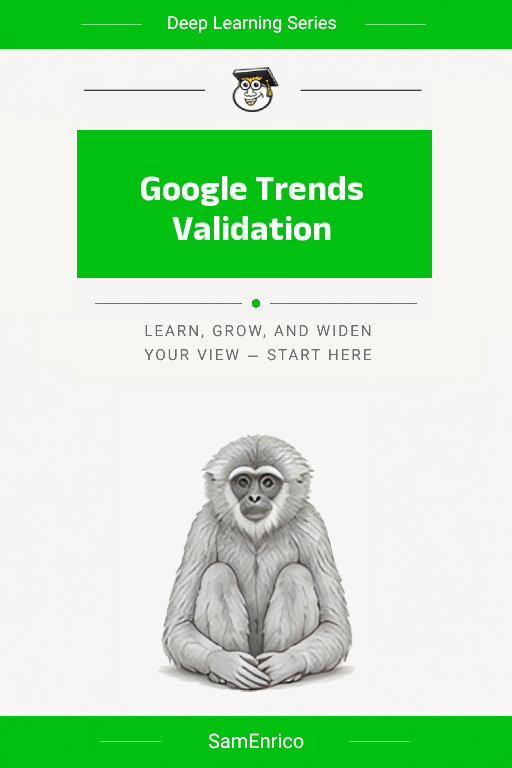
Google Trends Validation eBook
Use free Google Trends to validate market demand.
Use free Google Trends to validate market demand. Analyze search interest over time.
Formats
Free sample
Chapter 1: The $100 Billion Lie--–- The year I lost $47,000 learning that "everyone wants this" means absolutely nothing.It was 2018, and I was sitting in a coffee shop in Austin, Texas, holding a prototype that I believed would change the way people hydrated forever. The product was a collapsible, dishwasher-safe, insulated water bottle that fit in a back pocket. I had spent nine months of my life and $47,000 of my savings developing it. My friends loved it. My family said it was genius.
A focus group of thirty-two runners told me they would "definitely buy it." I had testimonials. I had a landing page. I had a manufacturer in China on retainer.What I did not have was a single customer.I launched the product on a Tuesday morning. I ran Facebook ads. I posted on Instagram.
I emailed my list of two thousand "interested" subscribers. By Friday, I had sold exactly seven units. Three of those were purchased by my mother.I could not understand what had gone wrong. The feedback had been overwhelmingly positive. The product solved a real problem—every runner I knew complained about carrying bulky water bottles.
The price point was reasonable. So why had the market rejected me so completely?Six months later, drowning in debt and self-doubt, I discovered the answer by accident. A mentor asked me a simple question: "Before you built that bottle, did you ever check if anyone was actually searching for it?"I had not. I had trusted opinions over data. I had confused the polite enthusiasm of people who liked me with the cold, hard signal of strangers typing their problems into Google.That mistake cost me forty-seven thousand dollars.
This book exists so you never make the same mistake.The chapter you are about to read will dismantle everything you think you know about validating business ideas. It will show you why traditional methods—asking friends, trusting your gut, running surveys, listening to experts—are not just unhelpful but actively dangerous. And it will introduce you to the only signal that has never lied to me: the quiet, anonymous, massive-scale data of what people actually search for when they think no one is watching.By the end of this chapter, you will never again confuse a compliment with a customer. You will learn the single question that separates a "nice idea" from a "validated problem." And you will take the first step toward becoming the kind of entrepreneur who bets on data, not hope.Let us begin.The Four Lies We Tell Ourselves About Market Demand Before we can talk about the solution—using Google Trends to validate demand—we must first understand the depth of the problem. The problem is not that entrepreneurs are stupid or lazy.
The problem is that our brains are wired to see patterns, hear confirmation, and fall in love with our own ideas. The problem is that the people around us are wired to be nice, to avoid conflict, and to tell us what we want to hear.Together, these two forces create a perfect storm of self-deception. Let me name the four specific lies that every entrepreneur tells themselves before they learn better.Lie #1: "My friends and family said they would buy it."This is the most seductive and dangerous lie of all. Your friends love you. Your family wants you to succeed.
When you show them your brilliant idea, they are not evaluating it objectively. They are evaluating you. And because they care about your feelings, they will almost never say "that is a terrible idea" even when it is.The research on this is devastating. A study published in the Journal of Consumer Research found that when people are asked to evaluate a product idea from someone they know personally, their positive feedback increases by over 300 percent compared to evaluating the same idea from a stranger. They are not lying to be mean.
They are lying to be kind.But kindness in feedback is cruelty in business. Every "I would buy that" from a friend is a small death for your future business, because it replaces real market data with comforting fiction.I learned this the hard way with my water bottle. Twenty-three friends told me they would buy it. Exactly zero of them did. Not one.
They loved me. They just did not love my product enough to open their wallets.The solution is brutal but simple: stop asking people who know you. Their opinions are structurally worthless for validation. If you must ask for feedback, ask strangers. Better yet, do not ask at all.
Watch what people do, not what they say.Lie #2: "My gut has never steered me wrong."Ah, the gut. The mysterious oracle of entrepreneurial intuition. The voice that tells you to quit your job, start a company, and ignore all evidence to the contrary. The gut feels so right. It is so compelling.
And it is almost always wrong when it comes to predicting market demand.There is a reason for this. Your gut instinct is based on your personal experience, your social circle, and your exposure to media. Unless you are a perfect statistical average of the entire population—and you are not—your gut is systematically biased toward what you already know and like.I call this the "Founder's Blind Spot." You become so immersed in your idea, so convinced of its brilliance, that you lose the ability to see it from the outside. Every piece of ambiguous information gets interpreted as confirmation. Every doubt gets rationalized away.The most successful entrepreneurs I know have learned to treat their gut with deep suspicion.
They do not ignore it entirely—intuition has a role in creativity and vision—but they never, ever use it as validation. They use data to test their gut, not the other way around.Lie #3: "I ran a survey and 84% said yes."Surveys feel like real research. They have numbers. They have percentages. They look scientific.
This makes them even more dangerous than friends and family, because they come dressed in the clothes of objectivity while delivering the same lies.The problem with surveys is not the format. It is the fundamental nature of the question. When you ask someone "would you buy this product?" you are asking them to predict their future behavior. Humans are spectacularly bad at this. We overestimate how much we will exercise, underestimate how much we will eat, and confidently claim we will buy things that we will absolutely forget about thirty seconds later.There is a famous study in behavioral economics where researchers asked consumers if they would buy a new type of cookie.
Eighty-seven percent said yes. When the cookies were actually placed in front of them with a price tag, less than 20 percent purchased. The gap between stated intention and actual behavior is enormous and predictable.The only thing a survey measures is how willing someone is to be polite to a stranger holding a clipboard. It does not measure demand. It does not measure purchase intent.
It measures politeness.If you have ever made a business decision based on a survey, you have made a decision based on a lie.…
This is the end of the free sample. Get the eBook to keep going. Buy now
About this book
Details
- Author
- Espinoza Irish
- Publisher
- SamEnrico
- Language
- English
- Genre
- Non-Fiction, Startup Guide, Lean Methodology
- Released
- 2026-05-30
- Pages (approx.)
- 157
- Available as
- eBook, Audiobook

Read better in the ZLOADR app
Your eBooks on your phone or tablet. Sign in with your SamEnrico account and start reading.
More by Espinoza Irish
 Sales Executive Quota StressEspinoza Irish$11.99
 The Anti Imposter MethodEspinoza Irish$11.99
 The IBS Disclosure GuideEspinoza Irish$11.99
 Parental Anger and Peer RejectionEspinoza Irish$11.99
 The Relapse Prevention for AlcoholEspinoza Irish$11.99
 The Starkeepers of Axum: Guardians of the CosmosEspinoza Irish$11.99
 Understanding Thumb Absence Hypoplastic HallucesEspinoza Irish$17.99
 Payment Outlook for Exporters 2026Espinoza Irish$12.99
 Robotics EngineerEspinoza Irish$11.99
 How to Start a Double Bass Business (Beginners Guide)Espinoza Irish$11.99
You may also like
 Lean Business Plan TemplateSwart Jannette$11.99
 No Money Idea Validation GuideLevy Joel$12.99
 Zero Cost Pivot GuideJoyner Cammie$12.99
 Solution Interview TechniqueCreech Blythe$12.99
 Reddit Validation MethodBarnette Ellie$12.99
 Quora Question ValidationMcmanus Jenifer$12.99
 Problem Interview TechniqueCordero Mafalda$12.99
 MVP Without Coding GuideRoche Alejandra$12.99
 LinkedIn Poll ValidationMojica Gavin$12.99
 Google Forms Survey GuidePuente Micah$12.99
 Free YouTube Channel GuideNixon Odette$12.99
 Free Video Validation GuideMcallister Tosha$12.99