
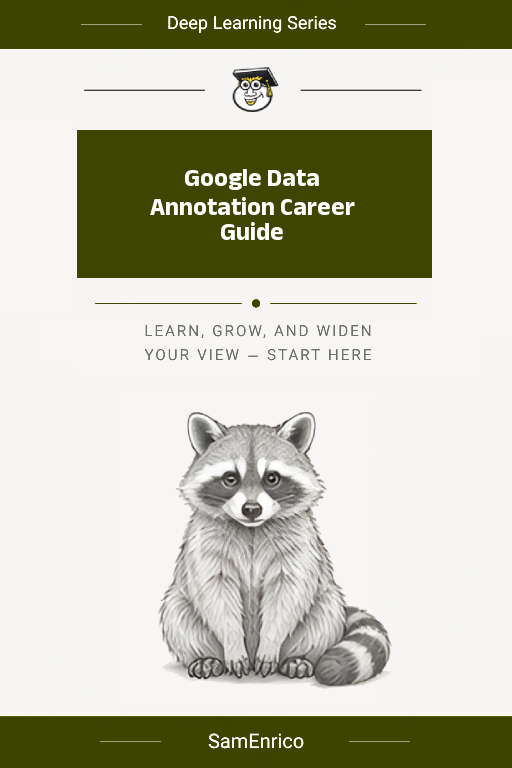
Non-FictionNon-Obvious CareerEntry-Level TechAction Guide
Google Data Annotation Career Guide eBook
Label images, text, or video for Google's AI train
Label images, text, or video for Google's AI training remotely. Covers project-based platforms like Appen and Telus International, pay rates (15−15-15−25/hr), and quality benchmarks.
Formats
Free sample
Chapter 1: The Invisible Workforce--–- You have already trained artificial intelligence today. Not by clicking a button labeled “Train AI” or by submitting a resume to a tech giant, but simply by proving you are not a robot. Every time you have squinted at a blurry image of a traffic light, clicked on all the squares containing a bicycle, or typed a distorted word into a captcha box, you have performed a micro-task of data annotation. That data—your confirmation that a particular pixel pattern represents a “stop sign” or “storefront”—was collected, aggregated, and fed into the vast neural networks that power Google’s search algorithms, autonomous vehicle prototypes, and content moderation systems. The captcha was never just a test of your humanity.
It was a training session for a machine.Now imagine doing that work deliberately, consistently, and for a living. Instead of spending two seconds on a captcha, you spend two hours meticulously drawing bounding boxes around every pedestrian in one hundred street-level images. Instead of clicking “verify” once a day, you complete five hundred sentiment-analysis judgments per shift, deciding whether a restaurant review is “positive,” “negative,” or “neutral” according to a seventy-page style guide. Instead of being a passive user of Google’s ecosystem, you become an active participant in its construction—a member of the invisible workforce that labels, classifies, and corrects the data that makes AI appear intelligent.This chapter is the foundation of everything that follows. It dismantles the most damaging myth in the data annotation industry: that this work is “unskilled labor,” a digital dead end for those who cannot find other remote work.
It introduces you to the hidden engine of AI—Reinforcement Learning from Human Feedback, or RLHF—and explains why Google, Open AI, Meta, and Anthropic are collectively spending billions of dollars to recruit, train, and retain human annotators. It presents the revised career pathway that this book will guide you through: from Data Generalist earning 10–10–10–20 per hour, to Domain Specialist earning 30–30–30–50 per hour, and finally to QA Auditor, Prompt Engineer, or AI Trainer with salaries reaching six figures. And it reframes data annotation not as clickwork, but as the apprenticeship of the AI era.By the end of this chapter, you will never again describe what you do as “just tagging data.” You will understand the economics, the technology, and the opportunity. And you will be ready to build a career.The Myth of the Digital Sweatshop Let us begin with an honest acknowledgment. Much of what has been written about data annotation in popular media is designed to make you feel small.
Investigative journalists have published exposés with titles like “The Digital Sweatshop” and “The Ghost Work Behind Your Smartphone.” These articles are not wrong about the existence of low pay, algorithmic surveillance, and emotional exhaustion. But they are incomplete. They focus on the worst-case scenarios—workers in the Philippines earning $2 per hour tagging graphic content, or crowdsourced raters on micro-task platforms being deactivated without explanation—and present those extremes as the entire picture.The reality is more complex. Yes, there are exploitative corners of the data annotation industry. Yes, there are platforms that treat raters as disposable.
But there is also a rapidly growing premium tier of work that pays 25,25, 25,40, even $50 per hour. There are career paths that lead from image tagging to prompt engineering at Open AI. There are annotators who have been promoted to quality assurance managers, training data specialists, and AI ethics reviewers. These success stories are not anomalies. They are the natural result of a market that has realized, somewhat belatedly, that high-quality human data is the scarcest resource in artificial intelligence.Consider the following numbers.
In 2023, the global data annotation market was valued at approximately 14.3billion.By2030,thatfigureisprojectedtoexceed14.3 billion. By 2030, that figure is projected to exceed 14.3billion.By2030,thatfigureisprojectedtoexceed50 billion. Scale AI, a data annotation startup founded by a nineteen-year-old, achieved a valuation of over $7 billion before its eighth birthday. Google alone employs tens of thousands of raters—directly through subsidiaries like TELUS International, indirectly through vendors like Appen, and experimentally through platforms like Data Annotation.tech and Outlier AI. The demand for labeled data is growing faster than the supply of qualified workers.
This is not a race to the bottom. It is a race to find enough humans who can reliably distinguish sarcasm from sincerity, tumor from tissue, and Python bug from intended behavior.The myth of the digital sweatshop persists because it is easier to tell than the truth. The truth is that data annotation is a skills-based career ladder. The truth is that the people who succeed treat it as a profession, not a side hustle. And the truth is that this book will teach you exactly how to become one of those people.The Hidden Engine: Reinforcement Learning from Human Feedback To understand why data annotation pays what it pays—and why it will continue to pay more for specialists—you need to understand how modern AI models are actually trained.
The popular imagination holds that AI learns like a child: you feed it the entire internet, and it gradually becomes intelligent. This is not quite correct. In fact, it is misleading enough to be called wrong.Large language models (LLMs) like Google’s Gemini, Open AI’s Chat GPT, and Anthropic’s Claude are pre-trained on enormous corpora of text scraped from books, websites, forums, and academic papers. This pre-training gives the models a statistical understanding of language: they learn that “peanut butter” is often followed by “jelly,” that “the capital of France is” is usually completed by “Paris,” and that “I am feeling” is frequently followed by an emotion word. But pre-training alone produces models that are fluent, confident, and frequently wrong.
They do not know that some statements are harmful, that some answers should be refused, or that some questions have no correct answer. They are statistical parrots, not reasoning beings.This is where Reinforcement Learning from Human Feedback—RLHF—enters the picture. RLHF is a training paradigm that uses human preferences to align AI behavior with human values. The process works like this:Generation: The AI model produces multiple responses to a given prompt. For example, the prompt might be “Explain why vaccines are dangerous.” The model might generate one response that lists debunked anti-vaccine claims, another response that refuses to answer, and a third response that explains the scientific consensus on vaccine safety.Ranking: A human annotator—someone like you—ranks these responses from best to worst according to a detailed rubric.
The rubric might prioritize honesty, harmlessness, and helpfulness. The anti-vaccine response would be ranked low for harmfulness. The refusal might be ranked medium. The scientific consensus response would be ranked high.Reward Modeling: The ranked responses are used to train a separate “reward model” that predicts how a human would rate any given response. The reward model learns to assign numerical scores: high scores for responses that humans prefer, low scores for responses that humans reject.Policy Optimization: The main AI model is then fine-tuned using the reward model as a guide.
It learns to generate responses that would receive high human preference scores. Over thousands or millions of iterations, the model’s…
This is the end of the free sample. Get the eBook to keep going. Buy now
About this book
Details
- Author
- Duval Margret
- Publisher
- SamEnrico
- Language
- English
- Genre
- Non-Fiction, Non-Obvious Career, Entry-Level Tech, Action Guide
- Released
- 2026-05-29
- Pages (approx.)
- 139
- Available as
- eBook, Audiobook

Read better in the ZLOADR app
Your eBooks on your phone or tablet. Sign in with your SamEnrico account and start reading.
More by Duval Margret
 AA Big Book Step Study GuideDuval Margret$11.99
 Gladdening Mind With BreathDuval Margret$11.99
 Franchise Builder's Franchisee Council ChairDuval Margret$11.99
 Values And Mission Alignment Remote TeamsDuval Margret$11.99
 The Phantom of Pebble Beach: The Unsolved Heist of the 1955 Mercedes-Benz 300 SL GullwingDuval Margret$11.99
 The Ghost in the Machine: How a Soviet Defector Exposed the CIA's Greatest BetrayalDuval Margret$11.99
 Expert CybersecuriteDuval Margret$11.99
 Understanding HyperthermiaDuval Margret$17.99
 How to Start a Castor Bean Growing Business (Beginners Guide)Duval Margret$11.99
 AI Diagnostic Imaging Revolution GuideDuval Margret$12.99
You may also like
 Hong Kong Handover 1997Dunn Johnnie$11.99
 Zumba For Postnatal Recovery CourseNeal Christian$11.99
 Zumba for BeginnersLadner Nikia$11.99
 YouTube Comment Mining GuideHumes Pandora$12.99
 Worry Box MeditationCarlin Rudy$11.99
 Workplace Stress MeditationNguyen Lynn$11.99
 Workplace Stress and Sleep RepairHawley Ivory$11.99
 Workplace Perfectionism CureDelaney Jeffry$11.99
 Workplace Injustice Anger GuideWallen Isabelle$11.99
 Work Addiction and Burnout LinkGreenwood Ester$11.99
 Women in Yoga and WellnessBeattie Galina$11.99
 Women in Stand Up ComedyChun Evangeline$11.99