
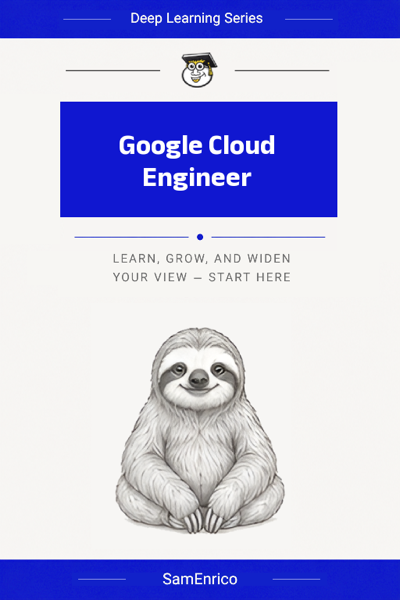
Non-FictionInformativeEducational
Google Cloud Engineer eBook
A Coursebook on Google Cloud Engineer
A Coursebook on Google Cloud Engineer
Formats
Free sample
Chapter 1: Cattle, Not Pets...--The first time I watched a production server get terminated by an automated script, my stomach dropped. I had spent three days hand-configuring that machine—tweaking kernel parameters, installing monitoring agents, and carefully documenting every change in a wiki that nobody would ever read again. The script didn't care about my documentation. It didn't care that I had named the server "web-prod-01-fragile-handle-with-care." The script saw that the instance was running an obsolete base image, marked it for replacement, and killed it without a moment of hesitation. My carefully crafted snowflake server was gone in sixty seconds.That was the moment I understood cloud engineering.The data center mindset treats servers like rescued pets.
Each one has a name, a personality, and a set of quirks you have learned to live with. You nurse them back to health when they get sick. You hesitate to reboot them because you are not entirely sure they will come back. You have a special folder of scripts that only work on that specific machine because of something you installed years ago and forgot to document.The cloud engineering mindset treats servers as cattle. Cattle are numbered, not named.
If one gets sick, you do not call a veterinarian—you replace it. If one wanders off, you do not go looking for it—you spin up a new one from the herd. The individual animal is disposable. The herd is what matters.This book exists to turn you into a cattle rancher.Welcome to Google Cloud Engineer: A Coursebook. This is not a certification cram guide, though you will absolutely pass the Associate Cloud Engineer exam if you work through these twelve chapters.
This is a career transformation manual. By the time you finish the final capstone project, you will think differently about infrastructure. You will automate things that used to terrify you. You will stop treating servers like fragile snowflakes and start treating them like the interchangeable commodities they are.And you will never name a production server again.The Three Mindset Shifts That Separate Cloud Engineers From Everyone Else Before we write a single line of code or click a single button in the Google Cloud Console, we need to rewire how you think about infrastructure. Technical skills get outdated every eighteen months.
Mindset survives every technology cycle.Shift One: From Capital Expenditure to Operational Expenditure In the old world, building a data center meant writing a million-dollar check before you had a single user. You bought servers that you hoped would be enough for next year's growth. You paid for cooling, power, physical security, and a team of people to swap failed hard drives. This is capital expenditure (Cap Ex)—spending money on physical assets that depreciate over time.In the cloud world, you pay only for what you use. Need one hundred servers for an hour to run a batch job?
You can have them in sixty seconds and destroy them when the job finishes. This is operational expenditure (Op Ex)—paying for services as you consume them, like electricity or water.Why does this matter for an engineer? Because the financial model drives technical decisions. When servers are expensive capital assets, you keep them running forever. You run every service on the same machine because you paid for it anyway.
When servers are hourly rental charges, you turn them off when they are idle. You build systems that scale to zero when nobody is using them.Real-world example: A startup I advised was running a staging environment on twenty-four hours a day, seven days a week, three hundred sixty-five days a year. Their monthly cloud bill was 4,700.Afterweimplementedscheduledshutdownsthatturnedoffthestagingenvironmenteverynightandallweekend,theirbilldroppedto4,700. After we implemented scheduled shutdowns that turned off the staging environment every night and all weekend, their bill dropped to 4,700.Afterweimplementedscheduledshutdownsthatturnedoffthestagingenvironmenteverynightandallweekend,theirbilldroppedto1,100. They saved 3,600permonth—over3,600 per month—over 3,600permonth—over40,000 per year—by changing nothing except their mindset about when resources needed to exist.Shift Two: From Manual Provisioning to API-Driven Infrastructure The old way: Someone submits a ticket requesting a new server.
A systems administrator logs into a management console, clicks through fifteen screens, selects an operating system, configures storage, assigns an IP address, and documents the new server in a spreadsheet. This takes three days if everyone is fast.The cloud way: You write a configuration file that describes exactly what you want. You run a command. Sixty seconds later, the server exists. You run the same command in a different region.
Sixty seconds later, an identical server exists there too. You check the configuration file into source control. Now every change to the infrastructure is reviewed, approved, and auditable.Why this changes everything: When infrastructure is API-driven, you can test changes before making them. You can roll back to a previous configuration when something breaks. You can create a complete copy of your production environment in a different region with one command.
The same APIs that Google engineers use to manage their own global infrastructure are available to you, right now, for the cost of the resources you create.Shift Three: From Pets to Cattle We opened with this metaphor for a reason. It is the single most important conceptual leap you will make as a cloud engineer.Pet servers:Have unique names like "prod-web-01" or "db-master-important"Are configured manually over months Contain accumulated cruft from years of updates Cannot be replaced without hours of work Keep developers awake at night wondering if a disk will fail Cattle servers:Have generic names generated by autoscalers like "mig-instance-7x2q9"Are created from immutable base images Never receive manual changes (if something needs to change, you build a new image)Can be destroyed and recreated automatically Let developers sleep through the night because automation handles failures The test: Go look at your current infrastructure. If you can identify individual servers by name and you would be upset if any particular one disappeared, you have pets. If you have a hundred identical servers and losing three of them would not even cause an alert because the autoscaler would replace them immediately, you have cattle.By the end of this book, everything you build will be cattle.The Shared Responsibility Model: Who Owns What One of the most common mistakes new cloud engineers make is assuming that because they are using Google Cloud, Google will secure everything for them. This is dangerously wrong.Google secures the cloud.
You secure what you put in the cloud.Layer Responsible Party What This Means Physical data centers Google Guards, biometrics, backup generators, fire suppression Network infrastructure Google Fiber cables, routers, switches, DDo S mitigation Hypervisors Google Isolation between customer VMs on the same physical server Operating system patches (Google-managed services)Google GKE Autopilot nodes, Cloud SQL maintenance Operating system patches (your VMs)Youapt-get update or equivalent on every Compute Engine instance Application code You No vulnerabilities, no hardcoded credentials, proper input validation Data encryption (at rest)Shared Google encrypts disks by default; you manage your own keys for customer-managed encryption Access management You Who can do what to which resources (covered in depth in Chapter 3)Network security (firewalls, private IPs)You Defining who can connect to your resources A story you will remember…
This is the end of the free sample. Get the eBook to keep going. Buy now
About this book
Details
- Author
- Linder Danilo
- Publisher
- SamEnrico
- Language
- English
- Genre
- Non-Fiction, Informative, Educational
- Released
- 2026-05-11
- Pages (approx.)
- 159
- Available as
- eBook, Audiobook

Read better in the ZLOADR app
Your eBooks on your phone or tablet. Sign in with your SamEnrico account and start reading.
More by Linder Danilo
 Curie Einstein FriendshipLinder Danilo$11.99
 The Gambling Craving Timer WorkbookLinder Danilo$11.99
 Cognitive Restructuring for DriversLinder Danilo$11.99
 Daily Review for Healthcare WorkersLinder Danilo$11.99
 Wrestling Bridge and Arch FlexibilityLinder Danilo$11.99
 The Last Voyage of the SS America: A Mind Palace of DisasterLinder Danilo$11.99
 Neon Ghosts: The AI That Predicted the FutureLinder Danilo$11.99
 Understanding BaritosisLinder Danilo$17.99
 One Page Market Expansion PlanLinder Danilo$12.99
 Boomer Hobby Spending PatternsLinder Danilo$12.99
 10 Ways to Use Chicken Thigh (Recipe Book)Linder Danilo$11.99
You may also like
 Hong Kong Handover 1997Dunn Johnnie$11.99
 Zumba For Postnatal Recovery CourseNeal Christian$11.99
 Zumba for BeginnersLadner Nikia$11.99
 YouTube Comment Mining GuideHumes Pandora$12.99
 Worry Box MeditationCarlin Rudy$11.99
 Workplace Stress MeditationNguyen Lynn$11.99
 Workplace Stress and Sleep RepairHawley Ivory$11.99
 Workplace Perfectionism CureDelaney Jeffry$11.99
 Workplace Injustice Anger GuideWallen Isabelle$11.99
 Work Addiction and Burnout LinkGreenwood Ester$11.99
 Women in Yoga and WellnessBeattie Galina$11.99
 Women in Stand Up ComedyChun Evangeline$11.99