
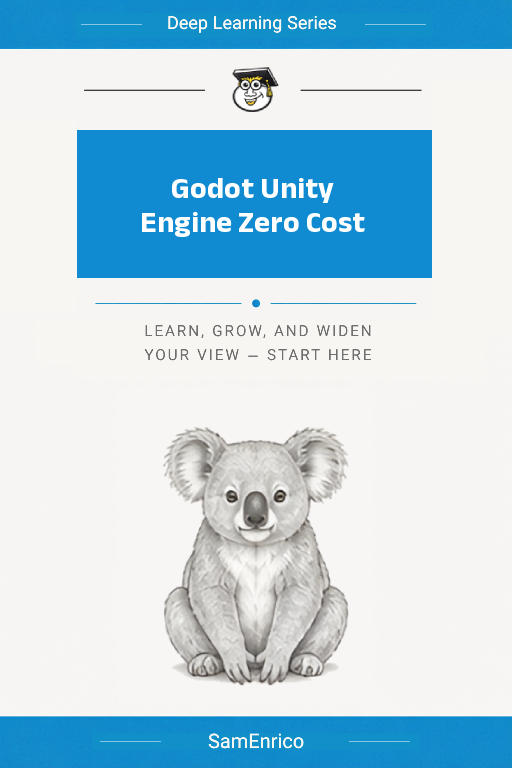
Non-FictionStartup GuideGame Development
Godot Unity Engine Zero Cost eBook
Build and ship video games using free Godot Engine
Build and ship video games using free Godot Engine. This guide replaces costly game development platforms for indie developers without royalties.
Formats
Free sample
Chapter 1: The $85 Billion Wake-Up Call...--–- On September 12, 2023, an estimated 1.2 million game developers woke up to an email that would fundamentally alter the economics of their industry. Unity Technologies, the engine powering nearly 70% of all mobile games and beloved by indie developers for its "democratizing" free tier, announced the Runtime Fee Policy. The message was simple but devastating: every time a player installed a game built with Unity, the developer would owe a fee. Not a percentage of revenue. Not a subscription increase. A per-install tax.The reaction was immediate and visceral. Developers of free-to-play games realized they could owe more in fees than they earned from ads. Viral hits calculated their potential liability in the millions. One developer, whose game had been pirated thousands of times, realized Unity would charge him for illegal copies. Within 48 hours, Unity's stock price dropped 7%. Within one week, dozens of high-profile indie studios publicly announced they were exploring other engines. Within one month, Godot—an open-source engine that had been quietly improving for nearly a decade—saw its Git Hub stars increase by 400% and its monthly active users triple.This book exists because of that week. And because of a question that every indie developer now must answer: Why would you build your business on a foundation that can change the rules overnight?The Myth of "Free Until You Succeed"Before we write a single line of code, before we install Godot, before we even define what a "node" is, we need to understand the economic reality of game development in 2026. The landscape has shifted. The old assumption—that you start with free tools and pay only when you succeed—has been revealed as a trap disguised as generosity.Let me be brutally clear about what Unity's "free until you make $200K" actually means. You do not get a free engine. You get a free trial of an engine attached to a ticking financial bomb. The moment your game crosses that threshold—the moment you have proven your concept works—you are suddenly subject to terms that can change retroactively. The 2023 Runtime Fee was not the first such change. In 2016, Unity introduced mandatory splash screens for free users. In 2019, they changed their pricing tiers. In 2022, they altered their revenue reporting requirements. Each time, developers who had already shipped games found themselves legally bound to new terms they never agreed to.Godot's MIT License offers something fundamentally different: stability. The license cannot be revoked. The terms cannot be changed retroactively. No future board of directors, no pressure from shareholders, no quarterly earnings report can alter the deal you made the day you started your project. The code you build today will remain free forever. Your royalties will always be zero. Your engine will never demand a cut of your success.The Mathematics of Survival Let me show you the numbers that most developers don't calculate until it's too late. Consider a moderately successful indie game that sells 100,000 copies at 15eachon Steam,generating15 each on Steam, generating 15eachon Steam,generating1.5 million in gross revenue before Steam's 30% cut. After Steam takes its 450,000,youhave450,000, you have 450,000,youhave1,050,000.Under Unity's current subscription model (as of 2026), you would pay 2,040peryearfora Unity Prolicenseperseat.Ifyou′reatwo−personteam,that′s2,040 per year for a Unity Pro license per seat. If you're a two-person team, that's 2,040peryearfora Unity Prolicenseperseat.Ifyou′reatwo−personteam,that′s4,080 annually. If your game took two years to build, that's 8,160beforeyousoldasinglecopy.Then,ifyourgamecrossesthe8,160 before you sold a single copy. Then, if your game crosses the 8,160beforeyousoldasinglecopy.Then,ifyourgamecrossesthe200K revenue threshold (which it has), you owe Unity a royalty—currently 2.5% of revenue above 1million,orapproximately1 million, or approximately 1million,orapproximately26,250 on our 1.5milliongross.Totalenginecost:1.5 million gross. Total engine cost: 1.5milliongross.Totalenginecost:34,410.But here's the hidden cost. To access Unity's console export capabilities (which Godot lacks natively), you need Unity Pro. To remove the mandatory "Made with Unity" splash screen, you need Unity Pro. To use advanced profiling tools, you need Unity Pro. The "free" tier is free only as long as you remain unprofitable, amateur, and unambitious. The moment you succeed, you pay.Now consider the same game built with Godot. Zero dollars for the engine. Zero dollars for royalties. Zero dollars per seat. Zero dollars for any feature—profiling, debugging, mobile export, desktop export, web export. The only cost is your time. And your time, unlike Unity's fees, is under your control.The Royalty Comparison Table (Projected Gross Revenue)Gross Revenue Unity Pro Cost (2 years, 2 seats)Unity Royalties Total Unity Cost Godot Cost$0 (hobby)$0$0$0$0$50,000$8,160$0$8,160$0$200,000$8,160$0$8,160$0$500,000$8,160$7,500$15,660$0$1,500,000$8,160$26,250$34,410$0$5,000,000$8,160$100,000$108,160$0The pattern is clear. The more successful you become, the more you pay. Godot's economic model is the inverse: the more successful you become, the more you keep.The Commercial Viability Question Every developer considering Godot asks the same question: Can I actually ship a commercial game with this? The answer, as of 2026, is not just yes—it's that Godot has become the preferred platform for cost-conscious indie developers who refuse to give up a percentage of their hard-earned revenue.Let me introduce you to three developers who bet on Godot and won.Case Study 1: Cassette Beasts (Bytten Studio) – This open-world monster-fusing RPG launched on Steam, Switch, and Xbox in 2023 to critical acclaim, holding a 91% positive rating on Steam. It was built entirely in Godot. The developers chose Godot not for ideological reasons but for practical ones: they were a small team with limited budget and couldn't afford Unity's per-seat licenses during their two-year development cycle. Godot's MIT license meant they could hire contractors without purchasing additional seats, scale up and down as needed, and focus their budget on art and sound rather than engine fees. The game sold over 300,000 copies in its first six months. Every dollar of that revenue stayed with the studio.Case Study 2: Sonic Colors: Ultimate (Sega) – When Sega decided to remaster a classic Sonic game for modern consoles, their internal team evaluated three engines: Unity, Unreal, and Godot. They chose Godot for a surprising reason: the engine's lightweight build size meant faster iteration cycles. The team could export a test build to Switch in under 90 seconds, compared to over 5 minutes with Unity. Over a two-year development cycle, that efficiency saved thousands of hours of developer waiting time. Sega has since quietly adopted Godot for multiple internal projects.Case Study 3: Cruelty Squad (Consumer Softproducts) – This cult hit, described as "an immersive sim with the visual aesthetic of a corporate Power Point from hell," was built by a single developer using Godot. The game sold over 200,000 copies and became a critical darling, featured in PC Gamer, Rock Paper Shotgun, and The New York Times. The developer has stated publicly that if they had been forced to pay Unity royalties, the game would never have been profitable. Godot's zero-cost model allowed them to take creative risks that would have been financially impossible otherwise.These are not edge cases. As of 2026, over 1,500 commercial games have been released on Steam using Godot, generating cumulative revenue in the hundreds of millions. The engine has proven itself across every genre: 2D platformers, 3D RPGs, puzzle games, simulation games, roguelites, and even VR experiences.The "Free" Trap: Why Unreal Isn't Better Before we commit to Godot, let me address the elephant in the room. If Unity charges fees, why not switch to Unreal Engine? Unreal's…
This is the end of the free sample. Get the eBook to keep going. Buy now
About this book
Details
- Author
- Stpierre Marcell
- Publisher
- SamEnrico
- Language
- English
- Genre
- Non-Fiction, Startup Guide, Game Development
- Released
- 2026-05-30
- Pages (approx.)
- 132
- Available as
- eBook, Audiobook

Read better in the ZLOADR app
Your eBooks on your phone or tablet. Sign in with your SamEnrico account and start reading.
More by Stpierre Marcell
 Waco Media CoverageStpierre Marcell$11.99
 Hillary Canadian Arctic CanoeStpierre Marcell$11.99
 RLS Essential Oils Aromatherapy GuideStpierre Marcell$11.99
 Family Emergency Communication PlanStpierre Marcell$11.99
 NVC For Grief GuideStpierre Marcell$11.99
 Cash Flow for ExportersStpierre Marcell$11.99
 Catherine the Great's Reform ManualStpierre Marcell$11.99
 Responsibility Pie ChartingStpierre Marcell$11.99
 Boundaries For Success SeekersStpierre Marcell$11.99
 The Caravels of Destiny: Portugal’s Empire of the SeasStpierre Marcell$11.99
 Hops & Rebellion: The Untold Story of the Beer That Fueled a RevolutionStpierre Marcell$11.99
 The Frozen Symphony: The Unsung Heroine of the Titanic’s Last HoursStpierre Marcell$11.99
You may also like
 Hong Kong Handover 1997Dunn Johnnie$11.99
 Zumba For Postnatal Recovery CourseNeal Christian$11.99
 Zumba for BeginnersLadner Nikia$11.99
 YouTube Comment Mining GuideHumes Pandora$12.99
 Worry Box MeditationCarlin Rudy$11.99
 Workplace Stress MeditationNguyen Lynn$11.99
 Workplace Stress and Sleep RepairHawley Ivory$11.99
 Workplace Perfectionism CureDelaney Jeffry$11.99
 Workplace Injustice Anger GuideWallen Isabelle$11.99
 Work Addiction and Burnout LinkGreenwood Ester$11.99
 Women in Yoga and WellnessBeattie Galina$11.99
 Women in Stand Up ComedyChun Evangeline$11.99