
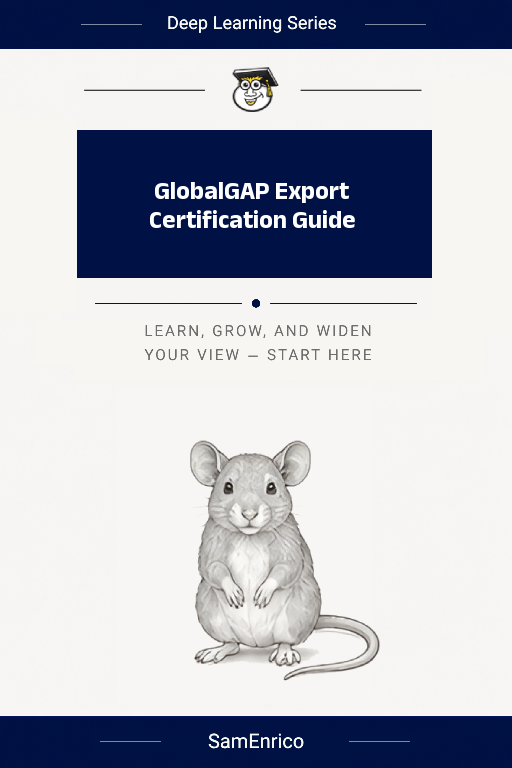
GlobalGAP Export Certification Guide eBook
Obtain GlobalGAP for fresh produce exports to Euro
by Rico Lavina
Obtain GlobalGAP for fresh produce exports to European retailers, completing food safety and environmental modules for supermarkets like Tesco and Carrefour.
Formats
Free sample
Chapter 1: The Golden Key--–- In 2019, a third-generation avocado farmer named James in central Kenya watched a €2 million contract disappear in a single email. The buyer from Carrefour wrote: "We regret to inform you that your national GAP certificate does not meet our minimum requirements for supplier registration. Please reapply when you hold valid Global GAP certification." James had the fruit. He had the packing house. He had the relationships.
What he did not have was a piece of paper that would have cost him €3,500 and eight weeks to obtain. That piece of paper was Global GAP. And without it, his avocados never left the farm gate.This is not a story about bureaucracy. It is a story about market access. Across Europe, from the produce aisles of Tesco in London to the hypermarkets of Carrefour in Paris and the Albert Heijn stores in Amsterdam, Global GAP has become the single non-negotiable requirement for fresh produce suppliers.
It is not the most stringent standard. It is not the most comprehensive standard. It is the gateway standard. And without it, you cannot even begin the conversation.The purpose of this chapter is to answer three questions that every fresh produce exporter asks when first encountering Global GAP. First: why has this particular standard become mandatory for European retail, while dozens of other national and international GAP programs remain optional?
Second: what exactly does Global GAP certify, and how does it differ from other food safety standards that you may have already encountered? Third: how does the standard connect to the specific requirements of the retailers you actually want to sell to – Tesco, Carrefour, Albert Heijn, and others – and what will it cost you in time and money to get certified?By the end of this chapter, you will understand why Global GAP is called the "golden key" to European supermarket shelves. You will know which retailers require which specific modules. And you will have a clear roadmap for the certification journey that the rest of this book will guide you through step by step.The Birth of a Standard: From Retailer Frustration to Global Benchmark To understand why Global GAP exists, you must first understand the problem that created it. In the mid-1990s, European retailers faced an impossible situation.
Each country had its own Good Agricultural Practices standards. France had one system. Germany had another. The United Kingdom had a third. Spain and Italy each had multiple regional standards.
For a retailer like Tesco, which sources from dozens of countries across multiple continents, verifying that every farm met every standard was operationally impossible.The breaking point came in 1997. A series of food safety incidents – including the Belgian dioxin crisis and ongoing concerns about pesticide residues – caused several major retailers to announce that they would only source from certified farms. But certified to which standard? The retailers could not agree. The result was chaos.
Some suppliers held five different certificates for the same farm, each requiring separate audits, separate fees, and separate paperwork. Others held no certificates at all and were simply excluded from entire markets.In response, a consortium of European retailers – including Tesco (UK), Carrefour (France), Migros (Switzerland), and later Albert Heijn (Netherlands) – formed the Euro-Retailer Produce Working Group. Their goal was simple: create a single, unified standard for good agricultural practices that all retailers would accept. In 2001, they launched EUREPGAP, which stood for Euro-Retailer Produce Good Agricultural Practices. The name was later changed to Global GAP to reflect the standard's worldwide reach, but the core mission remained unchanged: one standard, one audit, one certificate, accepted everywhere.The first version of the standard was relatively simple.
It focused primarily on food safety and traceability. But as food supply chains became more complex and consumer expectations evolved, the standard expanded. Version 3 introduced the comprehensive traceability requirements that now define the standard. Version 4 added the GRASP module for social practices, responding to growing concern about labor conditions in global supply chains. Version 5 consolidated multiple separate modules into the Integrated Farm Assurance framework.
And Version 6, released in 2022, introduced unannounced audits and strengthened environmental criteria.Each version has made the standard more rigorous, but also more valuable. Today, Global GAP certification is accepted by over 200 retailers in more than 40 countries. It is referenced in EU regulations as acceptable evidence of compliance with food safety requirements. And it has become the de facto passport for fresh produce moving across international borders.The GFSI Benchmark: Why Global GAP Stands Alone You may have heard of other food safety standards. BRCGS Food is common among packers and processors.
IFS is popular among branded food manufacturers. SQF is widely used in North America. Each of these standards is benchmarked against the Global Food Safety Initiative (GFSI), which means they meet a common set of requirements for food safety management systems.But here is the critical distinction that most exporters miss: Global GAP is the only GFSI-benchmarked standard designed specifically for primary production – the farm gate. BRCGS and IFS are designed for manufacturing and processing facilities. They assume that you are receiving raw materials, transforming them through a process, and shipping finished goods.
That model works for a juice bottling plant or a frozen vegetable processing line. It does not work for a farm where the "raw material" is growing in a field subject to weather, pests, and seasonal variation.Global GAP is built around the agricultural reality. Its control points address irrigation water, not just facility water. Its traceability requirements follow a punnet of berries back to the specific row and harvest hour, not just to a batch number. Its environmental module considers buffer zones and pollinator protection, not just waste disposal and energy use.
This agricultural focus is what makes Global GAP uniquely valuable to retailers. They are not buying processed goods from a factory. They are buying fresh produce from a farm. And they need assurance that the farm, not just the packing shed, meets food safety standards.The GFSI benchmark also matters for regulatory compliance. Under EU Regulation 2023/2025 on official controls, imported food must be produced and handled under conditions equivalent to EU requirements.
While the regulation does not explicitly name Global GAP, certification to a GFSI-benchmarked standard is widely accepted by EU member states as demonstrating equivalence. In practical terms, this means that Global GAP-certified farms face fewer physical inspections at the border, faster clearance times, and lower risk of shipment rejection. The regulation is discussed in more detail later in this chapter, but for now, understand this: Global GAP is not just a retailer requirement. It is increasingly embedded in European law.Mapping the Market: Which Retailer Requires What Not all European retailers require the same version of Global GAP. Some accept the basic IFA standard with no additions.
Others require specific modules that add dozens of extra control points. Knowing exactly what each retailer demands before you begin the certification process can save you months of wasted effort and thousands of euros in unnecessary audit fees.Tesco – The UK's largest retailer requires Global GAP IFA plus the Tesco Nurture module (formerly called Nature's Choice). The Nurture module adds approximately 40 extra control points on top of the standard IFA requirements. The…
This is the end of the free sample. Get the eBook to keep going. Buy now
About this book
Details
- Author
- Rico Lavina
- Publisher
- SamEnrico
- Language
- English
- Genre
- Non-Fiction, Business Brief
- Released
- 2026-06-01
- Pages (approx.)
- 144
- Available as
- eBook, Audiobook

Read better in the ZLOADR app
Your eBooks on your phone or tablet. Sign in with your SamEnrico account and start reading.
More by Rico Lavina
 The Family Trafficked GirlRico Lavina$11.99
 Hundred Days Offensive BreakdownRico Lavina$11.99
 Disrupt Then Reframe GuideRico Lavina$11.99
 Breaking the Gambling Trance StateRico Lavina$11.99
 Affirmations for Empty NestersRico Lavina$11.99
 Craft Supply HoardingRico Lavina$11.99
 Monsoon Trekking ProtocolRico Lavina$11.99
 Antidepressant RisksRico Lavina$11.99
 The Sky Wolves of the Himalayas: How the Mustang Aviators Defied the Gods (1915-1918)Rico Lavina$11.99
 The Shadow of the Snowy River: Australia's Coldest Case CrackedRico Lavina$11.99
 How to Produce Hooks, Buckles and FastenersRico Lavina$11.99
 Meta Remote Internship GuideRico Lavina$12.99
You may also like
 Hong Kong Handover 1997Dunn Johnnie$11.99
 Zumba For Postnatal Recovery CourseNeal Christian$11.99
 Zumba for BeginnersLadner Nikia$11.99
 YouTube Comment Mining GuideHumes Pandora$12.99
 Worry Box MeditationCarlin Rudy$11.99
 Workplace Stress MeditationNguyen Lynn$11.99
 Workplace Stress and Sleep RepairHawley Ivory$11.99
 Workplace Perfectionism CureDelaney Jeffry$11.99
 Workplace Injustice Anger GuideWallen Isabelle$11.99
 Work Addiction and Burnout LinkGreenwood Ester$11.99
 Women in Yoga and WellnessBeattie Galina$11.99
 Women in Stand Up ComedyChun Evangeline$11.99