
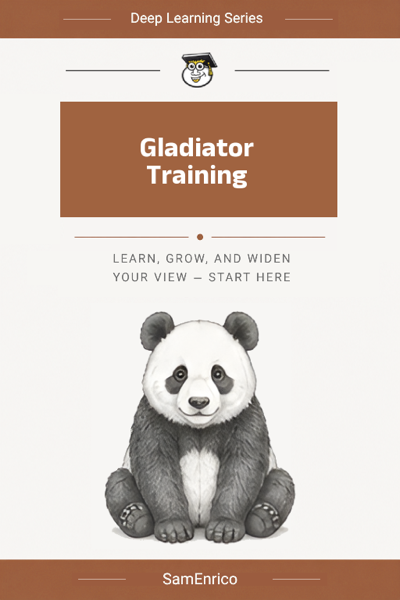
Gladiator Training eBook
A Coursebook on Gladiator Training
A Coursebook on Gladiator Training
Formats
Free sample
Chapter 1: The Living Dead...--The man who walked into the ludus on a hot morning in Capua had already died once. His name was gone—erased from the census rolls, scratched off the family shrine, spoken only in the past tense by the mother who had borne him. In its place, the lanista gave him a stage name: Amazonius, because he had been captured in a skirmish near the Black Sea, where the legends of warrior women still lingered in Roman imaginations. He was twenty-three years old, six feet tall, and had never held a sword before yesterday. By the time he walked out of that training school three years later, he would have fought twelve times in the arena, killed three men, been wounded seven times, and earned enough money to buy his freedom.
But on this morning, standing barefoot in the dirt of the training yard, surrounded by forty other recruits who smelled of fear and unwashed wool, Amazonius was nothing. He was less than nothing. He was a tiro—a raw recruit—and the only thing he owned was a promise carved into a wooden tablet: Uri, vinciri, verberari, ferroque necari. To be burned, to be bound, to be beaten, and to be killed by the sword.He had sworn it voluntarily. That was the strangest part.The Four Gates: How a Man Became a Gladiator The ludus did not care how you arrived, only that you arrived breathing.
Roman training schools accepted four distinct streams of humanity, each entering through a different gate—metaphorically and sometimes literally. The first and largest gate belonged to the servi: slaves bought at market, often prisoners of war from the endless frontier campaigns along the Danube, the Rhine, or the Euphrates. These men (and rarely, but attested in inscriptions, women) had no choice. They were inventory, priced by the lanista based on height, weight, and visible musculature. A tall Germanic tribesman with broad shoulders might fetch ten thousand sesterces; a malnourished Syrian half that.
The lanista was not a philanthropist. He was an investor, and every body in his barracks represented a bet placed against death.The second gate admitted captivi—prisoners of war sentenced directly to the arena as punishment for rebellion. These were the most dangerous recruits, men who had already killed Romans and would happily do so again if given the chance. The lanista kept them chained for the first three months, not out of cruelty but out of arithmetic. One loose captivus could kill two doctores before the guards arrived, and a good trainer cost more than a good fighter.
The third gate was the darkest: the damnati, condemned criminals who had been sentenced to the ludus as an alternative to crucifixion or the mines. Roman law allowed a judge to offer a condemned man a choice—death by execution or death by arena—with the slim promise of a pardon after three years of survival. Most chose the arena. They were called damnati ad ludum, and they were the only recruits who entered the training yard knowing exactly how many days they had left to live.The fourth gate was the strangest, and it is the gate through which Amazonius walked. He was an auctoratus—a free man who voluntarily signed a contract to become a gladiator.
The contract specified his price (usually a signing bonus of three thousand to twelve thousand sesterces, depending on his physique and desperation), the duration of his service (typically three to five years), and the number of fights he was obligated to perform (rarely more than five per year). Auctorati came from every rung of Roman society: bankrupt nobles fleeing their creditors, younger sons with no inheritance, veterans of the legions who missed the rhythm of violence, and occasionally—scandalously—equestrians and even senators who craved the adrenaline rush that no amount of political intrigue could provide. The Emperor Commodus would later fight in the arena as a secutor (though his opponents were given wooden swords, making the contest less a fight than a theatrical execution). But Amazonius was no emperor. He was a failed farmer, a man whose debt had swallowed his land, and the ludus offered him something the fields never had: a way to die rich or live famous.The Sacramentum Gladiatorum—the oath that transformed a free man into a legal nonentity—was not, contrary to popular myth, a declaration of literal death under Roman law.
Gladiators could still own property, marry, inherit, and leave wills. The jurist Gaius, writing in the second century CE, explicitly notes that gladiators retained the capacity to make contracts and receive inheritances. What the oath killed was something more intimate: the recruit's former identity, his social standing, and his protection against violence. By swearing to endure burning, binding, beating, and death by the sword, the auctoratus agreed that no injury inflicted upon him in training or combat would constitute a crime. The lanista could whip him for laziness.
The doctor could break his nose during sparring. The opposing gladiator could open an artery in his thigh. None of it was assault. It was performance.The oath was administered in a small underground chamber beneath the ludus—a room without windows, lit only by a single oil lamp. The recruit stood naked (to prove he carried no hidden weapons) while the lanista read the terms aloud.
A scribe recorded the recruit's responses on a wax tablet. Then the recruit placed his right hand on a bronze statue of Mars, the god of war, and spoke the words that would define the rest of his life: “I will endure to be burned, to be bound, to be beaten, and to be killed by the sword.” The oil lamp flickered. The scribe stamped the tablet. And the man who walked into the chamber emerged as something else entirely: a gladiator, which in Latin means “one who uses a sword,” but which in the streets of Rome meant “the living dead.”The Titulus: Your Name Is Now a Statistic Every gladiator carried his identity on a wooden placard called the titulus—a combination of military dog tag, boxing record, and wanted poster. The titulus was hung outside the recruit's cell door and updated after every fight, every injury, every change in rank.
It contained six pieces of information, and together they tell us more about the psychology of the arena than any literary account.First, the gladiator's stage name. Amazonius. Flamma (“Flame”). Achilleus. Ursus (“Bear”).
These names were chosen by the lanista or, for successful veterans, by the gladiator himself. They were always aggressive, always aspirational, and almost never the gladiator's birth name. The erasure of the original name was deliberate: a man named Gaius Marius who died in the arena brought shame on his family; a man named Amazonius who died brought only a moment of crowd noise and a quick cleanup of the sand.Second, the gladiator's origin. Not his birthplace—that was irrelevant—but his source category: servus (slave), captivus (prisoner of war), damnatus (condemned criminal), or auctoratus (volunteer). This classification determined how the lanista treated him and how the crowd would judge him.
A volunteer who fought poorly was booed for cowardice; a condemned criminal who fought poorly was merely fulfilling his death…
This is the end of the free sample. Get the eBook to keep going. Buy now
About this book
Details
- Author
- Fairley Savanna
- Publisher
- SamEnrico
- Language
- English
- Genre
- Non-Fiction, Informative, Educational
- Released
- 2026-06-02
- Pages (approx.)
- 145
- Available as
- eBook, Audiobook

Read better in the ZLOADR app
Your eBooks on your phone or tablet. Sign in with your SamEnrico account and start reading.
More by Fairley Savanna
 Genetic Risk for Blood ClotsFairley Savanna$11.99
 Low Carb Mediterranean FusionFairley Savanna$11.99
 Business Plan Revision And Iteration GuideFairley Savanna$11.99
 Self Worth Journaling Therapy GuideFairley Savanna$11.99
 Parent Loss Holiday Survival GuideFairley Savanna$11.99
 Blood & Bronze: The Olympic Conspiracy That Shook Ancient GreeceFairley Savanna$11.99
 Bones of the Deep: The Forensic Anthropologists Who Named the MissingFairley Savanna$11.99
 Understanding Giant Platelet SyndromeFairley Savanna$17.99
 How to Start a Baby Carriage Business (Beginners Guide)Fairley Savanna$11.99
 Demeter Biodynamic ExportFairley Savanna$12.99
 Charles Schwab Cash Discount GuideFairley Savanna$12.99