
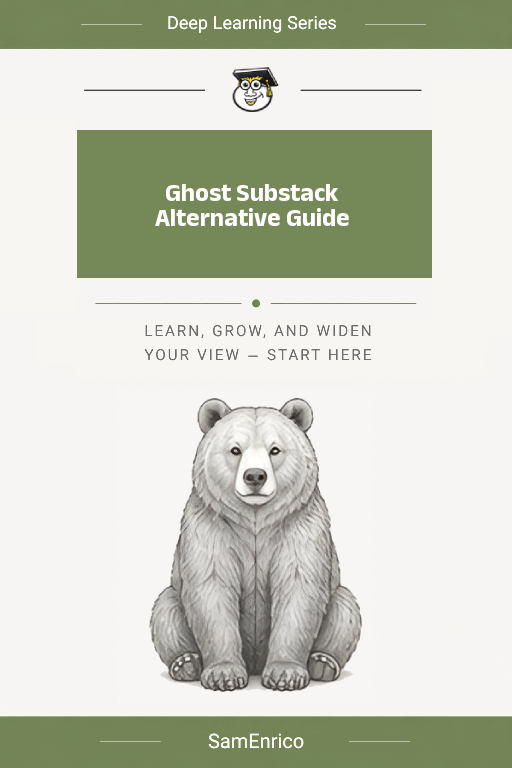
Ghost Substack Alternative Guide eBook
Start newsletter and blog with free Ghost instead
by Peter Candis
Start newsletter and blog with free Ghost instead of paying for Substack or Medium subscriptions.
Formats
Free sample
Chapter 1: The Ownership Illusion--–- In the spring of 2021, a journalist named Casey had built something remarkable. Over eighteen months on Substack, she had grown a newsletter about sustainable architecture to forty thousand free subscribers and nearly two thousand paying members. She was earning roughly eight thousand dollars per month—enough to quit her day job and write full-time. Her publication had become her identity, her livelihood, and her most valuable asset. Or so she believed.–- Then she tried to leave.
A reader had offered to sponsor a special issue, but only if she could guarantee that the email list was hers to take to a custom domain. Casey assumed it was. After all, she had written every word, recruited every subscriber, and built every relationship. When she requested her full subscriber list from Substack, she received a CSV file containing only email addresses—no names, no subscription histories, no custom fields she had added over two years. Worse, when she asked about exporting her paid subscribers' payment information, she was told it was impossible due to "platform policies." Her two thousand paying customers would have to sign up again from scratch, and many would inevitably fall away.–- Casey faced a brutal choice: stay on Substack forever, accept their ten percent revenue share on everything she earned, and never truly own her audience—or leave, rebuild her paid list from nearly zero, and pray that half her readers would follow.
She stayed. But she never stopped wondering what might have been if she had built her publication on her own terms from the beginning.–- This book exists because of Casey, and because of the thousands of creators who discover the same painful truth every year: on platforms like Substack and Medium, you are not the owner. You are a tenant. And tenants pay rent forever, follow the landlord's rules, and leave with nothing but what they can carry in a small CSV file.–- The Ghost Substack Alternative Guide is not a technical manual, though you will find plenty of technical instruction within these pages. It is a manifesto for ownership.
It is a step-by-step roadmap for building a newsletter and blog on Ghost—an open-source, flat-fee platform that gives you complete control over your content, your audience, your design, and your revenue. By the time you finish this book, you will understand why Ghost is the superior alternative to Substack and Medium, how to set it up in under an hour, and how to grow it into a profitable media business that you truly own.–- Let us begin by shattering the illusion that has trapped a generation of creators.The Seduction of "Free"–- Substack and Medium are masters of a particular kind of seduction. They whisper a simple, irresistible promise: "Start for free. Keep everything you earn. We only take a small cut when you succeed." This promise is technically true.
Neither platform charges an upfront fee. You can create a publication in sixty seconds, connect a Stripe account, and start collecting paid subscribers immediately. The friction is nearly zero. For a writer who has struggled with Word Press maintenance or been intimidated by web hosting, this feels like salvation.–- But "free" is never free. Substack and Medium are venture-backed companies that have raised hundreds of millions of dollars.
Their investors expect returns. Since they do not charge upfront fees, their business model depends entirely on extracting value from successful creators. Here is how it works: Substack takes ten percent of every paid subscription dollar you earn, plus Stripe's processing fees (another roughly three percent). On a hundred thousand dollars in annual revenue, you pay Substack ten thousand dollars. On a million dollars, you pay them a hundred thousand dollars.
This is not a tax on success—it is a toll on a road you do not own.–- Medium's model is even more opaque. Medium distributes a portion of its subscription revenue to writers based on reading time, but you have no control over pricing, no direct relationship with your readers, and no way to export your following. If Medium changes its algorithm tomorrow, your income could vanish by Friday.–- The hidden cost, however, is not merely financial. It is existential.The Walled Garden Problem–- When you build a publication on Substack or Medium, you are constructing a house on land you do not own. The platform controls the foundation, the walls, the doors, and the locks.
You are free to arrange the furniture, hang your artwork, and invite guests. But you cannot change the structure. You cannot add a room. You cannot install a different type of lock. And if the landlord decides to raise the rent, change the rules, or sell the property to someone with different priorities, you have no recourse.–- Consider what you actually control on Substack.
You control your writing. You control your branding within their limited theme system. You control the schedule of your emails. That is nearly the complete list. Now consider what you do not control: your subscriber data (exportable only in limited form), your payment processing (handled by Substack's Stripe account, not yours), your email deliverability (managed by Substack's shared sending infrastructure), your design (limited to a handful of themes), your domain (unless you pay extra for a custom one, and even then, Substack retains significant control), your recommendation algorithm placement, and your ability to migrate your paid subscribers.–- The term "walled garden" was coined to describe platforms like AOL in the 1990s—enclosed ecosystems where users could only interact with content and services inside the walls.
Substack and Medium are modern walled gardens. They are more sophisticated and less obviously restrictive than AOL's walled garden, but the underlying architecture is identical. You can only reach your audience through their servers. You can only accept payments through their payment gateways. You can only grow through their recommendation algorithms.
And you can only leave by abandoning much of what you built.–- Casey learned this the hard way. Her two thousand paid subscribers were not her subscribers. They were Substack's subscribers who happened to read her writing. When she tried to leave, Substack had every right—contractually and technically—to refuse to hand over their payment information. After all, those subscribers had entered into an agreement with Substack, not with Casey.
Substack had processed their credit cards, managed their billing, and maintained their login credentials. Casey was merely a content provider within their system.The Mathematics of Extraction–- Let us make the financial argument explicit, because the numbers reveal what marketing language obscures. Imagine you are a full-time creator earning one hundred thousand dollars per year from your newsletter. On Substack, you pay ten thousand dollars in platform fees plus approximately three thousand dollars in Stripe processing fees. Your net is eighty-seven thousand dollars.
On Ghost's highest plan (eighty dollars per month for up to ten thousand members), you pay nine hundred sixty dollars per year plus Stripe fees (still approximately three thousand dollars). Your net is approximately ninety-six thousand dollars.–- That is a difference of nine thousand dollars per year. Over five years, assuming your revenue remains constant…
This is the end of the free sample. Get the eBook to keep going. Buy now
About this book
Details
- Author
- Peter Candis
- Publisher
- SamEnrico
- Language
- English
- Genre
- Non-Fiction, Startup Guide, Newsletter, Blogging
- Released
- 2026-05-29
- Pages (approx.)
- 134
- Available as
- eBook, Audiobook

Read better in the ZLOADR app
Your eBooks on your phone or tablet. Sign in with your SamEnrico account and start reading.
More by Peter Candis
 The Pinterest Lead FunnelPeter Candis$11.99
 Student Burnout RecoveryPeter Candis$11.99
 Hormonal Shift Anger TrackingPeter Candis$11.99
 Statehouse SecretsPeter Candis$11.99
 IBS Probiotic Strains GuidePeter Candis$11.99
 The Silent Coup: How the Roman Senate Overthrew an EmperorPeter Candis$11.99
 The Dream Heist: How a Sleep Experiment Stole a Generation’s NightmaresPeter Candis$11.99
 How to Start a Hobby in QuillingPeter Candis$11.99
 Add On Acquisition ProfilesPeter Candis$12.99
 Understanding Chromosomes 1 and 2, Monosomy 2q Duplication 1pPeter Candis$17.99
 BeekeepingPeter Candis$11.99