
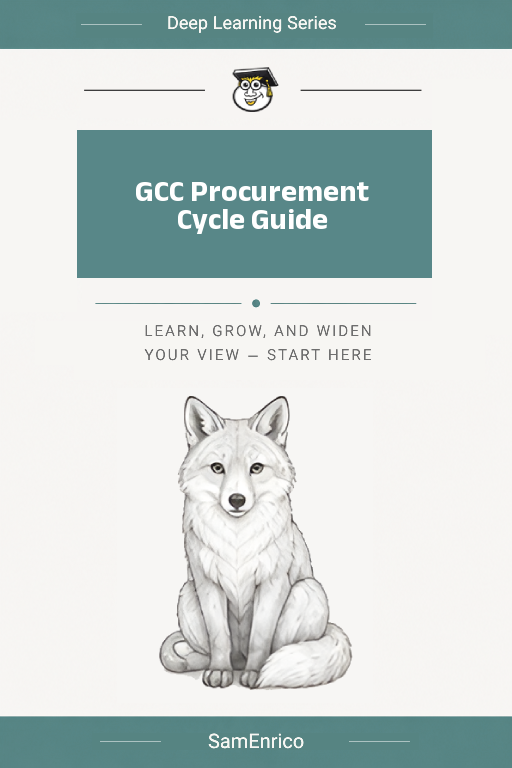
Non-FictionBusiness BriefProcurement Strategy
GCC Procurement Cycle Guide eBook
Map decision-making committees, budget cycles, and
Map decision-making committees, budget cycles, and approval hierarchies across Qatari, Saudi, and UAE enterprises.
Formats
Free sample
Chapter 1: The Handshake Trap--–- The managing director of a €200 million European engineering firm sat across from me in a Doha hotel lobby, his bid documents bulging in a leather briefcase. He had just returned from a meeting with a Qatari minister who had smiled, shaken his hand firmly, and said "Inshallah, we will work together." The director had spent €380,000 preparing that bid. He had flown his technical team in from Frankfurt. He had retained a local agent. He had done everything right—by European standards.Six months later, he still hadn't heard anything.
His emails went unanswered. His local agent stopped returning calls. The contract was eventually awarded to a Turkish firm whose bid was 12 percent higher than his. He never learned why.I asked him one question: "Who sits on the Central Tenders Committee for that ministry?"He had no idea. He didn't even know the committee existed.That is the Handshake Trap.
It is the single most expensive mistake foreign suppliers make when entering the Gulf Cooperation Council (GCC) procurement market. You believe you are selling to a person—a minister, a director, a procurement officer. You are not. You are selling to a committee. And until you understand how that committee thinks, votes, meets, and approves, your handshake is worth exactly the paper it is written on.This book exists because that managing director's story is not an exception.
It is the rule. Over the past decade, I have consulted with more than 200 international firms trying to win government contracts in Qatar, Saudi Arabia, and the United Arab Emirates. The ones who succeed do not have better technology, lower prices, or stronger relationships. They have one thing the others lack: a map.A map of who decides. A map of when they decide.
A map of how to appeal when they decide against you.This chapter introduces the foundational reality of GCC procurement: the Committee State. Everything else in this book—the budget cycles, the approval hierarchies, the negotiation windows, the appeal mechanisms—flows from this single insight. Master it, and you stop guessing. Ignore it, and you join the long line of suppliers who mistake a handshake for a contract.The Three Myths That Cost Millions Before we build the map, we must first clear the wreckage of the myths that have stranded so many suppliers on the shoals of GCC procurement. These myths are pervasive.
They are repeated in boardrooms across London, New York, Singapore, and Berlin. And they are all dangerously wrong.Myth Number One: "If I reach the right person, I can close the deal."In Western procurement systems, this is often true. A chief procurement officer, a category manager, or a supply chain director typically has delegated authority to sign contracts up to a certain threshold. Build a relationship with that person, present a compelling offer, and you can close in weeks.The GCC does not work this way. No single person—not a minister, not a director general, not a procurement manager—has the unilateral authority to award a government contract of any significant value.
Every award requires a committee vote. Committees have multiple members, fixed meeting schedules, quorum requirements, and oversight observers. Winning a single vote is not enough. You must win a majority. Sometimes a two-thirds majority.
And you must win it on a specific day, in a specific room, with specific members present.The person who shook your hand may genuinely like you. They may genuinely want to work with you. But they cannot deliver you a contract alone. They can only advocate for you inside a room where you are not present. The difference between these two realities is the difference between a handshake and a contract.Myth Number Two: "The lowest bid wins."This myth is partially true—which makes it even more dangerous.
All three GCC countries have laws that mention price as a factor. Some, like Qatar's Central Tenders Committee regulations, explicitly state that the lowest total cost proposal should be accepted unless there is a compelling reason not to. On paper, it looks like a pure price competition.In practice, "lowest cost" is a trap. Qatar's law includes a provision allowing the CTC to reject a bid that is "suspiciously very low." That phrase has ended more bids than any price war. If your bid is significantly lower than the government's internal estimate—an estimate you will never see—you can be disqualified for being too cheap.
The theory is that an abnormally low price indicates a misunderstanding of the scope, a desperate firm that will cut corners, or a future request for variations and extras.Saudi Arabia's 2019 Government Tenders and Procurement Law includes a similar provision, but adds another twist: a local content preference of up to 20 percent. A Saudi bidder with certified local content can be 20 percent more expensive than a foreign bidder and still win. The foreign bid must be more than 20 percent cheaper to overcome this preference. In practice, the effective threshold is closer to 25–30 percent when factoring in logistics, language, and relationship advantages.The UAE's federal procurement rules use a different mechanism: technical scoring thresholds. A bid that fails to achieve a minimum technical score—often 70 or 80 percent—is disqualified before price is even considered.
You can be the lowest bid by a factor of two and still lose if your technical submission misses a single required certification.Lowest price wins only when price is the only remaining variable. By the time you reach that stage, most of your competitors have already been eliminated on other grounds.Myth Number Three: "If I lose, I can complain and get a second chance."In Western systems, bid protests are common and often successful. Suppliers can challenge award decisions, request debriefings, and in some cases, force a re-evaluation or even a re-tender.In the GCC, the window for complaints is narrow, the standards are high, and the outcomes are unpredictable. Saudi Arabia offers the most formal appeals process through its Grievance Committee—but the window to file is only five business days from the date the award is published on the Etimad portal, not from the date you receive notification. Miss that window by one day, and your complaint is dead.
The committee can suspend the award, order a re-evaluation, or uphold the original decision. But it rarely overturns an award on procedural grounds alone; you must demonstrate a clear violation of procurement law, not merely that your bid was better.Qatar and the UAE offer longer administrative review periods—typically 15 to 30 days—but no independent Grievance Committee. Complaints are reviewed by the same body that made the original decision: the CTC in Qatar, the federal Procurement Committee in the UAE. Asking a committee to overturn its own decision is possible but statistically unlikely. Most complaints are acknowledged, reviewed, and rejected with a brief statement that the original process was followed correctly.The most successful complainants are those who identify a clear, documented violation of a published rule: a bid opened after the deadline, a conflict of interest not disclosed, a requirement split illegally to avoid a higher approval threshold.
Vague claims about your bid being "better" or "more cost-effective" go nowhere.These three myths share a common root: they assume…
This is the end of the free sample. Get the eBook to keep going. Buy now
About this book
Details
- Author
- Lomax Williemae
- Publisher
- SamEnrico
- Language
- English
- Genre
- Non-Fiction, Business Brief, Procurement Strategy
- Released
- 2026-05-30
- Pages (approx.)
- 141
- Available as
- eBook, Audiobook

Read better in the ZLOADR app
Your eBooks on your phone or tablet. Sign in with your SamEnrico account and start reading.
More by Lomax Williemae
 HIIT Joint Friendly AlternativesLomax Williemae$11.99
 Growing Up With An AddictLomax Williemae$11.99
 Stolen Diamond RecoveryLomax Williemae$11.99
 Hearing Aids Over Counter GuideLomax Williemae$11.99
 After Meal Cigarette ReplacementLomax Williemae$11.99
 The Day the Internet Broke: How a Single Tweet Toppled a Tech GiantLomax Williemae$11.99
 Pixel Prophets: The Unseen Battles of the 8-Bit RevolutionLomax Williemae$11.99
 Affenpinscher BreedingLomax Williemae$11.99
 Internet Stability For ExamsLomax Williemae$12.99
 Understanding Cardiomyopathy Due to AnthracyclinesLomax Williemae$17.99
 How to Start a Curtain Walling Made of Metal Business (Beginners Guide)Lomax Williemae$11.99
You may also like
 Hong Kong Handover 1997Dunn Johnnie$11.99
 Zumba For Postnatal Recovery CourseNeal Christian$11.99
 Zumba for BeginnersLadner Nikia$11.99
 YouTube Comment Mining GuideHumes Pandora$12.99
 Worry Box MeditationCarlin Rudy$11.99
 Workplace Stress MeditationNguyen Lynn$11.99
 Workplace Stress and Sleep RepairHawley Ivory$11.99
 Workplace Perfectionism CureDelaney Jeffry$11.99
 Workplace Injustice Anger GuideWallen Isabelle$11.99
 Work Addiction and Burnout LinkGreenwood Ester$11.99
 Women in Yoga and WellnessBeattie Galina$11.99
 Women in Stand Up ComedyChun Evangeline$11.99