
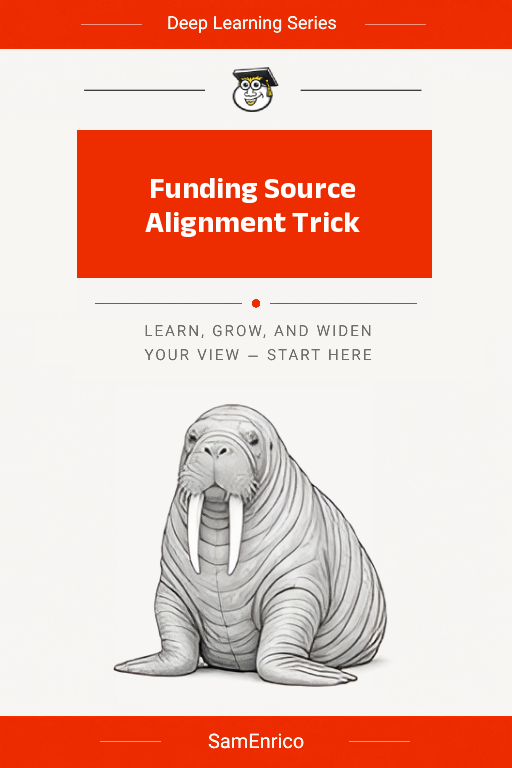
Non-FictionStudent's ShortcutGrant WritingFunding Strategy
Funding Source Alignment Trick Audiobook
Tailor your proposal language to match NSF, SSHRC,
by Moran Erick
Tailor your proposal language to match NSF, SSHRC, or private foundation keywords without sounding formulaic.
Formats
Free sample
Chapter 1: The Three Tribes...--You have probably been trained to think about grant writing as a technical exercise. Identify the problem. Write the objectives. List the methods. Calculate the budget.
Hit submit. This is the “paint-by-numbers” approach to academic fundraising, and it is the reason why ninety-three percent of proposals fail on the first submission. Not because the science was bad. Not because the budget was inflated. Not because the investigator lacked credentials.
But because the proposal spoke the wrong language to the wrong reviewer.Here is the secret that successful grant writers learn after their third or fourth rejection, usually following a period of professional despair: funding agencies are not neutral banks. They do not simply distribute money to the best science, judged by some universal, objective standard of excellence. Funding agencies are intellectual tribes. Each tribe has its own origin story, its own sacred texts, its own definition of what counts as a legitimate question, its own rituals for evaluating answers, and its own vocabulary for describing what matters. If you submit a proposal written in the dialect of one tribe to the reviewers of another tribe, you will be rejected not because your science is flawed but because you have committed a cultural violation.
You have worn a tuxedo to a beach party. You have shown up to a formal dinner in flip-flops.The good news is that you are not being asked to change your science. You are being asked to change your rhetoric. This chapter introduces the three major funding tribes in North American academic research—the National Science Foundation (NSF), the Social Sciences and Humanities Research Council (SSHRC), and private foundations—and provides you with a cultural fluency framework that will prevent you from committing the most common and most fatal grant writing error: writing for the wrong tribe.The Myth of the Neutral Funder Before we examine the tribes individually, we must dismantle a dangerous myth. Most early-career researchers believe that funding agencies are essentially passive conduits.
You write a proposal describing your excellent research. A panel of impartial experts reads it. They evaluate it against a universal standard of scientific merit. If your science is good enough, you get funded. If not, you revise and resubmit.
This myth is perpetuated by university research offices, which tend to treat all funders as interchangeable sources of revenue, and by senior mentors who say things…
This is the end of the free sample. Get the Audiobook to keep going. Buy now
About this book
Details
- Author
- Moran Erick
- Publisher
- SamEnrico
- Language
- English
- Genre
- Non-Fiction, Student's Shortcut, Grant Writing, Funding Strategy
- Released
- 2026-05-28
- Pages (approx.)
- 160
- Available as
- eBook, Audiobook

Listen in the VoxFlicks app
Audiobooks and audio dramas wherever you go. Sign in with your SamEnrico account and press play.
More by Moran Erick
 Tom Brady DeflatorMoran Erick$11.99
 The High Stress Career CoupleMoran Erick$11.99
 Mindful Breathing Daily PracticeMoran Erick$11.99
 Bipolar Crisis Resource GuideMoran Erick$11.99
 The Barbershop MeetingMoran Erick$11.99
 Active Listening For PoliticiansMoran Erick$11.99
 Three Good Things Daily PracticeMoran Erick$11.99
 Mental Health Hotlines GuideMoran Erick$11.99
 Procrastination ScienceMoran Erick$11.99
 Ashes of the Lion King: The Last Rites of Menelek IMoran Erick$11.99
 The Unseen Crown: How a Janitor’s Quiet Heroism Saved a NationMoran Erick$11.99
 The Last Transmission of the SS BaychimoMoran Erick$11.99
You may also like
 Hong Kong Handover 1997Dunn Johnnie$11.99
 Zumba For Postnatal Recovery CourseNeal Christian$11.99
 Zumba for BeginnersLadner Nikia$11.99
 YouTube Comment Mining GuideHumes Pandora$12.99
 Worry Box MeditationCarlin Rudy$11.99
 Workplace Stress MeditationNguyen Lynn$11.99
 Workplace Stress and Sleep RepairHawley Ivory$11.99
 Workplace Perfectionism CureDelaney Jeffry$11.99
 Workplace Injustice Anger GuideWallen Isabelle$11.99
 Work Addiction and Burnout LinkGreenwood Ester$11.99
 Women in Yoga and WellnessBeattie Galina$11.99
 Women in Stand Up ComedyChun Evangeline$11.99