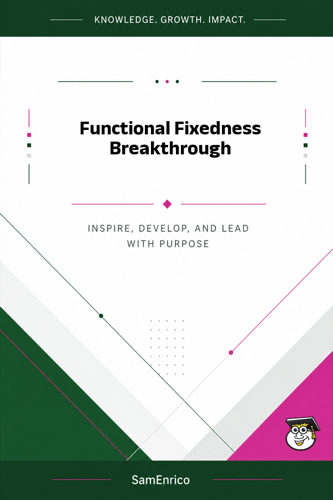
Functional Fixedness Breakthrough eBook
See new uses for existing tools and components usi
See new uses for existing tools and components using reverse thinking.
Formats
Free sample
Chapter 1: The Duct Tape Revolution--On April 13, 1970, at approximately 55 hours and 55 minutes into the Apollo 13 mission, a routine stir of the oxygen tanks produced a sound that no astronaut ever wants to hear. Jack Swigert reported it to Mission Control in Houston with a calmness that belied the terror of the moment: "Okay, Houston, we've had a problem here."A moment later, James Lovell corrected him: "Houston, we've had a problem."The understatement of the decade had just been spoken. An oxygen tank had exploded. The command module Odyssey was losing power. The lunar landing was aborted.
And three astronauts were now 200,000 miles from Earth in a spacecraft that was slowly dying around them.What happened next is the reason this book exists. And it is the reason you will never look at a roll of duct tape the same way again.The carbon dioxide levels in the command module began to rise. The scrubbers that removed CO₂ from the air were designed to work with square cartridges. But the only cartridges available were from the lunar module Aquarius, and they were round. Square pegs, round holes.
The filters did not fit. If the engineers could not solve this problem, the astronauts would suffocate before they reentered Earth's atmosphere.On the ground in Houston, engineer Ed Smylie gathered his team around a table. He dumped out a box of materials that were available on the spacecraft: duct tape, plastic bags, suit hoses, cardboard, and a few other odds and ends. Then he said something that should be carved into the wall of every engineering school, every design studio, and every office break room where people complain about not having the right tools."We have to figure out how to make this square filter fit into that round hole using nothing but that."Not "We need better equipment." Not "We don't have the right parts." Not "Someone should have planned for this."Just: here is what we have. Here is what we need to do.
Figure it out.The team did figure it out. They designed an adapter using only the materials on that table. They radioed instructions to the astronauts. The astronauts built the adapter with duct tape and plastic bags. The CO₂ levels dropped.
The mission survived.This is not a story about NASA having brilliant engineers, though they certainly did. This is not a story about astronauts being brave, though they certainly were. This is a story about a cognitive ability that every human being possesses but almost none of us use effectively: the ability to see new uses for existing tools and components.It is the story of functional fixedness—and how to break it.The Thirty Thousand Dollar Problem Before we go any further, let me tell you a much smaller story. One that you might recognize from your own life.A hospital in the Midwest had a problem with its soap dispensers. They were the expensive automated kind—the ones that use a motion sensor to dispense a precise amount of soap.
The dispensers kept breaking. The hospital spent thirty thousand dollars on replacements and repairs over two years. Then a janitor solved the problem in ten seconds with a piece of string.He tied the string to the manual pump dispenser that had been there all along. Pull the string, soap comes out. No sensors, no electronics, no thirty thousand dollars.The hospital had the solution the entire time.
The manual dispensers were still on the walls. The string was in a supply closet. But everyone was so focused on the broken automated dispensers—on what they should have, on what they were told they needed—that they could not see what they already had.This is functional fixedness. It is the cognitive bias that limits you to using an object only in the way it is traditionally used. And it is one of the most expensive, frustrating, and unnecessary barriers to problem-solving in every domain of human activity.The Curse of Knowing What Things Are For Let me ask you a question.
I want you to answer it honestly, not with what you think the "smart" answer is.You have a candle, a box of thumbtacks, and a book of matches. You are in a room with a wall. Your task is to attach the candle to the wall so that it burns without dripping wax onto the floor. How do you do it?Take a moment. Think about it.Most people try to melt the bottom of the candle and stick it directly to the wall.
It falls. They try to use the thumbtacks to pin the candle to the wall. The candle crumbles. They try to hold the candle in place with one hand while lighting it with the other. They burn their fingers.The solution is simple, but almost no one sees it immediately.
Empty the thumbtack box. Tack the box to the wall. Place the candle inside the box. The box becomes a platform.The reason most people fail is that they see the box only as a container for thumbtacks. They cannot see it as a potential platform because its function as a container is too dominant in their perception.
This is the candle problem, designed by psychologist Karl Duncker in 1945, and it has been replicated hundreds of times with the same results.Here is the part that should worry you. When Duncker gave the same problem to children, they solved it faster than adults. Why? Because the children had not yet learned what a thumbtack box was "for." They saw the box for what it physically was: a small, flat, tackable object. The adults saw it for what it was supposed to be: a thumbtack container.Your expertise is ruining you.I mean that with the utmost respect.
The more you know about what a tool is supposed to do, the harder it becomes to see what else it might do. This is not a character flaw. It is not a lack of creativity. It is a feature of how your brain works. And like any feature, it can be understood, managed, and overridden.How Your Brain Betrays You Let me explain what is happening inside your skull.Every time you use a hammer to drive a nail, your brain strengthens the neural pathway connecting the concept of "hammer" to the concept of "nail-driving." This happens through a process called long-term potentiation.
The more you use that pathway, the faster and more efficient it becomes. Your brain is optimizing for your most frequent tasks, because your brain consumes twenty percent of your body's energy despite being only two percent of your mass. It cannot afford to maintain equally strong pathways for every possible use of every object.This efficiency is wonderful when you are driving nails. It is catastrophic when you are solving novel problems.The alternative pathways—hammer as paperweight, hammer as doorstop, hammer as counterweight, hammer as makeshift plumb bob, hammer as emergency window breaker, hammer as tent stake driver, hammer as nutcracker, hammer as ice chipper, hammer as evidence weight, hammer as a tool to persuade a stuck drawer to open—these pathways atrophy from disuse. They are still…
This is the end of the free sample. Get the eBook to keep going. Buy now
About this book
Details
- Author
- Sheridan Roselia
- Publisher
- SamEnrico
- Language
- English
- Genre
- Non-Fiction, Self-Help, Cognitive Flexibility
- Released
- 2026-06-11
- Pages (approx.)
- 146
- Available as
- eBook, Audiobook

Read better in the ZLOADR app
Your eBooks on your phone or tablet. Sign in with your SamEnrico account and start reading.
More by Sheridan Roselia
 Probiotic Anxiety TrialSheridan Roselia$11.99
 Pain Noting TechniqueSheridan Roselia$11.99
 Downshift Stress GuideSheridan Roselia$11.99
 Automatic Anger ThoughtsSheridan Roselia$11.99
 The Taika Waititi BiographySheridan Roselia$11.99
 Power of AttorneySheridan Roselia$11.99
 Pomodoro for ProcrastinationSheridan Roselia$11.99
 Mutiny at Sea: The 2015 Pacific Princess Prisoner RiotSheridan Roselia$11.99
 The Poets of the Jazz Age: A Harlem Renaissance RevivalSheridan Roselia$11.99
 How to Start a Mineral Water Exporter (wholesale) Business (Beginners Guide)Sheridan Roselia$11.99
 The Essential Guide to Original ScoreSheridan Roselia$11.99
 How to Produce Eye MasksSheridan Roselia$11.99