
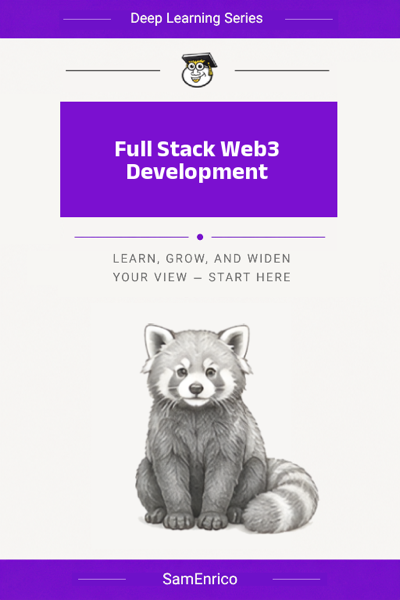
Full Stack Web3 Development eBook
A Coursebook on Full Stack Web3 Development
A Coursebook on Full Stack Web3 Development
Formats
Free sample
Chapter 1: The Trust Paradox...--You already know how to build web applications. You understand REST APIs, database migrations, authentication tokens, and the quiet satisfaction of seeing a 200 OK response. You have debugged CORS errors at 2 AM, argued about tabs versus spaces, and learned the hard way why you never rm -rf without double-checking the path.None of that is going away.What is changing is the assumption that trust must be delegated to a central authority. Every web application you have ever built rests on a fragile bargain: you promise to store user data safely, to not manipulate the rules, to stay online. And your users give you their passwords, their credit cards, their identities—hoping you keep that promise.But history suggests otherwise. Equifax exposed 147 million records. Facebook leaked 533 million phone numbers. Twitter had its internal tooling abused to delete accounts. And those are just the breaches we know about. The pattern is not malice—it's structural. Centralized systems have a single point of failure, and that point is controlled by people who can make mistakes, or worse, be compelled.Web3 is not about cryptocurrency speculation. It is not about NFT profile pictures selling for millions. Those are the headline grabbers, the distractions that obscure a deeper transformation. Web3 is about re-architecting trust from a human promise into a mathematical guarantee.This chapter will take you from skeptical Web2 developer to someone who sees the blockchain not as a magic database, but as a predictable, auditable, and ultimately liberating new primitive. You will set up your environment, run a local blockchain, and send your first transaction. By the final page, you will understand why thousands of developers are making this shift—and why you are about to join them.The Failure Modes You Already Know Let us start with a story. Not about crypto. About a coffee shop loyalty program.Imagine you build a beautiful mobile app for a local café chain. Customers earn points, redeem drinks, track their favorites. You use Postgre SQL, a React Native frontend, and a Node.js API. It works perfectly. The café owners love you. Then one day:The café's server goes down during a holiday sale. Customers cannot redeem points. They complain on Twitter. Your pager goes off at 3 AM on Christmas Eve.An intern accidentally runs DELETE FROM loyalty_points WHERE true on the production database. Backups are restored, but six hours of transactions are lost. Twenty-three customers email support saying their points vanished. You cannot prove they existed because the logs were overwritten.The café owner decides to change the rules: points now expire after thirty days instead of a year. You update the code, run the migration, and move on. But customers who saved points for months feel cheated. They leave bad reviews. The owner says "it's just business."None of these failures require a hacker or a villain. They are simply the cost of centralization. Someone controls the server. Someone controls the database. Someone controls the rules. And that someone—even if well-intentioned—is human.Now imagine a different system. One where:The loyalty balance is stored on thousands of computers simultaneously. No single server going down can erase it.Every point transfer is signed with a private key that only the customer controls. No intern can accidentally delete them because the database does not have delete permissions.The rules (points expire after one year) are written in code and deployed to a blockchain. Changing them requires either deploying a new contract (the old one continues running) or convincing every participant to upgrade. No unilateral rule changes from the café owner.This is not science fiction. This is a smart contract running on Ethereum today, costing less than a cup of coffee to deploy. The difference is not technological sophistication—it is architectural philosophy.The Full Stack Web3 Architecture (And How It Compares to What You Know)Before writing a single line of code, you need a mental map. Here is how the familiar Web2 stack maps to Web3:Web2 Stack (What you already know):Client: React/Vue/Angular running in a browser Backend: Node.js/Express, Django, Rails, Spring (your code)Database: Postgre SQL, My SQL, Mongo DBFile Storage: S3, Cloudinary Authentication: Passport, OAuth, sessions with JWTs Hosting: AWS, Vercel, Heroku, Digital Ocean Web3 Stack (What you are about to learn):Client: React/Vue/Angular + wallet integration (Meta Mask, Wallet Connect)Backend: Smart contracts (Solidity, Vyper, Huff) running on the blockchain Database: The blockchain itself (state trie) + indexes like The Graph for querying File Storage: IPFS, Arweave, Filecoin (decentralized, content-addressed)Authentication: Digital signatures + public key cryptography (no passwords involved)Hosting: Decentralized options available, but centralized hosting still common for frontend assets The most important shift is the removal of your backend server. In Web2, your Node.js application is the gatekeeper. It validates inputs, checks authentication, enforces business logic, and writes to the database. In Web3, the smart contract does all of that—and it runs on every node in the network simultaneously.You might ask: "If there is no backend server, how does the frontend talk to the blockchain?"The answer is nodes. When you send a transaction from your React component, you are broadcasting it to a node (often via a service like Infura, Alchemy, or a local node you run yourself). That node propagates the transaction to the network, miners/validators include it in a block, and the state update becomes permanent. Your frontend reads state by querying the same nodes—no API key required for basic reads (though you will use one for reliability).This is radically different. In Web2, your backend is a single point of control. In Web3, your smart contract is a public service that anyone can call, subject only to the rules you encoded. You cannot censor it, you cannot shut it down, and you cannot change the rules after deployment without everyone's agreement.That power comes with responsibility. You cannot patch a bug after deployment. You cannot recover stolen funds with a database rollback. You cannot "just reset" a bad migration. The blockchain is immutable—and immutability is a feature until you make a mistake.Which Blockchain? The Ecosystem Landscape As a new developer, you face an overwhelming choice of blockchains. Ethereum, Solana, Polygon, Avalanche, BNB Chain, Arbitrum, Optimism, Base, Sui, Aptos, Near, Flow, Starknet, zk Sync—the list grows monthly.Do not panic. The fundamentals transfer: if you learn one EVM (Ethereum Virtual Machine) chain, you know 80% of the others. This book focuses on Ethereum and EVM-compatible chains because they have the largest developer community, the most mature tooling, and the deepest pool of learning resources.Here is your cheat sheet:Ethereum Mainnet The original smart contract platform. Highest security, most decentralized, largest validator set.Tradeoff: Expensive gas fees ($5-50 per transaction depending on network load) and slower finality (~12 seconds per block).Best for: High-value assets (USDC, DAI, major NFT collections), protocols needing maximum security (Maker DAO, Uniswap).Polygon (formerly Matic)Ethereum Layer 2 (sidechain with commitments to Ethereum). EVM-compatible, low fees (fractions of a cent), faster blocks.Tradeoff: Slightly less decentralized than Ethereum mainnet; security depends on checkpoint mechanism.Best for: Gaming, micro-transactions, applications needing high throughput with lower security requirements.Arbitrum & Optimism Optimistic rollups—true Layer 2 solutions that inherit Ethereum security while bundling transactions.Fees: Much lower than mainnet (~$0.01-0.10). Security: Higher than Polygon due to fraud proofs (with tradeoffs in withdrawal times).Best for: De Fi protocols that want Ethereum security without mainnet costs.Solana (Non-EVM…
This is the end of the free sample. Get the eBook to keep going. Buy now
About this book
Details
- Author
- Flanders Miss
- Publisher
- SamEnrico
- Language
- English
- Genre
- Non-Fiction, Informative, Educational
- Released
- 2026-05-08
- Pages (approx.)
- 156
- Available as
- eBook, Audiobook

Read better in the ZLOADR app
Your eBooks on your phone or tablet. Sign in with your SamEnrico account and start reading.
More by Flanders Miss
 Migraine and Cervicogenic HeadacheFlanders Miss$11.99
 Eisenhower For Remote WorkersFlanders Miss$11.99
 Negative Assertion PracticeFlanders Miss$11.99
 Fear Recognition MethodsFlanders Miss$11.99
 Betaine Liver Health GuideFlanders Miss$11.99
 The 10 Second Pause MethodFlanders Miss$11.99
 Meal Delivery for SeniorsFlanders Miss$11.99
 Team Building NonverbalsFlanders Miss$11.99
 Sunk Cost Fallacy AvoidanceFlanders Miss$11.99
 Starlight Serpents: The Lost Mission of Pioneer 10Flanders Miss$11.99
 Quantum Rhapsody: The Enigma of Schrödinger’s CatFlanders Miss$11.99
 Subprime Shadows: The Collateral Damage of Lehman's FallFlanders Miss$11.99