
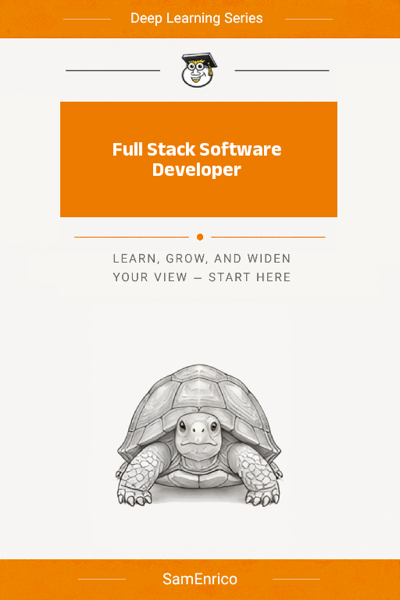
Non-FictionInformativeEducational
Full Stack Software Developer eBook
A Coursebook on Full Stack Software Developer
by Clancy Kecia
A Coursebook on Full Stack Software Developer
Formats
Free sample
Chapter 1: The Hidden Compass–- Every great building begins with a blueprint. Not with bricks, not with mortar, not with the frantic energy of construction. First, someone sits quietly with a pencil and imagines how weight will flow through beams, how light will enter through windows, how people will move through halls. Then, and only then, does the first nail get driven.Software development is no different. Yet the most common mistake new full stack developers make is rushing toward code—typing furiously, installing frameworks, wiring up databases—before they understand what they're actually building or how the pieces connect.
They learn React and Node and Postgre SQL in isolation, never seeing the anatomy of a complete system. Then they wonder why their applications break in production, why adding one feature takes three weeks, why they're constantly firefighting instead of building.This chapter is the blueprint you never knew you needed.Before you write a single line of code for your capstone project (an e-commerce platform you'll deploy to production by Chapter 12), you need a mental map. You need to understand what "full stack" actually means in 2026—because it's changed dramatically from the LAMP stacks of 2010. You need to see the entire landscape: the client, the server, the database, the network that connects them, and the cloud that hosts them. You need to understand the difference between a website and a web application, why that distinction changes your architecture, and how the 12-Factor App methodology keeps you from making the mistakes that sink startups.Most importantly, you need to learn how to learn.
Full stack developers don't memorize every framework—they recognize patterns, understand layers, and confidently dive into whatever technology a project requires. This chapter gives you the compass. The rest of the book gives you the map.1.1 What Even Is a "Full Stack Developer" in 2026?The term "full stack" has been abused so thoroughly that it barely means anything anymore. Some job postings use it to describe someone who knows React and Node—as if two technologies make a stack. Others use it to demand ten years of experience with every database, every cloud provider, and every frontend framework that has ever existed.
Neither definition is useful.Here's the definition this book uses:A full stack developer understands how data flows from a user's fingertip (clicking a button in a browser) to a permanent storage system (a database) and back again—and can build, deploy, and maintain every layer in between.Notice what this definition doesn't say. It doesn't list specific technologies. It doesn't require mastery of every tool. Instead, it emphasizes understanding and capability. A full stack developer sees the whole system, not just their favorite piece of it.The stack itself has evolved through three distinct eras:Era 1: The LAMP Stack (2000–2015)Linux (operating system), Apache (web server), My SQL (database), PHP (backend language).
This was the original "full stack" for millions of websites. Everything ran on a single server. The frontend was minimal—some HTML, a little CSS, maybe some j Query. The backend generated HTML on the fly and sent complete pages to the browser.Era 2: The Separation of Concerns (2015–2022)Frontend frameworks (React, Vue, Angular) exploded. Backend APIs (REST, Graph QL) became their own layer.
Databases specialized (Postgre SQL for relational data, Redis for caching, Mongo DB for documents). This is when "full stack" got harder—now you needed to know at least three distinct technologies just to get a working application.Era 3: The Cloud-Native Stack (2022–Present)Containers (Docker), orchestration (Kubernetes), serverless functions, edge computing, real-time databases, and AI-assisted development. The stack is no longer a fixed set of technologies—it's a series of decisions. Do you use a traditional database or a cloud-native one? Do you run your own servers or use serverless functions?
Do you build a single-page application or a progressive web app?Here's the crucial insight: The underlying principles haven't changed, even as the technologies have. A request still travels from browser to server. Data still needs to be stored persistently. Users still expect fast, secure, accessible experiences. Master the principles, and you can learn any new technology in a week instead of a month.Your capstone project in this book will use a modern stack: Type Script (for type safety across frontend and backend), React (for the user interface), Node.js with Express (for the API), Postgre SQL (for relational data), Redis (for caching and sessions), Docker (for containerization), and a cloud provider (either AWS or Google Cloud) for deployment.
But the principles you'll learn apply to any stack.1.2 The Anatomy of a Web Request (A Journey from Finger to Database)Imagine you're building an e-commerce site. A user visits your product page. She clicks the "Add to Cart" button for a vintage leather journal. What happens next?If you can't trace this journey in your sleep, you don't understand the web. Let's walk through it step by step.Step 1: The Browser (Client-Side)The user's browser already loaded your product page.
When she clicks "Add to Cart," Java Script intercepts that click (preventing the default form submission). Your frontend code gathers data: the product ID, the quantity (probably 1), and the user's session token (if she's logged in). It then constructs an HTTP request—likely a POST request to /api/cart/items—and sends it to your server.Step 2: The Network (DNS, TCP, TLS)The browser extracts the domain from your API URL (e.g., https://api.yourstore.com). It performs a DNS lookup to convert that domain into an IP address (a series of numbers like 192.0.2.1). It opens a TCP connection to that IP address on port 443 (for HTTPS) or 80 (for HTTP).
It negotiates a TLS handshake to encrypt the connection—this is the "S" in HTTPS. Only after all this negotiation does the browser actually send the HTTP request.Step 3: The Load Balancer (Entry Point to Your Infrastructure)Your production application isn't running on a single server—it's probably running on dozens. The request arrives at a load balancer (like AWS ALB, Nginx, or HAProxy). The load balancer terminates the TLS connection (decrypts the request) and decides which backend server should handle it. It checks health statuses (avoiding servers that are failing), considers current load (spreading requests evenly), and forwards the request.Step 4: The Web Server (Handling the Request)The request reaches your web server—in our capstone, this will be a Node.js process running Express.
The server parses the request URL and method (POST /api/cart/items). It matches this to a route handler: app.post('/api/cart/items', add To Cart Handler). It extracts the request body (the product ID and quantity, probably in JSON format) and the authentication token (from the Authorization header or a cookie).Step 5: The Authentication Check Your route handler first checks: Is this user authenticated? If the token is missing or invalid, the server immediately returns a 401 Unauthorized response—no further processing happens. If the user is authenticated, the handler extracts the user ID from the token and proceeds.Step 6: The Business Logic (Your Application Code)Now the real work begins.
The handler validates the input: Is the product ID a positive integer? Is the quantity between 1 and 999? Are…
This is the end of the free sample. Get the eBook to keep going. Buy now
About this book
Details
- Author
- Clancy Kecia
- Publisher
- SamEnrico
- Language
- English
- Genre
- Non-Fiction, Informative, Educational
- Released
- 2026-06-02
- Pages (approx.)
- 160
- Available as
- eBook, Audiobook

Read better in the ZLOADR app
Your eBooks on your phone or tablet. Sign in with your SamEnrico account and start reading.
More by Clancy Kecia
 Mindful Self Compassion GuideClancy Kecia$11.99
 Breath Noting TechniqueClancy Kecia$11.99
 Mindfulness For Chest PainClancy Kecia$11.99
 Microbiome Smoothie GuideClancy Kecia$11.99
 Love Letters from the Battlefield: The Reality TV Romance That Defied WarClancy Kecia$11.99
 How to Start a Paper Clips Made of Metal Business (Beginners Guide)Clancy Kecia$11.99
 At Will Employment State Exceptions ManualClancy Kecia$12.99
 How to Produce Butter DishesClancy Kecia$11.99
You may also like
 Hong Kong Handover 1997Dunn Johnnie$11.99
 Zumba For Postnatal Recovery CourseNeal Christian$11.99
 Zumba for BeginnersLadner Nikia$11.99
 YouTube Comment Mining GuideHumes Pandora$12.99
 Worry Box MeditationCarlin Rudy$11.99
 Workplace Stress MeditationNguyen Lynn$11.99
 Workplace Stress and Sleep RepairHawley Ivory$11.99
 Workplace Perfectionism CureDelaney Jeffry$11.99
 Workplace Injustice Anger GuideWallen Isabelle$11.99
 Work Addiction and Burnout LinkGreenwood Ester$11.99
 Women in Yoga and WellnessBeattie Galina$11.99
 Women in Stand Up ComedyChun Evangeline$11.99