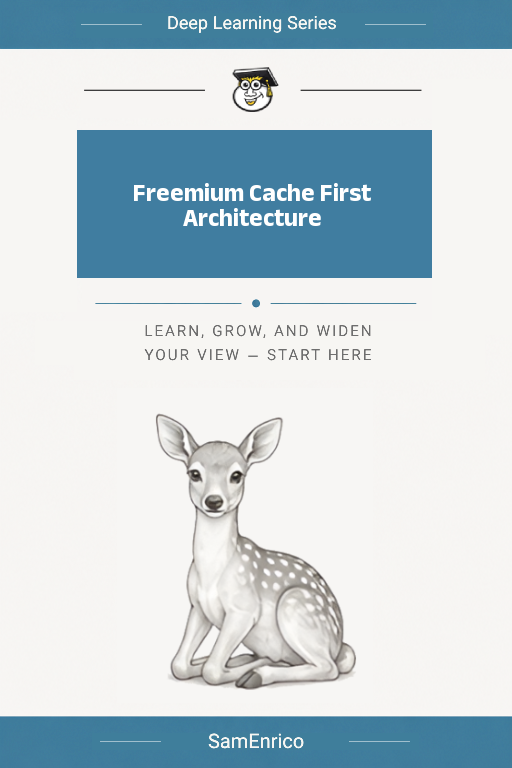
Freemium Cache Strategy eBook
Implement smart caching for freemium features to r
by Sager Shu
Implement smart caching for freemium features to reduce repeat data downloads.
Formats
Free sample
Chapter 1: The $50,000 Hour--It was 2:47 AM on a Tuesday when Sarah, the CTO of a promising AI startup, received the alert that would change how she thought about caching forever. Her phone buzzed not once, but seventeen times in rapid succession—each notification a fresh budget alert from AWS. She sat up in bed, rubbed her eyes, and opened the billing dashboard. What she saw made her stomach drop. In the past three hours, her company had accrued $47,832 in unexpected API charges.
Not for new users, not for exciting new features, but for the same data being requested over and over again by the same five thousand free-tier users. Every time a user refreshed their dashboard, the system fetched the same analytics from scratch. Every time someone searched for a product, the database ran the same query. Every time the frontend polled for updates, the backend paid full price for answers it had already computed moments earlier. Sarah wasn't paying for innovation.
She was paying for repetition.This story is not an anomaly. It is the quiet scandal of modern cloud architecture.The Quiet Epidemic of Duplicate Work Over the past decade, software development has undergone a remarkable transformation. We have moved from running our own servers in dingy basements to spinning up limitless compute in the cloud. We have exchanged fragile monoliths for resilient microservices. We have traded manual deployments for continuous delivery pipelines that run dozens of times per day.
In almost every dimension, we have become faster, more reliable, and more scalable. But in one crucial dimension, we have actually regressed. We have stopped asking a very simple question before fetching any piece of data: Have I seen this before?Consider the typical modern application. A user logs in, and the authentication service checks their credentials against a database. The user navigates to their dashboard, and the analytics service queries a data warehouse to compute their key metrics.
The user searches for a product, and the search service hits an Elasticsearch cluster. The user clicks on a product, and the catalog service fetches details from a Postgre SQL database. The user adds the item to their cart, and the cart service reads from Redis. The user checks out, and the payment service validates their token against a third-party API. Every single one of these operations is treated as unique, precious, and worthy of full compute cost.
Yet the vast majority of them are anything but unique.The same user logs in every morning. The same dashboard metrics are computed on every page load. The same search queries are issued by thousands of users. The same product details are viewed millions of times. The same cart contents are read on every page.
The same payment token is validated repeatedly during checkout. We are running the same calculations, fetching the same bytes, and paying the same cloud bills over and over again for work that could have been done once and remembered.This is the Idempotency Tax—the hidden cost of treating all requests as if they are equally expensive and equally novel. For most engineering teams, this tax consumes between 40% and 50% of their cloud spend. That is not a typo. Half of your cloud bill may be paying for work that never needed to happen in the first place.Let us put some numbers on this.
A modest Saa S application with ten thousand daily active users might spend 10,000permonthondatabasereadoperations.If5010,000 per month on database read operations. If 50% of those reads are repeat queries, that is 10,000permonthondatabasereadoperations.If505,000 per month—60,000peryear—wastedonduplicatework.Ahigh−volumee−commercesitewithonemilliondailyusersmightspend60,000 per year—wasted on duplicate work. A high-volume e-commerce site with one million daily users might spend 60,000peryear—wastedonduplicatework.Ahigh−volumee−commercesitewithonemilliondailyusersmightspend200,000 per month on API gateway fees, Lambda invocations, and database reads. Half of that is 100,000permonth,100,000 per month, 100,000permonth,1.2 million per year, vaporized into the cloud for no value whatsoever. An AI startup making five million LLM API calls per month might spend 50,000onmodelinference.Ifsemanticcachingeliminates8050,000 on model inference.
If semantic caching eliminates 80% of repeat calls, that is 50,000onmodelinference.Ifsemanticcachingeliminates8040,000 per month, nearly half a million dollars annually, returned to the bottom line.These are not hypothetical numbers. They are the real waste that the author has observed across dozens of engineering organizations, from two-person startups to Fortune 500 enterprises. The problem is universal, it is massive, and almost nobody is talking about it.The Freemium Mindset: A New Way to Think About Caching Why do we tolerate this waste? Partly because caching is boring. It lacks the glamour of machine learning, the excitement of real-time streaming, the sex appeal of a new frontend framework.
Caching is the plumbing of software architecture—invisible when it works, catastrophic when it fails, and almost never discussed at engineering all-hands. But there is a deeper reason. Most engineers think of caching as a binary thing: either you have a cache, or you do not. Either the data is in Redis, or it is not. Either you get a hit, or you get a miss.
This binary thinking is the enemy of efficiency.The Freemium Cache Strategy replaces binary thinking with spectrum thinking. It borrows a metaphor from the business model that has powered companies like Spotify, Dropbox, Zoom, and countless others. In a freemium business, you do not treat all users the same. Free users get a slower, restricted, ad-supported experience. Paying users get the fast lane, premium features, and priority support.
The same logic applies to data. Not all data requests deserve the same treatment. Some requests are urgent, high-value, and worth spending money to serve quickly. Others are low-stakes, repetitive, and perfectly fine to serve from a slower, cheaper cache.Here is the unifying definition that will guide everything that follows in this book:The Freemium Cache Strategy means applying different caching rules to different user tiers (free versus paying) and different data value tiers (hot versus cold). It is NOT a specific storage layer, a particular TTL value, or a single technology.
It is a decision framework for treating data requests according to their true economic value.This definition has three critical implications. First, it means your cache strategy must be multi-tiered. One cache layer cannot serve all needs. Second, it means your cache strategy must be user-aware. A paying user and a free user should not have the same caching experience.
Third, it means your cache strategy must be economically informed. Every cache miss should be evaluated not just in terms of latency but in terms of actual dollar cost.Think of it this way. In a traditional caching architecture, you have a single cache (usually Redis or Memcached) sitting between your application and your database. Every request checks the cache. If there is a hit, great.
If there is a miss, the request goes to the database. This is a democracy of data requests—every request gets exactly one vote, regardless of its importance. The Freemium Cache Strategy is an aristocracy. Important requests get expedited treatment. Unimportant requests get economical treatment.
And the definition of "important" is not technical. It is economic.The Cacheable Surface Area: Finding Your Waste Before you can fix the problem, you need to measure it. The first step…
This is the end of the free sample. Get the eBook to keep going. Buy now
About this book
Details
- Author
- Sager Shu
- Publisher
- SamEnrico
- Language
- English
- Genre
- Non-Fiction, Business Brief, Caching
- Released
- 2026-05-30
- Pages (approx.)
- 129
- Available as
- eBook, Audiobook

Read better in the ZLOADR app
Your eBooks on your phone or tablet. Sign in with your SamEnrico account and start reading.
More by Sager Shu
 Relationship Habit BuilderSager Shu$11.99
 Biofeedback Eating UrgesSager Shu$11.99
 Neighborhood Watch Meeting GuideSager Shu$11.99
 The Nobel And GeneticsSager Shu$11.99
 Walking Meditation for LonelinessSager Shu$11.99
 The Last Breath of the Iron LungSager Shu$11.99
 The Phoenix That Burned Twice: The Unsolved Mystery of the 1993 World Trade Center BombingSager Shu$11.99
 Reimbursement SpecialistSager Shu$11.99
 How to Become a Cleaner And PolisherSager Shu$11.99
 Foreign Exchange Risk PrimerSager Shu$12.99
 Understanding Gorlin–bushkell–jensen SyndromeSager Shu$17.99