
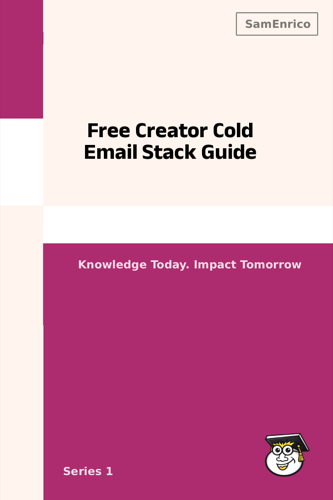
Non-FictionZero-to-One CreatorOutreach
Free Creator Cold Email Stack Guide eBook
Send outreach emails using Gmail and GMass free ti
by Bruner Elma
Send outreach emails using Gmail and GMass free tier for collaborations.
Formats
Free sample
Chapter 1: The 50-Email Advantage--–- Most cold email guides start with a lie. They tell you that success requires sending five thousand emails a week, that you need a $500 monthly budget for infrastructure, and that without a custom domain you might as well stay home. Those guides are written by people selling something—usually email automation software, domain hosting, or consulting services that start at five thousand dollars. This book is different. This book starts with a constraint that most people would call a handicap and reveals why it is actually your greatest weapon.The constraint is simple: the free tier of GMass, when paired with a free Gmail account, limits you to fifty emails per day.
That is it. No more. Fifty emails to convince creators to collaborate with you, to notice your work, to reply to a stranger. At first glance, this seems like a dealbreaker. How can you possibly compete with agencies blasting ten thousand emails a week using dedicated IP addresses and warmup services and deliverability consultants?
The answer is that you do not compete with them. You ignore them entirely. You play a different game—one where volume is impossible, so precision becomes mandatory.This chapter reframes the fifty-email limit not as a constraint but as a forcing function. It explains why traditional "spray and pray" outreach is dying, how scarcity forces you to build a quality Ideal Collaboration Partner (ICP), and why sending one thousand highly personalized emails per month will outperform ten thousand generic blasts every single time. By the end of this chapter, you will never again ask "How do I send more emails?" Instead, you will ask the far more profitable question: "How do I make each of my fifty emails better than the five thousand spam emails they received today?"The Death of Spray and Pray Outreach For the past decade, cold email has operated on a simple mathematical model: send more, get more.
The formula looked something like this. Ten thousand emails sent. One thousand opened. One hundred replies. Ten meetings booked.
Two deals closed. The numbers were terrible, but the math worked because sending ten thousand emails cost almost nothing. You could buy a million email addresses for a hundred dollars, rent a cheap server, and blast away. Spam filters were primitive. People were less suspicious.
The world was different.That world is gone.Modern spam filters are powered by machine learning models that Google and Microsoft have been training on billions of emails for years. These filters do not just look for obvious spam words like "Viagra" or "Nigerian prince." They look for patterns. They look for sending velocity. They look for reply rates. If you send ten thousand emails and only get fifty replies, the algorithm notices.
If you send the exact same message to hundreds of people, the algorithm notices. If you send emails at three in the morning in bursts of five hundred per hour, the algorithm absolutely notices.The free tier of GMass makes volume impossible. You cannot send ten thousand emails from a free Gmail account. You cannot even send five hundred. The technical limits are hard.
Gmail’s daily sending limit for free accounts is five hundred emails, but that is an absolute maximum—the point at which your account gets flagged, investigated, and potentially shut down. The safe limit, the limit that keeps your account in good standing, is fifty emails per day. GMass enforces this limit in its permanent free tier, and while the seven-day trial allows higher volumes, the permanent reality of the free stack is fifty emails daily.This is not a bug. This is the entire point.When you can only send fifty emails per day, you cannot afford to guess. You cannot afford to blast generic messages and hope for a 0.5% reply rate.
A 0.5% reply rate on fifty emails would give you one reply every four days. You would book one collaboration per month if you were lucky. That is not a strategy. That is a tragedy.To succeed with fifty emails per day, you need a reply rate of ten to twenty percent. That means ten replies per day.
Two hundred replies per month. From those two hundred replies, you can reasonably expect to convert thirty percent into actual collaborations—guest appearances, joint projects, paid work. That is sixty collaborations per month theoretically, but a more realistic target is ten to fifteen high-quality collaborations monthly. That is more than enough to build a career, grow an audience, and generate significant income.The math works only if every email matters. The math works only if you abandon everything you thought you knew about cold outreach.Scarcity as a Strategic Weapon There is a concept in startup investing called "the forcing function." A forcing function is a constraint that compels creative problem-solving.
When you have unlimited resources, you get lazy. When you have fifty dollars, you get inventive. The same principle applies to cold email.Fifty emails per day forces you to do three things that most cold email senders never do. First, it forces you to define your Ideal Collaboration Partner with surgical precision. Second, it forces you to research each prospect before sending a single word.
Third, it forces you to personalize every email to the point where the recipient cannot tell it is cold outreach at all.Let us start with the Ideal Collaboration Partner, or ICP. This term comes from sales literature, but it applies perfectly to creator collaborations. Your ICP is not "anyone with a podcast" or "You Tubers in my niche." Those are categories, not partners. A true ICP has four specific dimensions that you must define before you send a single email.The first dimension is niche. What specific sub-field do they serve?
Not "digital marketing"—that is too broad. Instead, "email marketing for Saa S founders with fewer than fifty employees." Not "fitness"—instead, "calisthenics for office workers with lower back pain." The narrower your niche, the more valuable your outreach becomes. A creator who serves a broad audience hears generic pitches constantly. A creator who serves a micro-niche rarely hears from anyone who truly understands their world. Be that person.The second dimension is content format.
What do they actually produce? Podcasts, You Tube videos, newsletters, blogs, social media series, online courses. Each format has different collaboration opportunities. A podcaster needs shownotes, transcriptions, and guest introductions. A You Tuber needs thumbnails, editing help, and research assistance.
A newsletter writer needs lead magnets, graphics, and copyediting. Know their format before you reach out.The third dimension is the gap. What is missing from their work? This is the most important dimension and the one most people skip. Every creator has gaps.
The podcaster who never writes shownotes. The You Tuber whose thumbnails are weak. The blogger who cites outdated research. The newsletter writer who needs better lead magnets. Your entire value as a collaborator rests on your ability to identify these gaps and fill them.
If you cannot identify a gap, you do not have a collaboration—you have a wish.The fourth dimension is collaboration style. How does this creator prefer to work with others? Some want guest appearances.…
This is the end of the free sample. Get the eBook to keep going. Buy now
About this book
Details
- Author
- Bruner Elma
- Publisher
- SamEnrico
- Language
- English
- Genre
- Non-Fiction, Zero-to-One Creator, Outreach
- Released
- 2026-06-06
- Pages (approx.)
- 133
- Available as
- eBook, Audiobook

Read better in the ZLOADR app
Your eBooks on your phone or tablet. Sign in with your SamEnrico account and start reading.
More by Bruner Elma
 Exercise for Emotional HealthBruner Elma$11.99
 Elderly Senior Loneliness GuideBruner Elma$11.99
 Solar Temple Baby Abduction Cases WorkbookBruner Elma$11.99
 Mindfulness for Retirement TransitionBruner Elma$11.99
 The Crown’s Shadow: How Queen Elizabeth II’s Secret War Cabinet Shaped the Modern MonarchyBruner Elma$11.99
 Love Letters in the Attic: The Secret Romance of Anne Frank and Peter van PelsBruner Elma$11.99
 Understanding Cerebro Oculo Skeleto Renal SyndromeBruner Elma$17.99
 Dubai Distance Learning GuideBruner Elma$12.99
 ESG Performance Supply Chain RiskBruner Elma$12.99
 How to Start a Positioner for Pneumatic Control Equipment Business (Beginners Guide)Bruner Elma$11.99
 Collection Agency OperationBruner Elma$11.99
You may also like
 Hong Kong Handover 1997Dunn Johnnie$11.99
 Zumba For Postnatal Recovery CourseNeal Christian$11.99
 Zumba for BeginnersLadner Nikia$11.99
 YouTube Comment Mining GuideHumes Pandora$12.99
 Worry Box MeditationCarlin Rudy$11.99
 Workplace Stress MeditationNguyen Lynn$11.99
 Workplace Stress and Sleep RepairHawley Ivory$11.99
 Workplace Perfectionism CureDelaney Jeffry$11.99
 Workplace Injustice Anger GuideWallen Isabelle$11.99
 Work Addiction and Burnout LinkGreenwood Ester$11.99
 Women in Yoga and WellnessBeattie Galina$11.99
 Women in Stand Up ComedyChun Evangeline$11.99