
Non-FictionZero-to-One CreatorIdeation
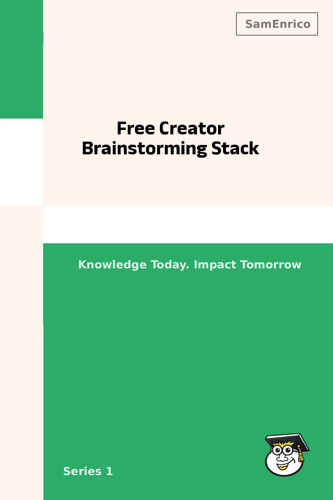
Free Creator Brainstorming Stack eBook
Generate content ideas using AnswerThePublic free
Generate content ideas using AnswerThePublic free and Miro whiteboard.
Formats
Free sample
Chapter 1: The 3-Search Lie...--Most creators have been sold a lie about content research.The lie sounds like truth. It whispers in your ear every time you open a keyword tool, every time you stare at a blank content calendar, every time you convince yourself that you just need one more search before you can start creating. The lie is this: More data leads to better content.It feels correct, does it not? If you have ten data points, you can make a decent decision. If you have a hundred, you can make a great decision.
And if you have a thousand – well, then you can make a perfect decision. This is the logic of the spreadsheet. This is the religion of the enterprise SEO platform. And it is catastrophically wrong for creators who actually need to produce content, not just analyze it.I have watched hundreds of creators fall into this trap. They sign up for Answer The Public.
They see the 3-free-searches-per-day limit. And they feel cheated. They feel like the tool is holding back. They close the tab and complain on social media about paywalls. Or worse – they obsessively "save" their searches, waiting for the perfect keyword, the perfect question, the perfect moment.
They run one search, then another, then another. They export the data into a spreadsheet. They look at the 187 questions. And then... nothing.
The spreadsheet sits there. The cursor blinks. The content never gets made.The lie has won again.But here is the truth that the enterprise software companies do not want you to understand: Your creativity does not need more fuel. It needs better constraints.This entire book is built on a single, provable, repeatable counterintuitive principle. The principle comes from design thinking, from behavioral psychology, and from studying the most productive creators on the planet.
Here it is: When you have unlimited data, you suffer from analysis paralysis. When you have exactly three searches, you are forced to ask the one question that actually matters: "What does my audience need to know right now?"The 3-search limit on Answer The Public's free tier is not a bug. It is not a paywall. It is not a limitation designed to frustrate you into upgrading. It is a creative constraint – and creative constraints are the secret engine of every successful content operation you have ever admired.Think about the most memorable content you have consumed in the past year.
Was it the meticulously researched, 5,000-word white paper that covered every possible angle of a topic? Probably not. You remember the You Tube video with the provocative title. You remember the podcast episode where the host asked the uncomfortable question. You remember the Linked In post that named the fear you had not spoken aloud.
These pieces of content did not come from unlimited data. They came from a creator who was forced to choose.This chapter will teach you how to stop treating the 3-search limit as an obstacle and start treating it as your secret weapon. You will learn a specific architecture for your three searches – Hook, Friction, and Intent – that ensures you cover your entire audience funnel in just three keyword entries. You will learn the Constraint Ratio, a forcing function that requires you to generate twenty content ideas from only the data you have collected. And you will learn why the creators who complain about paywalls are the same creators who never publish anything.By the end of this chapter, you will never look at a keyword tool the same way again.
You will stop asking "What other keywords could I search?" and start asking "What am I missing in the data I already have?" This shift – from seeking more to using what you have – is the difference between being a perpetual researcher and being a prolific creator.Let us destroy the lie.The Psychology of Creative Constraints Before we get into the mechanics of the three searches, we need to understand why constraints work. This is not just productivity advice. This is cognitive science.In the 1950s, a psychologist named Bluma Zeigarnik discovered something fascinating about the human brain. She noticed that waiters could remember complex orders while they were still taking them, but as soon as the order was delivered, the memory vanished. This became known as the Zeigarnik Effect: our brains hold onto incomplete tasks more tightly than completed ones.
The open loop creates tension. The tension creates focus.Creative constraints work the same way. When you have unlimited options, your brain treats the task as "incomplete" in a different sense – there is always another search you could run, another angle you could explore. The loop never closes. You never feel ready.
But when you impose a hard limit – three searches, no more – your brain shifts gears. The constraint tells your brain: This is the complete set. Work with what you have. The loop closes. Creation becomes possible.There is a second psychological principle at work here, and it comes from a study you may have heard of.
In 2000, researchers Sheena Iyengar and Mark Lepper set up a jam tasting booth at a grocery store. Sometimes they offered 24 varieties of jam. Sometimes they offered only 6. Which booth got more sales? The booth with 6 varieties.
Customers were ten times more likely to buy when they had fewer options. Unlimited choice led to paralysis. Limited choice led to action.Your content research is the same as that jam tasting booth. When you have 187 questions from a single ATP search, your brain is standing in front of 24 jams. You cannot decide.
You try one angle, then another, then another. You second-guess yourself. You close the spreadsheet. When you have forced yourself to work with only the questions from three targeted searches – and when you have forced yourself to generate twenty specific ideas from that limited set – you are standing in front of 6 jams. The decision becomes easy.
You pick one and start creating.This is not a metaphor. This is the core mechanism of this book. Every chapter, every template, every workflow is designed to enforce creative constraints. The free tier of Answer The Public gives you three searches per day. The free tier of Miro gives you three editable boards.
The Rule of 3 – which you will see throughout this book – limits you to three content pieces per week. These are not arbitrary numbers. They are constraints scientifically proven to increase output.The creators who complain about the 3-search limit are the creators who have not yet understood this psychology. They are still chasing the illusion of perfect information. They believe that if they could just see one more question, one more keyword, they would finally know what to create.
But perfect information does not exist. And even if it did, it would not help you. Perfect information produces perfect paralysis. Constrained information produces action.So here is your first assignment before we go any further: Admit that you have been hiding behind research. Admit that you have used "I need more data" as an excuse to avoid the vulnerability of creating.
And then let that admission go. You are about to learn a system that turns three searches into twenty content…
This is the end of the free sample. Get the eBook to keep going. Buy now
About this book
Details
- Author
- Odell Zenobia
- Publisher
- SamEnrico
- Language
- English
- Genre
- Non-Fiction, Zero-to-One Creator, Ideation
- Released
- 2026-06-06
- Pages (approx.)
- 135
- Available as
- eBook, Audiobook

Read better in the ZLOADR app
Your eBooks on your phone or tablet. Sign in with your SamEnrico account and start reading.
More by Odell Zenobia
 Lactose Intolerance in Elderly GuideOdell Zenobia$11.99
 Immigrant Loneliness GuideOdell Zenobia$11.99
 Solar Temple Swiss Vacherin Murders WorkbookOdell Zenobia$11.99
 LBO Valuation Multiples DatabaseOdell Zenobia$11.99
 The Silent War: How a 19th-Century Spy Ring Shaped Modern EspionageOdell Zenobia$11.99
 The Secret Calculus of Freedom: The Hidden Mathematicians of the Underground RailroadOdell Zenobia$11.99
 Understanding Cerebellar Ataxia Ectodermal DysplasiaOdell Zenobia$17.99
 Amblygonite MiningOdell Zenobia$11.99
 Indian University Dubai GuideOdell Zenobia$12.99
 ESG Performance vs CEO Pay GuideOdell Zenobia$12.99
 How to Start a Poste Restante Business (Beginners Guide)Odell Zenobia$11.99
You may also like
 Hong Kong Handover 1997Dunn Johnnie$11.99
 Zumba For Postnatal Recovery CourseNeal Christian$11.99
 Zumba for BeginnersLadner Nikia$11.99
 YouTube Comment Mining GuideHumes Pandora$12.99
 Worry Box MeditationCarlin Rudy$11.99
 Workplace Stress MeditationNguyen Lynn$11.99
 Workplace Stress and Sleep RepairHawley Ivory$11.99
 Workplace Perfectionism CureDelaney Jeffry$11.99
 Workplace Injustice Anger GuideWallen Isabelle$11.99
 Work Addiction and Burnout LinkGreenwood Ester$11.99
 Women in Yoga and WellnessBeattie Galina$11.99
 Women in Stand Up ComedyChun Evangeline$11.99