
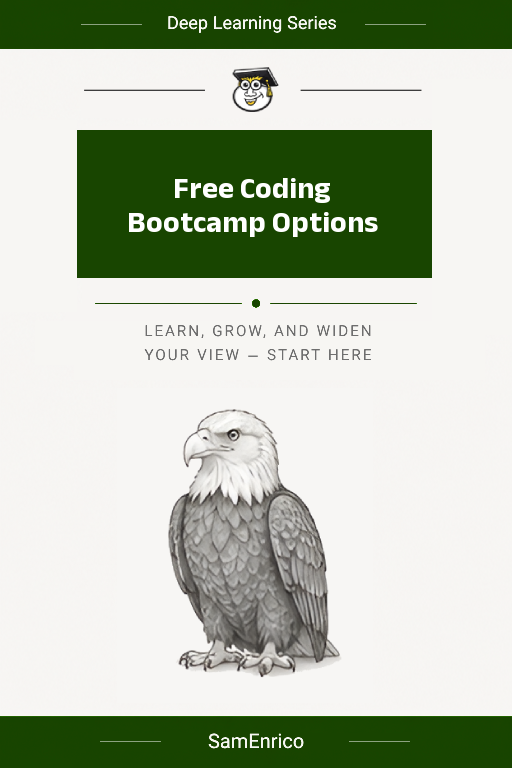
Non-FictionStudent's ShortcutFree EducationAlternative Paths
Free Coding Bootcamp Options eBook
Discover tuition free coding bootcamps like 42 and
Discover tuition free coding bootcamps like 42 and Odin Project including admission requirements and job outcomes.
Formats
Free sample
Chapter 1: The Hundred Million Dollar Bet--–- In the autumn of 2013, a French billionaire named Xavier Niel did something that made the Parisian educational establishment choke on its croissant. He announced that he was investing one hundred million dollars of his own money to build a coding school with no teachers, no books, no tuition, and no degrees. The school would be called 42—named after the answer to life, the universe, and everything in Douglas Adams’ The Hitchhiker’s Guide to the Galaxy. It would be open to anyone between the ages of eighteen and thirty, regardless of their previous education, and it would cost exactly zero euros. The French government, which had spent decades building a rigid, credential-obsessed higher education system, was not amused.
The newspaper Le Figaro called it a dangerous experiment. Traditional computer science professors dismissed it as a gimmick. And yet, within five years, 42 had become the most sought-after coding school in Europe, with companies like Apple, Tesla, and Microsoft fighting over its graduates. The school had no accreditation, no official ranking, and no celebrity spokespeople—just a waiting list of over sixty thousand applicants for a few hundred seats. How did a school without teachers become one of the most effective tech training programs in the world?
And what does Xavier Niel’s gamble reveal about the future of education—and your ability to become a developer without spending a dime?This chapter traces the unlikely rise of the tuition-free coding movement, from the gluttonous ambitions of a French telecom mogul to the humble open-source project started by a former school administrator who was tired of watching people waste money on broken bootcamps. You will learn why removing teachers might actually make you a better programmer, what the word “free” really means in the context of these programs, and why the dropout rate—while terrifying—is not the full story. By the end of this chapter, you will understand the forces that created the free coding bootcamp ecosystem and, more importantly, whether you have the temperament to survive it.The Billionaire Who Hated School To understand the free coding bootcamp movement, you first have to understand Xavier Niel’s relationship with formal education—or rather, his lack of one. Niel dropped out of high school at sixteen. He never attended university.
He started his first business, a subscription-based adult chat service called Minitel, from his parents’ basement at a time when the internet was still a government experiment. By his mid-twenties, he had made his first million. By his forties, he was a billionaire, having built Iliad, the parent company of Free, one of France’s largest internet providers. But despite his wealth and influence, Niel never forgot what it felt like to be told he was not smart enough for the traditional system. France’s grandes écoles—the elite engineering and business schools that produce the country’s political and economic leadership—had rejected him.
He had watched brilliant, self-taught engineers get passed over for jobs because they lacked the right piece of paper. And he had seen the French tech sector struggle to compete with Silicon Valley because it was obsessed with credentials rather than capability.So when Niel decided to build a coding school, he did not ask the government for permission. He did not seek accreditation from any educational authority. He simply bought a former printing press building in the heart of Paris, hired a team of software engineers (none of whom had teaching credentials), and wrote a check for one hundred million dollars. The rules of 42 were simple and radical.
First, there would be no teachers. Instead, students would learn by completing increasingly difficult programming projects, working in small groups, and reviewing each other’s code. Second, there would be no lectures, no textbooks, and no video tutorials. All learning materials would be written by the students themselves, who would document their solutions and share them with the next cohort. Third, there would be no tuition, ever.
The school would be funded entirely by Niel’s personal fortune and by donations from the companies that hired its graduates. Fourth, there would be no degree. Upon completion, students would receive a certificate that meant nothing in the official French education system—but meant everything to the tech companies that had grown tired of interviewing graduates who could recite textbook definitions but could not write a working function.The name 42 was a deliberate provocation. In the science fiction series The Hitchhiker’s Guide to the Galaxy, a supercomputer spends seven and a half million years calculating the answer to life, the universe, and everything—and comes back with the number 42. The problem, of course, is that nobody knows what the question was.
Niel saw a parallel with traditional education: students spend years memorizing answers to questions nobody is asking, while the real problems of the modern economy go unsolved. At 42, the question was always the same: can you build this?The Open-Source Revolutionaries While Niel was writing checks in Paris, two other experiments were unfolding elsewhere in the world—quieter, more modest, but equally important to the free coding bootcamp movement.In 2013, a freelance web developer named Erik Trautman was growing increasingly frustrated with the state of online coding education. The internet was overflowing with free tutorials, You Tube videos, and blog posts, but there was no coherent path through them. A beginner would start with a promising-looking tutorial, only to find that it was outdated, or that it assumed knowledge of three other topics, or that it led to a paywall halfway through. Trautman had seen this problem from both sides: as a self-taught developer, he had wasted hundreds of hours on dead-end resources; as a mentor to aspiring coders, he had watched students bounce from one tutorial to another, never building anything real.
So he did something that would have been unthinkable in any other industry—he created an open-source curriculum called The Odin Project and gave it away for free. The Odin Project was not a school. It was not a platform. It was simply a carefully curated list of resources, organized into a logical sequence, with projects at every step that forced students to build real applications from scratch. There were no videos, no certificates, and no support other than a Discord community of fellow learners.
And yet, within a few years, The Odin Project had become the gold standard for self-taught developers, with graduates landing jobs at Dropbox, Asana, and hundreds of other companies. Trautman never made a dime from it. He ran the project as a volunteer, funded by donations from students who had gotten jobs. The Odin Project proved that you did not need a billionaire’s backing to change tech education—you just needed a good roadmap and a willingness to share it.The same year that Trautman launched The Odin Project, a former school administrator named Quincy Larson was having his own crisis of faith. Larson had spent years working in the American public school system, watching students fall through the cracks while administrators debated standardized test scores.
He had seen brilliant kids drop out because they could not afford college, and he had seen working adults struggle…
This is the end of the free sample. Get the eBook to keep going. Buy now
About this book
Details
- Author
- Glynn Graciela
- Publisher
- SamEnrico
- Language
- English
- Genre
- Non-Fiction, Student's Shortcut, Free Education, Alternative Paths
- Released
- 2026-06-01
- Pages (approx.)
- 138
- Available as
- eBook, Audiobook

Read better in the ZLOADR app
Your eBooks on your phone or tablet. Sign in with your SamEnrico account and start reading.
More by Glynn Graciela
 The Ralbag PhilosopherGlynn Graciela$11.99
 Opioid Dependency Housing Stability GuideGlynn Graciela$11.99
 The Adoptive Parent Self CareGlynn Graciela$11.99
 Past Life Regression SelfGlynn Graciela$11.99
 Parental Anger and Perfectionism LinkGlynn Graciela$11.99
 The Lost Element: Uncovering the Secrets of Tin in Ancient Southeast AsiaGlynn Graciela$11.99
 The Midnight Impeachment: Nixon’s Secret Tapes RevealedGlynn Graciela$11.99
 Buy Now Pay Later Outlook 2030Glynn Graciela$12.99
 Understanding Braddock–Jones–superneau SyndromeGlynn Graciela$17.99
 10 Ways to Use Coffee Granules (Recipe Book)Glynn Graciela$11.99
 Hotel ManagementGlynn Graciela$11.99
You may also like
 Hong Kong Handover 1997Dunn Johnnie$11.99
 Zumba For Postnatal Recovery CourseNeal Christian$11.99
 Zumba for BeginnersLadner Nikia$11.99
 YouTube Comment Mining GuideHumes Pandora$12.99
 Worry Box MeditationCarlin Rudy$11.99
 Workplace Stress MeditationNguyen Lynn$11.99
 Workplace Stress and Sleep RepairHawley Ivory$11.99
 Workplace Perfectionism CureDelaney Jeffry$11.99
 Workplace Injustice Anger GuideWallen Isabelle$11.99
 Work Addiction and Burnout LinkGreenwood Ester$11.99
 Women in Yoga and WellnessBeattie Galina$11.99
 Women in Stand Up ComedyChun Evangeline$11.99