
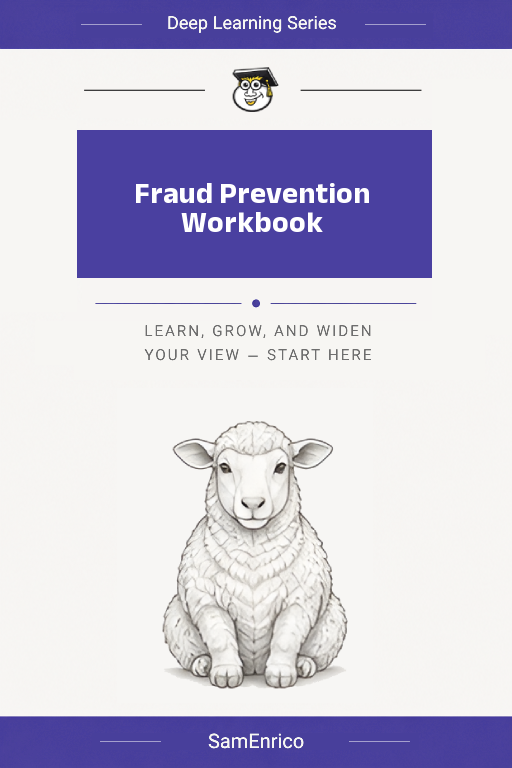
Non-FictionBusiness BriefFraud Detection
Fraud Prevention Workbook eBook
Detect fraudulent orders from Brazilian and Ghanai
Detect fraudulent orders from Brazilian and Ghanaian dropshipping customers. Screen high-risk transactions, verify addresses, and set chargeback alerts.
Formats
Free sample
Chapter 1: The Profit Paradox--–- Every morning, Maria checked her Shopify dashboard like a general surveying a battlefield. Her dropshipping store had grown 300% in six months. She had cracked the code on sourcing high-margin electronics from Asia and selling them to eager buyers in Brazil and Ghana. The numbers were beautiful—until they weren't.Last Tuesday, she lost $4,700. Not to a competitor.
Not to a shipping disaster. To a ghost.A customer in São Paulo ordered eight i Phone 15 cases, paid with a credit card that cleared all initial checks, and requested expedited shipping to an apartment in the Vila Mariana neighborhood. Maria shipped within four hours. Three days later, the chargeback arrived. The card was stolen.
The money vanished. The customer—if that's what you could call them—had never existed.The fraudster had used a fake CPF (Brazil's national ID), a residential proxy to mask their location, and a shipping address that belonged to an abandoned building. Maria's fraud filters had caught nothing. Worse, she had also declined three legitimate orders from Ghana that same week because her "safe" settings had flagged them as suspicious. Those customers never came back.Maria had fallen into the oldest trap in cross-border commerce: she thought fraud prevention was about saying "no" more often.
She was wrong.This chapter is about why she was wrong, and how you will avoid her fate. You are about to learn that fraud prevention is not a wall—it is a scale. And on that scale, every decision you make either adds profit or erases it.The Central Paradox: Security Costs You Money (Even When It Works)Fraud prevention is unique among business functions because success is invisible. When you stop a fraudulent transaction, you never see the loss you avoided. That feels good.
But when you block a legitimate customer by mistake, you see the loss clearly—that customer rarely returns, and their lifetime value disappears from your books.This is the Friction vs. Fraud Paradox:If you...You prevent...But you also risk...Apply strict filters More fraud Blocking legitimate customers (false positives)Apply loose filters Fewer false positives Accepting fraudulent orders (false negatives)Every merchant must find their optimal point on this spectrum. There is no universal "right" setting. A merchant selling 20phonecaseswiththinmarginsmightneedextremelystrictfiltersbecauseasinglechargebackdestroystheirprofitondozensofsales.Amerchantselling20 phone cases with thin margins might need extremely strict filters because a single chargeback destroys their profit on dozens of sales. A merchant selling 20phonecaseswiththinmarginsmightneedextremelystrictfiltersbecauseasinglechargebackdestroystheirprofitondozensofsales.Amerchantselling2,000 luxury watches can afford to manually review every order because the margin per sale justifies the labor cost.The mistake most dropshippers make—and Maria made it—is assuming that more fraud prevention is always better.
It is not. Fraud prevention has a cost curve. At low levels of prevention, fraud losses destroy your business. At moderate levels, you stop most fraud while blocking few good customers. At excessive levels, you lose more money from lost sales than you save from stopped fraud.Let me show you the math.The Mathematics of Optimization: Customer Lifetime Value Before you can set any fraud rule, you must know one number: your Customer Lifetime Value (LTV) .
This is the total profit a typical customer generates over their entire relationship with your store.The formula is deceptively simple:LTV = Average Order Value × Purchase Frequency × Customer Lifespan But in dropshipping, with its low margins and high customer churn, you must calculate this precisely. Let me walk you through a realistic example.Step 1: Average Order Value (AOV)Add up all revenue from the last 90 days. Divide by the number of orders.Example: 45,000revenue÷300orders=45,000 revenue ÷ 300 orders = 45,000revenue÷300orders=150 AOVStep 2: Purchase Frequency Calculate how many orders the average customer places per year.*Example: 300 orders ÷ 200 unique customers = 1.5 orders per customer per year*Step 3: Customer Lifespan This is the hardest number because dropshipping customers often buy once and never return. Track a cohort of customers from six months ago. How many have purchased again within 180 days?
Multiply that percentage by 0.5 (for a crude annualized lifespan).*Example: 20% of customers buy again within 180 days. 20% × 0.5 = 0.1 years average lifespan*Step 4: Calculate LTV150AOV×1.5frequency×0.1years=∗∗150 AOV × 1.5 frequency × 0.1 years = **150AOV×1.5frequency×0.1years=∗∗22.50 LTV**This is a realistic number for a low-margin dropshipping store. But if you sell higher-value items or have stronger retention, your LTV could be 200,200, 200,500, or $2,000.Why LTV Changes Everything About Fraud Prevention Once you know your LTV, you can calculate the Review Threshold—the order value at which manual review becomes financially worthwhile.Here is the rule of thumb used by Stripe's risk team and documented in Practical Fraud Prevention (Saporta & Maraney, 2023):Manual Review Threshold = LTV × 0.2That is, you should manually review any order worth more than 20% of a typical customer's lifetime value.Let me show you why this works.If your LTV is 22.50,yourreviewthresholdis22.50, your review threshold is 22.50,yourreviewthresholdis4.50. Almost every order triggers review. That is correct for a low-margin business—you cannot afford to lose even small fraudulent orders because your margins are razor-thin.If your LTV is 1,000,yourreviewthresholdis1,000, your review threshold is 1,000,yourreviewthresholdis200.
Orders below 200canauto−approvebecauseevenif5200 can auto-approve because even if 5% are fraudulent, your profit from the 95% legitimate orders far exceeds the fraud losses. Orders above 200canauto−approvebecauseevenif5200 trigger manual review because a single fraudulent $500 order would wipe out the profit from five legitimate customers.Maria, from our opening story, had an LTV of approximately 180.Herreviewthresholdshouldhavebeen180. Her review threshold should have been 180.Herreviewthresholdshouldhavebeen36. But she was manually reviewing orders over 50∗and∗blockingallordersfromcertain Brazilianregions.Shewasspendinghoursreviewinglow−valueorderswhilea50 *and* blocking all orders from certain Brazilian regions. She was spending hours reviewing low-value orders while a 50∗and∗blockingallordersfromcertain Brazilianregions.Shewasspendinghoursreviewinglow−valueorderswhilea4,700 fraud sailed through because it looked "normal." Her system was optimized for the wrong metric.The Risk Appetite Calculator: Quantifying Your Tolerance Now it is time to make this personal.
Every fraud prevention strategy begins with a single question: How much risk are you willing to accept?Complete the following calculator. Be honest. Most merchants overestimate their tolerance for false positives (blocking good customers) and underestimate their tolerance for false negatives (accepting fraud). This exercise will force clarity.Part A: Calculate Your False Positive Cost A false positive is a legitimate customer you block or subject to manual review who then abandons their purchase.The cost of a false positive is: AOV × (1 - recovery rate)The recovery rate is the percentage of blocked customers who complete their purchase elsewhere in your store. For most dropshippers, it is under 10%.Example: 150AOV×0.90(90150 AOV × 0.90 (90% lost) = 150AOV×0.90(90135 cost per false positive Part B: Calculate Your False Negative Cost A false negative is a fraudulent order you approve and ship.The cost of a false negative is: AOV + chargeback fee + lost goods The chargeback fee is typically 15–15–15–25 per incident.
Lost goods are your cost of goods sold (COGS), not the retail price.*Example: 150AOV+150 AOV + 150AOV+20 fee + 45COGS=45 COGS = 45COGS=215 cost per false negative*Part C: Determine Your Risk Ratio Divide the false negative cost by the false positive cost:Risk Ratio = False Negative Cost ÷ False Positive Cost In our example: 215÷215 ÷ 215÷135 = 1.59This number tells you how much more damaging a false negative is than a false positive. A ratio above 1.0 means you should bias your system toward blocking more orders…
This is the end of the free sample. Get the eBook to keep going. Buy now
About this book
Details
- Author
- Guillory Maranda
- Publisher
- SamEnrico
- Language
- English
- Genre
- Non-Fiction, Business Brief, Fraud Detection
- Released
- 2026-06-01
- Pages (approx.)
- 158
- Available as
- eBook, Audiobook

Read better in the ZLOADR app
Your eBooks on your phone or tablet. Sign in with your SamEnrico account and start reading.
More by Guillory Maranda
 Micro Self Care for Busy ParentsGuillory Maranda$11.99
 Alcoholism and ADHD Dual Recovery GuideGuillory Maranda$11.99
 Work Addiction for AcademicsGuillory Maranda$11.99
 Whole Fund Model GuideGuillory Maranda$11.99
 Whispers in the Wildfire: The Unseen Accuser of SalemGuillory Maranda$11.99
 How to Start a Ferrosilicon Tungsten Business (Beginners Guide)Guillory Maranda$11.99
 How to Produce an Ambient DeviceGuillory Maranda$11.99
 Supply Chain SpecialistGuillory Maranda$11.99
You may also like
 Hong Kong Handover 1997Dunn Johnnie$11.99
 Zumba For Postnatal Recovery CourseNeal Christian$11.99
 Zumba for BeginnersLadner Nikia$11.99
 YouTube Comment Mining GuideHumes Pandora$12.99
 Worry Box MeditationCarlin Rudy$11.99
 Workplace Stress MeditationNguyen Lynn$11.99
 Workplace Stress and Sleep RepairHawley Ivory$11.99
 Workplace Perfectionism CureDelaney Jeffry$11.99
 Workplace Injustice Anger GuideWallen Isabelle$11.99
 Work Addiction and Burnout LinkGreenwood Ester$11.99
 Women in Yoga and WellnessBeattie Galina$11.99
 Women in Stand Up ComedyChun Evangeline$11.99