
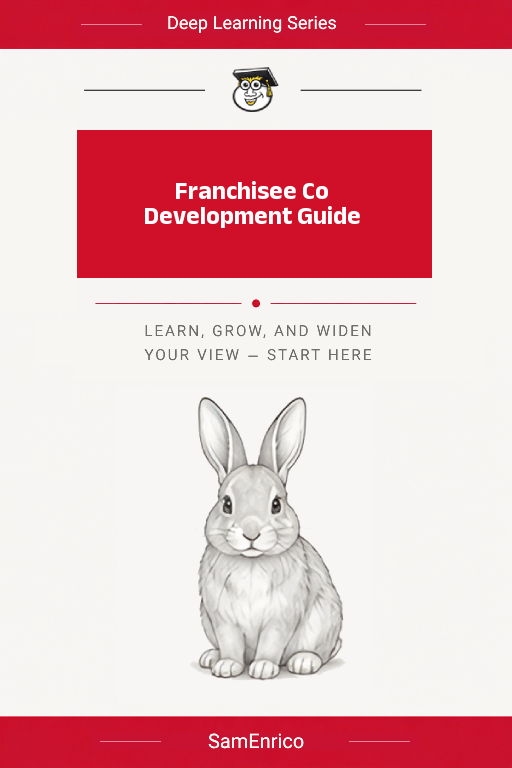
Non-FictionBusiness BriefCo Development
Franchisee Co Development Guide eBook
Co-develops international franchise markets with s
Co-develops international franchise markets with strategic franchisees who invest in brand growth beyond individual units.
Formats
Free sample
Chapter 1: Beyond the Binary--–- For nearly seventy years, the franchise industry has operated on a deceptively simple premise. There are franchisors, who own the brand and sell the right to use it. And there are franchisees, who buy that right, open units, and pay royalties. Two parties. Two sets of incentives.
One contract. That binary model has generated trillions of dollars in economic activity, launched household names from Mc Donald's to Marriott, and created more millionaires than any other business model in history. It works. But only up to a point.The point where it stops working is the exact moment a brand decides to cross a border.International franchising, as traditionally practiced, is a graveyard of good intentions. For every Starbucks that succeeds in China, there are a dozen brands that failed in Brazil, collapsed in India, or limped out of Eastern Europe with lawsuits trailing behind them.
The post-mortems all read the same: cultural mismatch, underinvestment by the local partner, misaligned incentives, insufficient local R&D, royalty disputes, quality erosion, and a slow, painful unraveling of brand equity that took years to build and months to destroy.What those post-mortems rarely admit is that the problem wasn't the market, the product, or even the partner. The problem was the model itself.This book introduces a third way. It is not a modification of master franchising. It is not a variation of direct unit development. It is a fundamentally different structure for international brand expansion, one that dissolves the franchisor-franchisee binary and replaces it with a single, shared identity: co-developer.The Hidden Failure Rate of International Franchising Before we can appreciate the co-development model, we must first understand what it replaces and why that replacement is urgently needed.
The data on international franchising is sobering, though rarely discussed in public forums where brand executives tout their global footprints.According to a multi-year study published in the Journal of International Franchising, approximately 42 percent of international master franchise agreements terminate or are renegotiated before their initial term expires. Of those, nearly two-thirds end in litigation or arbitration. The most common causes are not force majeure events or acts of war, but predictable, structural failures: the master franchisee stops opening new units after the first three, the franchisor discovers quality breaches that would never be tolerated at home, royalty payments fall into arrears while the local partner pleads market conditions, and both sides retreat into their respective legal teams.The master franchise model contains a fatal structural flaw. The master franchisee pays an upfront fee and ongoing royalties for the right to sub-franchise an entire territory. Their incentive is to collect as many sub-franchise fees as possible while spending as little as possible on brand building, local R&D, and quality enforcement.
The franchisor, meanwhile, has ceded control of the territory but retains liability for the brand's reputation. This is not a partnership. It is a divorce waiting to happen.Direct unit franchising across borders solves the control problem but creates an even larger one: capital. Opening international units one by one, with the franchisor funding or guaranteeing each location, is impossibly slow and capital-intensive. Most franchisors lack the balance sheet to build fifty units in a foreign country, and those that do discover that they also lack local real estate expertise, labor law knowledge, and cultural intuition.
The few brands that succeed with this model—think Starbucks in its early international phase—do so only because they have near-infinite capital reserves and the patience to lose money for a decade.Master franchising gives up control. Direct franchising gives up speed and capital efficiency. Co-development gives up neither.The Co-Developer Defined A co-developer is not a franchisee in the traditional sense, though they will sign a franchise agreement. They are not a joint venture partner in the corporate sense, though they will share governance. And they are not an employee, though they will be deeply integrated into the franchisor's strategic planning.The co-developer occupies a new category.
They are an independent entrepreneur who makes three distinct commitments that no traditional franchisee ever makes.First, the co-developer commits capital not just to individual units but to the territory's brand equity. This means they fund market research, localized product development, regional marketing campaigns, and training infrastructure before the first unit opens. In traditional franchising, these expenses are either borne by the franchisor (delaying profitability) or ignored entirely (leading to failure). In co-development, they are shared from day one.Second, the co-developer commits managerial bandwidth to building the brand beyond their own operations. They recruit and support sub-franchisees, but unlike a master franchisee who merely collects fees, the co-developer actively mentors, audits, and rescues underperforming units because their compensation is tied to the territory's aggregate performance, not just upfront fees.Third, and most radically, the co-developer commits to a shared exit.
When the territory matures, the co-developer does not simply sell their units back to the franchisor or to a third party. They participate in the brand's eventual sale, IPO, or recapitalization through equity-like instruments that align their long-term wealth with the global brand's success.This third commitment is what separates co-development from every other franchise model. A master franchisee builds a business they hope to sell one day. A direct franchisee builds units they hope to operate for decades. A co-developer builds an asset that rises and falls with the global brand itself.The Three Models Compared To make these distinctions concrete, consider three brands entering the same hypothetical market: a mid-sized fitness concept from the United States expanding into Germany.Under the master franchise model, the brand sells territorial rights to a German entrepreneur for €500,000 plus a 6 percent royalty on all sub-franchise revenue.
The master franchisee opens a flagship location, then recruits thirty sub-franchisees over five years. The master franchisee's compensation comes from sub-franchise fees and a share of their royalties. The brand provides an operations manual, initial training, and periodic visits. When quality issues emerge at ten locations, the master franchisee is slow to act because enforcing standards costs money and generates no immediate revenue. The brand discovers the problem eighteen months later during a routine audit.
Litigation follows. The territory is eventually repurchased at a discount, but the brand's reputation in Germany never recovers.Under the direct unit franchise model, the brand opens its own German subsidiary, hires a country manager, and begins opening company-owned units. Each unit costs €500,000. After two years and €5 million invested, the brand has ten locations and is still losing money on operations. The German manager understands local real estate but struggles with German labor laws around fitness instructor certification.
The brand's US-based leadership grows impatient with the losses. Expansion slows. A private equity firm eventually acquires the brand and divests the German operations at a steep loss.Under the co-development model, the brand identifies a German entrepreneur who has already built and sold a fitness business. They sign a Co-Development Charter (detailed in Chapter 4) that outlines a 50/50 split of all territory-level investment. The brand contributes the playbook, the training systems, and the global brand license.
The German partner contributes €1 million in initial capital, local real estate relationships, and operating expertise. Together, they open three…
This is the end of the free sample. Get the eBook to keep going. Buy now
About this book
Details
- Author
- Harden Lenita
- Publisher
- SamEnrico
- Language
- English
- Genre
- Non-Fiction, Business Brief, Co Development
- Released
- 2026-06-01
- Pages (approx.)
- 140
- Available as
- eBook, Audiobook

Read better in the ZLOADR app
Your eBooks on your phone or tablet. Sign in with your SamEnrico account and start reading.
More by Harden Lenita
 Human Resources Innovation GuideHarden Lenita$11.99
 Growth Mindset For MidlifeHarden Lenita$11.99
 Forgiveness After Medical ErrorHarden Lenita$11.99
 Spiritual Approaches to Sexual SobrietyHarden Lenita$11.99
 The UAE Interview Attire GuideHarden Lenita$11.99
 The Great Escape: How AI and Drones Caught a Killer LionHarden Lenita$11.99
 Understanding Trisomy 11 MosaicismHarden Lenita$17.99
 How to Become a PipelinerHarden Lenita$11.99
 African Healthtech YC GuideHarden Lenita$12.99
 Clinical Data AnalystHarden Lenita$11.99
You may also like
 Hong Kong Handover 1997Dunn Johnnie$11.99
 Zumba For Postnatal Recovery CourseNeal Christian$11.99
 Zumba for BeginnersLadner Nikia$11.99
 YouTube Comment Mining GuideHumes Pandora$12.99
 Worry Box MeditationCarlin Rudy$11.99
 Workplace Stress MeditationNguyen Lynn$11.99
 Workplace Stress and Sleep RepairHawley Ivory$11.99
 Workplace Perfectionism CureDelaney Jeffry$11.99
 Workplace Injustice Anger GuideWallen Isabelle$11.99
 Work Addiction and Burnout LinkGreenwood Ester$11.99
 Women in Yoga and WellnessBeattie Galina$11.99
 Women in Stand Up ComedyChun Evangeline$11.99