
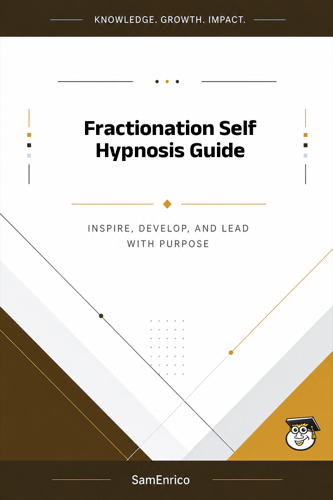
Non-FictionSelf-HelpAdvanced Induction
Fractionation Self Hypnosis Guide eBook
Uses repeated trance exit and re entry to deepen h
by Jacob Pilar
Uses repeated trance exit and re entry to deepen hypnotic states.
Formats
Free sample
Chapter 1: The Yo-Yo Illusion...--Most people believe that hypnosis is about going deep—very, very deep—and staying there. They imagine a spiral staircase descending into a dark, quiet basement of the mind, where the outside world fades to nothing and the hypnotist's voice becomes the only reality. This image, popularized by stage shows and Hollywood thrillers, has done more to limit the potential of self-hypnosis than almost any other myth. It suggests that success is measured by how far down you go, that the best trance is the one from which you barely emerge, and that any interruption of that state is a failure.This chapter will dismantle that belief entirely.The truth is that a static, unchanging trance leads to habituation—a well-documented neurological phenomenon in which the brain learns to ignore repetitive, predictable stimuli. When you hold a single state for too long, your mind treats it like background noise.
The hypnotist's suggestions, or your own inner voice, become the equivalent of a clock ticking on the wall: present but irrelevant. The deepest trance in the world is worthless if the brain has filtered it out.Enter fractionation. This technique, known in clinical hypnosis for over a century but rarely taught to the general public, flips the entire model on its head. Instead of trying to go deep and stay there, fractionation teaches you to deliberately exit the trance state and re-enter it repeatedly—like a yo-yo cycling up and down, in and out, awake and asleep. Each re-entry is a fresh learning opportunity.
Each transition resets the brain's attention filters. Each cycle strips away the habituation that kills static trance.The brain, it turns out, learns fastest during transitions between states, not during steady states. This is not mystical speculation; it is neurobiology. And understanding this single principle will transform everything you thought you knew about hypnosis.The Myth of the Bottomless Well Let us begin by examining the myth more closely, because you cannot dismantle what you do not understand.The "deep trance" model holds that hypnosis exists on a linear scale from light (eyes fluttering, relaxation, mild suggestibility) to deep (somnambulism, amnesia, anesthesia). The goal, according to this model, is to get as far down that scale as possible and then deliver your suggestions.
This is intuitive. It matches our physical metaphors: falling asleep, sinking into relaxation, dropping into trance. Gravity pulls down. So deeper must be better.But clinical research tells a different story. A 1998 meta-analysis in the International Journal of Clinical and Experimental Hypnosis reviewed over 50 studies on trance depth and therapeutic outcome.
The finding was surprising: depth correlated weakly with outcome. Some subjects in light trance achieved profound behavioral changes. Some subjects in somnambulism (the deepest measurable stage) showed no change at all. What mattered more was not depth but what researchers called "responsiveness"—the subject's ability to accept and act on suggestions.This is where fractionation enters. Fractionation does not primarily increase depth, though it often does.
Its primary effect is to increase what we will call pliability: the ease with which the mind accepts new suggestions, reframes old beliefs, and rewires neural patterns. Pliability is not depth. You can be in a medium trance—still aware of your surroundings, still hearing traffic outside—yet be highly pliable, highly open to change. And the quickest way to generate pliability is not to sink deeper but to cycle.The Ultradian Rhythm: Nature's Built-In Oscillator To understand why cycling works, we must look at the brain's natural temporal structure.Every 90 to 120 minutes, your brain moves through an ultradian rhythm—a cycle of alertness and rest that continues throughout the day. You have experienced this rhythm countless times without naming it.
It is the reason you feel a dip in focus around 11:00 AM and again around 3:00 PM. It is why your concentration flags after an hour of intense work. It is why meditation teachers often recommend 20-minute sessions rather than hour-long marathons.The ultradian rhythm is not a flaw in your design. It is a feature.During the alert phase of the cycle, your brain is dominated by beta waves (12-30 Hz), associated with active concentration, critical thinking, and the sympathetic nervous system. During the rest phase, theta waves (4-8 Hz) begin to emerge, associated with relaxation, creativity, memory consolidation, and hypnotic trance.
You cannot force yourself to stay in theta indefinitely. The brain will naturally cycle back toward beta every 90 minutes or so, whether you want it to or not.Fractionation works with this rhythm rather than against it. Instead of fighting the natural cycle—trying to hold theta for an hour while the brain strains toward beta—fractionation rides the wave. You allow the exit (the natural return toward alertness), then you deliberately re-enter (a fresh descent into theta). Each cycle aligns with the brain's own oscillatory nature.
The result is not exhaustion but synergy.This is why the 3-5-3 method (introduced in detail in Chapter 3) uses intervals of roughly three minutes in trance. Three minutes is enough time to sink into theta but not so long that habituation sets in. The five-second alert phase is a clean break—a door opening and closing. Then three minutes again, but this time, the re-entry is faster and deeper because the neural pathways are already warm.Nature oscillates. Tides go in and out.
Lungs inhale and exhale. Hearts contract and relax. Fractionation simply applies this universal principle to the domain of consciousness.The Neuroscience of the "State Break"Let us get more specific about what happens inside the skull during a fractionation cycle.When you enter trance for the first time, your brain shifts from beta-dominant activity to a mix of alpha (8-12 Hz, relaxed alertness) and theta. This shift is mediated by the thalamus, which acts as a gatekeeper for sensory information, and the default mode network (DMN), which quiets during focused trance. This is a good state.
But it is also a fragile state. After a few minutes, the brain begins to habituate. The novelty wears off. The thalamus stops treating the hypnotic suggestions as urgent. The DMN may even begin to reactivate, bringing back self-referential thoughts and internal chatter.This is the moment when most self-hypnosis fails.
The practitioner, believing they must stay "under," tries to fight through the habituation. They repeat suggestions more forcefully. They try to relax harder. This almost never works. The brain habituates to forced repetition just as it habituates to anything else.Fractionation solves this problem by exploiting a different neurological mechanism: the orienting response.The orienting response is a primitive survival reflex.
When something changes in your environment—a sudden sound, a shift in light, a movement at the edge of your vision—your brain instantly stops what it is doing and reorients. This response is mediated by the reticular activating system (RAS), a network of neurons in the brainstem that filters sensory information and determines what deserves conscious attention. The RAS is exquisitely sensitive to novelty and change.When you exit trance—opening your eyes, moving a finger, taking a deliberate breath—you trigger the orienting response. The RAS wakes up. Norepinephrine floods the cortex.
You are suddenly alert, present, aware. This is not a failure. This is a tool.Then, when you immediately re-enter trance—closing…
This is the end of the free sample. Get the eBook to keep going. Buy now
About this book
Details
- Author
- Jacob Pilar
- Publisher
- SamEnrico
- Language
- English
- Genre
- Non-Fiction, Self-Help, Advanced Induction
- Released
- 2026-06-09
- Pages (approx.)
- 145
- Available as
- eBook, Audiobook

Read better in the ZLOADR app
Your eBooks on your phone or tablet. Sign in with your SamEnrico account and start reading.
More by Jacob Pilar
 Barry MarionJacob Pilar$11.99
 The Pecha Kucha PracticeJacob Pilar$11.99
 Remote Work Tech InvestmentJacob Pilar$11.99
 After Blame Repair GuideJacob Pilar$11.99
 The Floating Cloud MethodJacob Pilar$11.99
 Hoarding OCD GuideJacob Pilar$11.99
 Emergency Room Doctor BurnoutJacob Pilar$11.99
 The River Whisperers: Ancient Voices of the Amazon’s Hidden SourcesJacob Pilar$11.99
 The Lioness of Dahomey: Warriors in Rhythm and SongJacob Pilar$11.99
 The Ice King of Phoenix: How a Small-Town Cop Became a Meth LordJacob Pilar$11.99
 Research Proposal Funding Source AlignmentJacob Pilar$12.99
 Checklist Digital Product GuideJacob Pilar$12.99
You may also like
 Hong Kong Handover 1997Dunn Johnnie$11.99
 Zumba For Postnatal Recovery CourseNeal Christian$11.99
 Zumba for BeginnersLadner Nikia$11.99
 YouTube Comment Mining GuideHumes Pandora$12.99
 Worry Box MeditationCarlin Rudy$11.99
 Workplace Stress MeditationNguyen Lynn$11.99
 Workplace Stress and Sleep RepairHawley Ivory$11.99
 Workplace Perfectionism CureDelaney Jeffry$11.99
 Workplace Injustice Anger GuideWallen Isabelle$11.99
 Work Addiction and Burnout LinkGreenwood Ester$11.99
 Women in Yoga and WellnessBeattie Galina$11.99
 Women in Stand Up ComedyChun Evangeline$11.99