
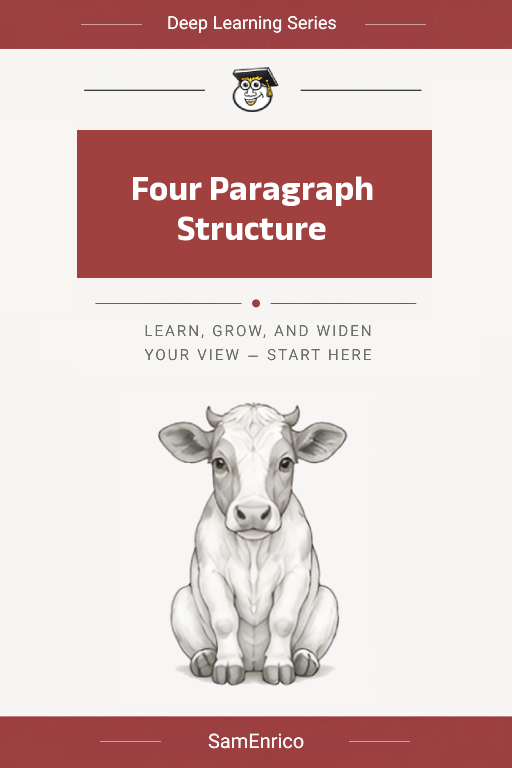
Four Paragraph Structure eBook
Write your contribution, impact metrics, future va
Write your contribution, impact metrics, future value, and requested title in four concise paragraphs.
Formats
Free sample
Chapter 1: The Eleven-Second Siege--It begins not with a grand idea, but with a quiet, devastating fact: the average executive spends eleven seconds on any given document before deciding whether to read it or delete it.That is not a metaphor. It is not an exaggeration. It is the measured result of multiple workplace attention studies conducted over the past decade. Researchers from Microsoft, the Nielsen Norman Group, and the University of California, Irvine have all arrived at the same unsettling conclusion. The human brain, when confronted with an email, a proposal, a memo, or a report, makes a rapid-fire triage decision in less time than it takes to tie a pair of shoes.
And that decision is almost always final.If your document does not pass that eleven-second test, it does not get read later. It does not get filed for future reference. It does not get forwarded to a colleague for their opinion. It gets deleted, archived, or answered with a one-word reply—“Thanks”—that means nothing and closes the door permanently.You have experienced this. You have sent a carefully crafted message, waited for a response, and received only silence or a polite dismissal.
You told yourself the recipient was too busy. You told yourself the timing was wrong. You told yourself that next time, you would add more data, more context, more proof to overcome their resistance.You were wrong on every count. The problem was not the quality of your idea. The problem was not the amount of evidence you provided.
The problem was that you violated a fundamental, unspoken rule of modern professional communication. You asked someone to read something their brain had already decided to ignore before they even opened it.This book exists because that rule is now the most important rule in persuasion. And almost no one knows it exists.The Neuroscience of Skimming Let us go deeper into the eleven seconds. What actually happens inside the brain during that time?The answer lies in a bundle of nerves called the reticular activating system, or RAS. The RAS sits at the brainstem and acts as a filter for every piece of incoming information.
It decides what deserves conscious attention and what can be safely ignored. Without the RAS, your brain would be overwhelmed by the millions of sensory inputs hitting it every second. The RAS is not a flaw. It is a survival mechanism.When you send a document to a decision-maker, their RAS processes it in three sequential stages. First, relevance: “Does this relate to my current goals, problems, or responsibilities?” Second, credibility: “Does this appear to come from a trustworthy source with evidence to back it up?” Third, urgency: “Does this require action now, or can it wait?”Each stage takes roughly three to four seconds.
If a document fails any stage, the RAS flags it as low priority. Low priority documents are not read later. They are sent to the mental equivalent of a spam folder—still visible, technically accessible, but never revisited. The decision-maker will not even remember that they ignored it. Their brain protected them from the discomfort of acknowledging a missed opportunity.Here is the cruelest part of this process: the RAS operates below conscious awareness.
Your reader does not know they are filtering you out. They will tell you they are “too busy.” They will tell you they will “circle back next week.” They believe these excuses. But the truth is simpler and more painful. Your document failed the eleven-second test, and their brain moved on before their conscious mind could intervene.The Myth of the Diligent Reader Most professionals operate under a dangerous assumption. They assume that their reader—especially a senior reader—will be diligent.
They assume that because the topic is important, the reader will invest time. They assume that because they spent hours writing, the reader will spend minutes reading.This assumption is not just wrong. It is catastrophic.In 2016, researchers at the University of California, Irvine, conducted a landmark study of workplace attention. They installed tracking software on the computers of forty senior executives and observed their behavior for twelve weeks. The results were devastating.
The average executive spent thirty-seven seconds on any given document before switching to another task. Thirty-seven seconds sounds better than eleven, until you realize that thirty-seven seconds includes the time it takes to open the file, scroll to the bottom, close it, and check a separate email notification.The researchers also found something else. When executives were asked later about the content of documents they had “read,” their retention was near zero for any document longer than two hundred words. But for documents shorter than two hundred words—roughly the length of four short paragraphs—retention jumped to over seventy percent.Think about what this means. A longer document is not just less likely to be read.
It is less likely to be remembered even if someone pretends to read it. The relationship between length and impact is not linear. It is exponential in the wrong direction. Every additional sentence beyond the first four paragraphs does not reduce your chances of success by a small amount. It reduces them by a large amount.
Beyond two hundred words, the curve falls off a cliff.This is not a matter of opinion. This is cognitive physics. You cannot persuade someone with information they never process. You cannot convince someone with evidence they never see. You cannot close a deal with a proposal that never gets opened.The Failure of Long-Form Persuasion I need to say something that will make some readers uncomfortable.
Long-form reports are no longer a sign of professionalism. They are a sign of unawareness.For decades, business communication operated under a simple rule: more information is better. If a two-page memo was good, a twenty-page report was better. Detail signaled diligence. Length signaled importance.
Brevity was for people who did not have enough to say. This rule made sense in an era of information scarcity. When documents were typed on paper and distributed physically, every page represented real labor. Length was a signal of investment.That era is over. And it is never coming back.The information economy has flipped the equation.
There is now vastly more information available than any human can process. In 1980, the average professional received fewer than ten written communications per day. In 2024, the average professional receives over one hundred and twenty emails, plus instant messages, documents, meeting invitations, and project updates. The scarce resource is no longer information. The scarce resource is attention.When you send a long document, you are not demonstrating diligence.
You are demonstrating that you have not noticed that your reader is drowning. You are handing a drowning person a cinder block and calling it a life preserver.The executive who ignores your twenty-page report is not being lazy. They are being efficient. They have learned, through painful experience, that most long documents contain mostly filler. They have learned that the first two pages often contain the only two paragraphs that matter.
They have learned that if something is truly important, it can be said in four paragraphs or less. They have developed an automatic…
This is the end of the free sample. Get the eBook to keep going. Buy now
About this book
Details
- Author
- Davila Sanford
- Publisher
- SamEnrico
- Language
- English
- Genre
- Non-Fiction, Professional's Cheat Sheet, Promotion Writing, Structured Arguments
- Released
- 2026-06-01
- Pages (approx.)
- 144
- Available as
- eBook, Audiobook

Read better in the ZLOADR app
Your eBooks on your phone or tablet. Sign in with your SamEnrico account and start reading.
More by Davila Sanford
 Manager Listening Skills GuideDavila Sanford$11.99
 Boredom as Fuel GuideDavila Sanford$11.99
 Immigrant Vending Machine Route SuccessDavila Sanford$11.99
 Cryotherapy for Injury RecoveryDavila Sanford$11.99
 The Silent Treatment YearDavila Sanford$11.99
 Mentorship in Military ServiceDavila Sanford$11.99
 GDPR vs CCPA PenaltiesDavila Sanford$11.99
 Douglas DynastyDavila Sanford$11.99
 Assertiveness For PoliticiansDavila Sanford$11.99
 The Whispering Lanterns of Obon: Ghosts and FirefliesDavila Sanford$11.99
 The Healers of Sound: Ancient Greek Music Therapists and the Birth of Jazz InnovationDavila Sanford$11.99
 Deepfake Democracy: The AI Election Heist of 2016Davila Sanford$11.99