
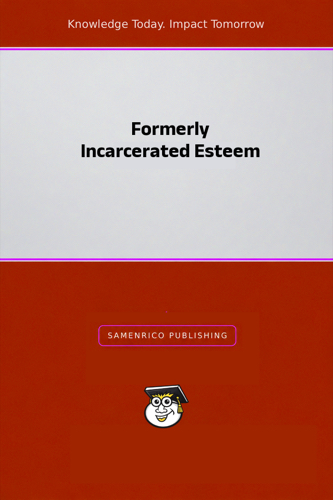
Formerly Incarcerated Esteem eBook
Rebuild professional confidence after prison.
by Shore Wes
Rebuild professional confidence after prison.
Formats
Free sample
Chapter 1: The Walls Inside...--–- The first time Marcus applied for a job after his release, he sat in his cousin's Honda Civic for forty-seven minutes. The engine was off. The February air seeped through a crack in the window. In the cupholder sat a printed application—six pages, stapled twice—for a warehouse position that paid fourteen dollars an hour. He had read every word three times.
He had not yet opened the car door. His hands, which had once loaded a truck in under twelve minutes flat, could not turn the handle. Marcus was not afraid of the employer. He was not afraid of the background check. He was afraid of a voice that lived entirely inside his own skull, a voice that whispered with surgical precision: You don't belong out here.
You'll mess this up like you mess everything up. Who do you think you are?That voice is not Marcus's alone. It belongs to nearly every person who has spent time behind bars and then tried to stand before an employer as an equal. It is the subject of this chapter and the first obstacle this book will help you dismantle: the hidden prisons of self-doubt.Before you can convince an employer to hire you, before you can write a compelling resume or nail an interview or negotiate a salary, you must confront the barriers that live between your own ears. The criminal justice system incarcerates the body.
But long after the body is freed, the mind often remains in a cell of its own making. This chapter is about identifying those internal bars, naming them, and understanding how they sabotage your professional confidence before you ever submit an application.The Two Sets of Bars Let us begin with a distinction that will frame everything that follows. There are two kinds of bars that separate you from professional success. The first kind is external. These are the actual barriers placed on you by the criminal legal system: a felony record that appears on background checks, probation or parole supervision that restricts your movements, mandatory disclosure laws that require you to check a box on job applications, occupational licensing bans that exclude you from certain fields, and the very real discrimination that some employers will practice no matter how qualified you are.
These external bars are real. They are unfair. They are, for many readers, infuriating. And they are not going away overnight.The second kind of bar is internal. These are the psychological and emotional prisons we build inside our own minds: shame that convinces you your past defines your future, negative self-talk that repeats the worst things anyone ever said about you, imposter syndrome that makes you feel like a fraud in any professional setting, hypervigilance left over from survival mode, and a deeply ingrained expectation of rejection that causes you to reject yourself before anyone else can.
These internal bars are also real. Unlike external bars, however, they are entirely within your power to dismantle. No law, no judge, no employer can force you to keep living inside a prison of self-doubt. Only you can unlock that door. And only you can choose to walk through it.This chapter focuses on the internal bars.
Later chapters will give you the tools to navigate external barriers like background checks and disclosure laws. But if you try to tackle the external barriers without first addressing the internal ones, you will find yourself like Marcus in that parked car—armed with a perfect application and unable to turn the handle.What Prison Does to the Mind That Handcuffs Cannot Reach Prison is designed to break down the self. This is not a side effect of incarceration; for many prison systems, it is the point. From the moment you enter, you are stripped of your name (replaced by a number), your clothing (replaced by a uniform), your schedule (controlled entirely by bells and counts), your privacy (watched, searched, recorded), your autonomy (every decision requires permission), and your identity (you are no longer a person with a past and a future; you are an inmate, defined entirely by your worst moment). Over months and years, this systematic dismantling becomes internalized.
Psychologists call this process prisonization—the adoption of the inmate code, the hypervigilance, the emotional numbness, and the learned helplessness that allows a person to survive inside but cripples them outside.Consider the survival habits that prison teaches. You learn to scan every room for threats because a fight can break out in an instant. You learn to avoid eye contact with authority figures because looking a guard in the eye can be read as defiance. You learn to walk with a certain slowness or a certain swagger, depending on your yard, because speed can mean fear and stillness can mean weakness. You learn to minimize your own achievements because showing pride can make you a target.
You learn to expect betrayal because informants exist. You learn to suppress your emotions because vulnerability is dangerous. You learn to say "I don't know" and "it doesn't matter" and "I'm nothing" because those phrases keep you alive.Every single one of these survival habits is a liability in the civilian workplace. The manager interviewing you does not know you are scanning the room for threats. She sees a candidate who looks nervous, shifty, or distracted.
The coworker who asks about your weekend does not know you are avoiding eye contact to stay safe. He sees someone who seems dishonest or disengaged. The HR director reading your application does not know you minimized your prison kitchen management experience because you learned not to brag. She sees a candidate with a suspicious gap and no apparent skills. Your survival strategies are sabotaging your success because the rules of survival inside are the opposite of the rules of success outside.The Anatomy of a Hidden Prison Let us get specific.
A hidden prison is any internal belief, thought pattern, or emotional response that keeps you stuck in a mindset of worthlessness, helplessness, or defeat long after your physical release. These prisons are "hidden" because they operate below the level of conscious awareness. You do not choose to think I'm not good enough. The thought simply appears, often before you can catch it, and it feels like truth rather than a habit.Here are the most common hidden prisons that undermine professional confidence among formerly incarcerated individuals.The Prison of Shame Shame is the belief that you are fundamentally bad, not that you did something bad. This distinction is crucial and will be explored in depth in Chapter 3.
For now, understand that shame attaches to your identity rather than your behavior. A person who feels shame does not say "I made a mistake." They say "I am a mistake." Shame whispers that you do not deserve a good job, a second chance, or even basic respect. It causes you to apologize for existing, to preemptively disclose your worst moments to strangers, and to shrink from opportunities because you feel unworthy of them. Shame is not the same as guilt. Guilt can be productive—it tells you that a specific action violated your values, which motivates…
This is the end of the free sample. Get the eBook to keep going. Buy now
About this book
Details
- Author
- Shore Wes
- Publisher
- SamEnrico
- Language
- English
- Genre
- Non-Fiction, Self-Help, Reentry
- Released
- 2026-06-07
- Pages (approx.)
- 137
- Available as
- eBook, Audiobook

Read better in the ZLOADR app
Your eBooks on your phone or tablet. Sign in with your SamEnrico account and start reading.
More by Shore Wes
 TCM Stroke RecoveryShore Wes$11.99
 Keto Constipation Relief GuideShore Wes$11.99
 Pokemon Go Outdoor BalanceShore Wes$11.99
 The Legend of Juan 'El Rey' Machete: The Birth of Latin American BoxingShore Wes$11.99
 How to Start a Pipes and Fittings Made of Ceramics Business (Beginners Guide)Shore Wes$11.99
 How to Produce Chemical Machinery and EquipmentShore Wes$11.99
 AI Profit Margin Analysis ToolsShore Wes$12.99
 Reliability Program ManagerShore Wes$11.99
You may also like
 Hong Kong Handover 1997Dunn Johnnie$11.99
 Zumba For Postnatal Recovery CourseNeal Christian$11.99
 Zumba for BeginnersLadner Nikia$11.99
 YouTube Comment Mining GuideHumes Pandora$12.99
 Worry Box MeditationCarlin Rudy$11.99
 Workplace Stress MeditationNguyen Lynn$11.99
 Workplace Stress and Sleep RepairHawley Ivory$11.99
 Workplace Perfectionism CureDelaney Jeffry$11.99
 Workplace Injustice Anger GuideWallen Isabelle$11.99
 Work Addiction and Burnout LinkGreenwood Ester$11.99
 Women in Yoga and WellnessBeattie Galina$11.99
 Women in Stand Up ComedyChun Evangeline$11.99