
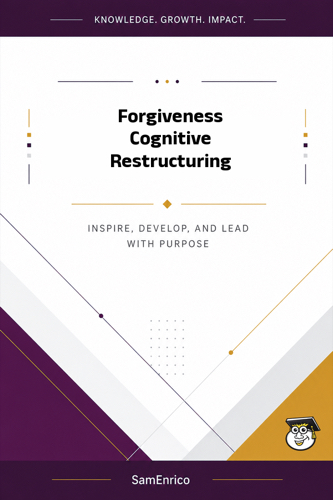
Non-FictionSelf-HelpForgiveness
Forgiveness Cognitive Restructuring eBook
Reframes letting go as strength, not weakness.
Reframes letting go as strength, not weakness.
Formats
Free sample
Chapter 1: The Grudge Tax--–- Margaret had been carrying the same wound for eleven years, four months, and approximately three days. She knew this with embarrassing precision because she had replayed the scene so many times that the memory had worn smooth as a river stone—polished, featureless, and still heavy.The offense was not small. Her older sister had publicly humiliated her at a family wedding, revealing a confidence Margaret had shared in tears, turning the moment into a joke that rippled through the entire reception. People laughed. Margaret excused herself to the bathroom and did not return to the party.
That night, she made a silent vow: I will never trust her again. I will never forget what she did. And I will never let her off the hook.For eleven years, she kept that vow. She attended family gatherings with a smile that did not reach her eyes. She answered her sister's texts with single words.
She rehearsed cutting remarks in the shower, though she never actually said them. She told the story of the betrayal to anyone who would listen, each time adding a new detail, each time feeling the old anger rise fresh in her chest.What Margaret did not know—what she could not see from inside the grudge—was that her sister had long since moved on. The sister had apologized twice (dismissed). She had tried to rebuild (rebuffed). Eventually, she had stopped trying.
The sister's life continued: promotions, children, a new home. She thought of the wedding incident perhaps once a year, if that.Margaret thought of it every single day.She was paying a tax she did not know existed. And this book is the receipt.The Invisible Tax You Are Paying Right Now Let us name what Margaret could not name. She was paying what this book will call The Grudge Tax—the cumulative cost of holding onto an offense long after the offense has ended. The tax is extracted in four currencies, each more expensive than the last.Currency One: Attention.
Every time Margaret replayed the memory, she was spending attention that could have gone to her children, her work, her sleep, her joy. Over eleven years, the total hours of rumination exceeded 2,300—the equivalent of 96 full days. Nearly three months of her life, spent inside a moment she wished had never happened.Currency Two: Physiology. Her body did not know the difference between a real threat and a remembered one. Each time the memory played, her amygdala triggered a stress response.
Cortisol flooded her system. Her blood pressure rose. Her sleep fragmented. Chronic resentment is not an emotion; it is a long-term health condition.Currency Three: Relationships. The grudge did not only affect her relationship with her sister.
It leaked. Margaret became more cynical with friends, more guarded with her partner, more impatient with her children. Resentment is not a contained fire. It burns everything nearby.Currency Four: Identity. Most insidiously, Margaret had begun to define herself by the wound.
She was not "a woman who experienced a betrayal"; she was "a woman who was betrayed." The grudge had become furniture. She had forgotten the room could be rearranged.This chapter exists to do one thing: show you that you are paying this tax, name its true cost, and give you permission to stop paying it—not because the offense was small, but because your life is too large to spend it inside a prison of your own making.The Paradox That Will Change Everything Here is the counterintuitive truth at the heart of this book, and you will want to read this sentence twice:Holding a grudge feels like protection but functions as self-harm.This is the paradox that keeps people trapped for years, decades, entire lifetimes. The grudge feels powerful. It feels like you are holding someone accountable. It feels like you are refusing to let them get away with it.
But step back and look at the actual mechanics:– The person who hurt you is almost certainly not thinking about you right now.– The person who hurt you is sleeping, eating, laughing, moving on.– You are the one who cannot sleep, who eats mechanically, who has forgotten how to laugh.The grudge does not hurt them. It hurts you. It was never a weapon. It was always a prison, and you have been both the prisoner and the guard.This is not abstract philosophy. Research in psychoneuroimmunology has demonstrated that the physiological signature of unforgiveness is indistinguishable from the physiological signature of chronic stress.
Elevated cortisol. Elevated inflammatory markers. Elevated blood pressure. Reduced heart rate variability. Reduced immune function.
Your body does not care why you are stressed. It only registers that you are stressed.When Margaret told herself the story of the wedding for the thousandth time, her body reacted as if the wedding were happening right now. The threat was not in the past. It was being generated fresh, every single day, by her own mind.The Forgiveness Definition That Will Anchor This Entire Book Before we go any further, we need a shared definition of forgiveness. This book will use one definition, consistently, in every chapter, applied to every situation.
Write it down if that helps.Forgiveness is the decision to stop demanding a different past.Read that again. Notice what it does not say. It does not say the offense was acceptable. It does not say you must reconcile. It does not say you must forget.
It does not say you must feel warm feelings toward the person who hurt you.All it says is this: you stop demanding that the past be different than it was.That is it. That is the entire engine of this book. Not emotional bypass. Not spiritual platitudes. Not pretending everything is fine.
Just a clean, cognitive decision to close the ledger on what cannot be changed.When you demand a different past, you are doing something impossible. The past cannot be changed. No amount of rumination, revenge, resentment, or righteous anger will alter a single fact about what happened. The only thing your demand for a different past accomplishes is your own suffering.Forgiveness is not about the offender. It is about your relationship with reality.
And reality, as you may have noticed, is not asking for your permission.The Science of Why You Cannot Let Go (And Why That Is Not Your Fault)Before you blame yourself for being stuck, you need to understand what you are up against. Your brain is not broken because you cannot forgive. Your brain is doing exactly what evolution designed it to do—it is just doing it in an environment evolution did not anticipate.The Negativity Bias Humans have what psychologists call a negativity bias. We remember criticism more than praise. We remember losses more than gains.
We remember betrayal more than kindness. This was adaptive on the savanna, where failing to remember a threat could get you killed. It is maladaptive in modern life, where replaying a social slight for eleven years serves no protective function whatsoever.Your brain is not betraying you. It is running outdated software. This chapter, and the chapters that follow, will…
This is the end of the free sample. Get the eBook to keep going. Buy now
About this book
Details
- Author
- Greer Micheal
- Publisher
- SamEnrico
- Language
- English
- Genre
- Non-Fiction, Self-Help, Forgiveness
- Released
- 2026-06-05
- Pages (approx.)
- 122
- Available as
- eBook, Audiobook

Read better in the ZLOADR app
Your eBooks on your phone or tablet. Sign in with your SamEnrico account and start reading.
More by Greer Micheal
 Koresh and the GuitarGreer Micheal$11.99
 Tenzing Everest Cigarette StoryGreer Micheal$11.99
 The Work Addiction Spiritual RecoveryGreer Micheal$11.99
 NVC For Kids GuideGreer Micheal$11.99
 Water Storage and Purification GuideGreer Micheal$11.99
 Female Rulers Financial Mastery HandbookGreer Micheal$11.99
 Cash Flow for Pool ServiceGreer Micheal$11.99
 Type A Burnout SolutionsGreer Micheal$11.99
 The Lost Caravan of the Sahara: Ibn Battuta’s Miraculous SurvivalGreer Micheal$11.99
 Neural Odyssey: The Forgotten AI of Ancient AlexandriaGreer Micheal$11.99
 Crown & Code: The Digital Succession of the British MonarchyGreer Micheal$11.99
 The Mineral Guide to YttroceriteGreer Micheal$11.99
You may also like
 Hong Kong Handover 1997Dunn Johnnie$11.99
 Zumba For Postnatal Recovery CourseNeal Christian$11.99
 Zumba for BeginnersLadner Nikia$11.99
 YouTube Comment Mining GuideHumes Pandora$12.99
 Worry Box MeditationCarlin Rudy$11.99
 Workplace Stress MeditationNguyen Lynn$11.99
 Workplace Stress and Sleep RepairHawley Ivory$11.99
 Workplace Perfectionism CureDelaney Jeffry$11.99
 Workplace Injustice Anger GuideWallen Isabelle$11.99
 Work Addiction and Burnout LinkGreenwood Ester$11.99
 Women in Yoga and WellnessBeattie Galina$11.99
 Women in Stand Up ComedyChun Evangeline$11.99