
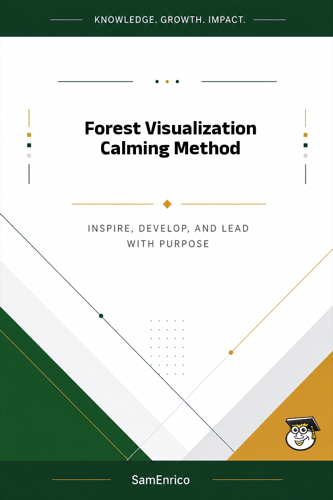
Non-FictionSelf-HelpNature Imagery
Forest Visualization Calming Method eBook
Walk mentally through a sun-dappled woodland, noti
Walk mentally through a sun-dappled woodland, noticing moss, ferns, and the scent of pine.
Formats
Free sample
Chapter 1: The Hidden Canopy...--–- Every morning, before the rest of the world wakes, something remarkable happens inside your body. Your heart rate settles into a quiet rhythm. Your breathing slows without your instruction. And for a few fleeting moments, your mind hovers in a state of pure potential – not yet caught by the day’s anxieties, not yet replaying old wounds or forecasting future disasters. This is the window.
And most people sleep right through it.You didn’t pick up this book by accident. Something in you already knows that the endless scroll, the constant ping of notifications, the low-grade hum of mental clutter – none of it is sustainable. You’ve tried meditation apps that left you feeling like a failure. You’ve attempted “just breathe” advice that felt like being told to calm down while standing in a burning room. You’ve suspected, perhaps, that nature might hold the key, but you don’t live near a forest.
Or you’re too busy. Or the weather is wrong. Or you’re simply too exhausted to drive anywhere.The Forest Visualization Calming Method is not about going to the woods. It is about bringing the woods to you – not as an escape from reality, but as a deeper entry into it. And before you learn a single technique, before you close your eyes or take a single specialized breath, you need to understand why this works at the level of bone and blood and ancient wiring.
That is what this first chapter exists to give you: not motivation, but mechanism. Not inspiration, but instruction in how your own brain already knows the way home.The Biophilia Hypothesis: Why Your Bones Remember the Forest In 1984, the biologist Edward O. Wilson published a book that quietly changed how we understand human nature. He proposed something so obvious in retrospect that it feels almost embarrassing to need evidence for it: humans have an innate tendency to seek connections with other forms of life. He called it biophilia – literally “love of life.” But Wilson wasn’t writing poetry.
He was writing evolutionary biology. His argument was simple and devastating: for 99 percent of human existence, we lived inside nature, not apart from it. Our senses were calibrated to read the forest floor, to distinguish the rustle of a predator from the rustle of wind, to know which berries would nourish and which would kill. The ones who could not read those signals did not survive to become our ancestors.This means that your nervous system is not designed for fluorescent lighting, for the relentless ping of email, for eight hours of seated stillness in climate-controlled boxes. Your nervous system is designed for dappled light, for variable temperatures, for the soft information-rich chaos of a woodland.
And when you do not give it those things, it does not simply feel vaguely unhappy. It sounds an alarm.Consider what happens when you sit in a modern office for eight hours. Your cortisol – the primary stress hormone – does not stay flat. It rises, then plateaus, then rises again. Your blood pressure creeps upward.
Your heart rate variability, a key marker of resilience, narrows. Your sympathetic nervous system – the fight-or-flight branch – stays switched on like a forgotten porch light. You are not, in any meaningful sense, relaxed. You are simply enduring. And endurance is not the same as restoration.Now consider what happens when a person – any person, from any culture, of any age – spends time in a forest setting.
Even fifteen minutes of genuine woodland exposure produces measurable changes: cortisol drops by an average of 16 percent, blood pressure decreases, heart rate slows, and parasympathetic (rest-and-digest) activity increases. These are not small effects. These are comparable to what pharmaceutical companies spend billions trying to achieve.But here is the question that drives this entire book: what if you could achieve those same physiological changes without leaving your chair? What if the forest could come to you?Mirror Neurons and the Reality of Imagined Experience For a long time, scientists dismissed visualization as wishful thinking. “Just imagining” something was considered categorically different from actually experiencing it.
Then, in the 1990s, a team of Italian neuroscientists made a discovery that shattered that assumption. They were studying macaque monkeys, recording neurons in the premotor cortex – the part of the brain that plans movements. They noticed something strange. When a monkey reached for a peanut, certain neurons fired. But when the monkey simply watched a researcher reach for a peanut – without moving at all – the exact same neurons fired.
The monkey’s brain was simulating the action it observed, as if it were performing the action itself.These became known as mirror neurons. And subsequent research has shown that humans have an even more extensive mirror neuron system than monkeys do. When you watch someone cry, a part of your own brain associated with sadness activates. When you see a spider crawl across someone’s hand, your own disgust and fear circuits light up. When you hear a description of a sun-dappled forest floor, your visual cortex – the same visual cortex that processes actual sight – begins to fire.This is not metaphor.
This is neurobiology. Your brain does not distinguish perfectly between a vividly imagined experience and a real one. The same regions activate. The same neurotransmitters release. The same cascading physiological effects follow.Let me say that again: your brain treats a richly imagined forest as partially real.This is why athletes visualize their performance before competition.
A basketball player who visualizes making free throws for twenty minutes a day improves almost as much as a player who practices physically for twenty minutes a day. This is why trauma survivors can be triggered by a memory – the memory alone activates the same stress response as the original event. This is why a vividly recalled happy moment can genuinely lift your mood. And this is why the Forest Visualization Calming Method works: you are not pretending to be in a forest. You are, in a very real neurological sense, visiting one.The Cortisol-Forest Connection: What the Research Actually Shows Let me walk you through the specific studies that underpin this method – not to overwhelm you with data, but to give you the confidence that when you close your eyes and imagine moss beneath your palms, you are not engaging in wishful thinking.
You are engaging in a scientifically validated intervention.In 2007, a team of Japanese researchers led by Dr. Qing Li conducted what became a landmark study on forest bathing (shinrin-yoku). They sent subjects into forests for two days and measured their urinary cortisol, adrenaline, and noradrenaline levels. The results were striking: cortisol dropped by 13.5 percent on the first day and 15.8 percent on the second. Adrenaline dropped by over 20 percent.
Noradrenaline, which is associated with the body’s “alarm” response, dropped by nearly 30 percent. These were not subtle shifts. These were major physiological recalibrations.But here is where it gets interesting for our purposes. A follow-up study examined whether simply looking at forest landscapes – through a window or on a screen – produced similar effects. The answer was yes, but only partially.
Viewing forest imagery reduced cortisol by about half as much as actual forest immersion. Blood pressure dropped less. Heart rate…
This is the end of the free sample. Get the eBook to keep going. Buy now
About this book
Details
- Author
- Lockett Karrie
- Publisher
- SamEnrico
- Language
- English
- Genre
- Non-Fiction, Self-Help, Nature Imagery
- Released
- 2026-06-08
- Pages (approx.)
- 140
- Available as
- eBook, Audiobook

Read better in the ZLOADR app
Your eBooks on your phone or tablet. Sign in with your SamEnrico account and start reading.
More by Lockett Karrie
 MBSR For Test Anxiety WorkbookLockett Karrie$11.99
 PCOS Intermittent FastingLockett Karrie$11.99
 Middle Manager Sandwich StressLockett Karrie$11.99
 The Dorothy Hodgkin Crystallography LifeLockett Karrie$11.99
 The Dragon's Last Breath: A Forgotten Immortal's OathLockett Karrie$11.99
 Understanding Osteitis DeformansLockett Karrie$17.99
 Canadian Graduate Express Entry FAQLockett Karrie$12.99
 AIG SWOT LibraryLockett Karrie$12.99
 School SecretaryLockett Karrie$11.99
 How to Start a Telecommunications Resellers BusinessLockett Karrie$11.99
You may also like
 Hong Kong Handover 1997Dunn Johnnie$11.99
 Zumba For Postnatal Recovery CourseNeal Christian$11.99
 Zumba for BeginnersLadner Nikia$11.99
 YouTube Comment Mining GuideHumes Pandora$12.99
 Worry Box MeditationCarlin Rudy$11.99
 Workplace Stress MeditationNguyen Lynn$11.99
 Workplace Stress and Sleep RepairHawley Ivory$11.99
 Workplace Perfectionism CureDelaney Jeffry$11.99
 Workplace Injustice Anger GuideWallen Isabelle$11.99
 Work Addiction and Burnout LinkGreenwood Ester$11.99
 Women in Yoga and WellnessBeattie Galina$11.99
 Women in Stand Up ComedyChun Evangeline$11.99