
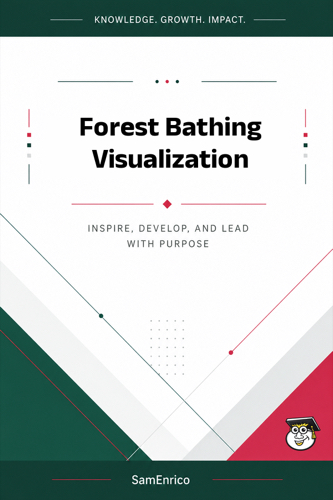
Non-FictionSelf-HelpNature Therapy
Forest Bathing Visualization eBook
Walk through a lush woodland path using all five s
by Troy Helene
Walk through a lush woodland path using all five senses for deep calm.
Formats
Free sample
Chapter 1: The Doorway Habit...--–- You are about to learn something that most people never discover: calm is not a place you find. It is a doorway you learn to open. And that doorway lives inside your own imagination, available at any moment, requiring nothing more than the breath already moving through your body. This chapter is not a visualization. It is the preparation for every visualization that follows—the ritual that separates aimless daydreaming from transformative practice.
Without this chapter, the remaining eleven walks will feel shallow, inconsistent, or frustrating. With it, you will build a doorway that opens faster each time you approach it, until one day you realize you are no longer trying to enter the forest. You have been living inside it all along.The Indoor Epidemic You Didn't Know You Had Let us begin with an uncomfortable truth. The average person in the developed world now spends approximately ninety-three percent of their life indoors. That is not a typo.
Ninety-three percent. Inside cars, inside offices, inside homes, inside fluorescent-lit rooms where the air is recycled and the only sky is a screen saver. Your nervous system evolved over hundreds of thousands of years to regulate itself in response to the natural world—the smell of rain on dry soil, the sound of wind moving through pine needles, the sight of dappled light shifting across a forest floor. You have been asking your ancient nervous system to function in an environment it does not recognize as safe.The result is not a personal failure. It is a design mismatch.Forest bathing, or shinrin-yoku, emerged in Japan during the 1980s as a direct response to this same problem—rising stress, burnout, and what the Japanese called karoshi (death by overwork).
Researchers discovered that even fifteen minutes of slow, sensory attention in a forest produced measurable physiological changes: lower cortisol, reduced blood pressure, improved immune function. But here is the problem that no one talks about. Most people cannot access a forest every day. You might live in a city. You might have a disability that makes woodland paths impossible.
You might work fourteen-hour shifts. You might be a parent whose only quiet moment comes after everyone else has finally fallen asleep.This book exists because of a discovery that changes everything: your brain cannot reliably distinguish between a vividly imagined sensory experience and a real one. When you close your eyes and truly imagine the crunch of dry leaves underfoot, the same auditory cortex activates as when you actually walk through a forest. When you imagine the rough texture of pine bark against your fingertips, your somatosensory cortex lights up at seventy to eighty percent of real touch. When you imagine the smell of rain-soaked earth, your olfactory bulbs send signals directly to your amygdala and hippocampus—the brain's emotional and memory centers—in the same pathways as physical scent.You do not need to go to the forest.
You need to learn how to bring the forest to you.But there is a catch. Visualization is not daydreaming. Daydreaming is passive. It wanders. It follows whatever thought appears next.
Visualization, as it will be taught in this book, is a disciplined act of attention. It requires a doorway. And every doorway requires a ritual.Why Most Visualization Attempts Fail Before we build your doorway, let us name the reason you may have tried visualization in the past and found it lacking. Perhaps you have closed your eyes before, tried to imagine a peaceful beach or a quiet meadow, and discovered that your mind refused to cooperate. Instead of calm, you got a running commentary.
Is this working? I should be relaxing. Why am I thinking about my email? My back hurts. What's for dinner?You were not failing.
You were missing the preparation.Visualization without preparation is like walking onto a stage without rehearsal. Your mind is a theater with a thousand lights, sound cues, and set pieces. If you simply close your eyes and say "imagine a forest," the stage manager (your prefrontal cortex) has no instructions. The lights come up randomly. The wrong sounds play.
The set changes mid-scene. You experience not calm but chaos, and then you judge yourself for not being "good at visualization."The research on guided imagery makes one finding consistently clear: the single strongest predictor of visualization success is not imagery ability, not meditation experience, not even stress level. It is preparation ritual. The people who succeed are the ones who create a repeatable, sensory-rich, context-specific routine before they ever close their eyes.This chapter gives you that routine.The Unified Breath Anchor: Your First Tool Every visualization in this book will rest on a single breath pattern. We call it the Unified Breath Anchor.
You will use it in every chapter, every practice, every time you return to your inner forest. It is the foundation. Master it now, and everything that follows becomes easier.Here is the pattern: inhale for four counts, hold for six counts, exhale for eight counts.Let us walk through it slowly.First, find a comfortable seated position. Sit upright in a chair with your feet flat on the floor, or on a cushion with your legs crossed. Your spine should be straight but not rigid—imagine a string pulling gently upward from the crown of your head.
Rest your hands on your thighs or in your lap. Close your eyes. We will keep our eyes closed for every visualization practice in this book unless specifically instructed otherwise.Now, breathe in through your nose for four seconds. Feel your abdomen expand, then your ribcage, then the very top of your chest. Do not force the breath.
Let it fill you like water rising in a vessel.Hold that breath for six seconds. This is not a strain. It is a pause. Notice the momentary stillness between fullness and release. Your heart rate will begin to slow during this hold, which sends a direct signal to your nervous system: we are safe, we are not running from a predator, we can rest.Exhale through your mouth for eight seconds.
Let the air leave slowly, evenly, completely. Imagine you are fogging a window. The long exhale activates your parasympathetic nervous system—the branch responsible for rest, digestion, and repair. Each eight-second exhale is like pressing a reset button on your stress response.Repeat this pattern four to six times before you begin any visualization. Do not rush.
The counts are guidelines, not prison walls. If four-six-eight feels uncomfortable, try three-five-seven. The important relationship is that the exhale is longer than the hold, and the hold is longer than the inhale. This ratio—short inhale, medium hold, long exhale—is what tells your nervous system to shift from fight-or-flight to rest-and-digest.Practice this breath pattern right now. Read the instructions, then close your eyes and run through it six times.
Do not continue reading until you have done this....Welcome back. You just built the foundation of your inner forest.Creating Your Sacred Container The Unified Breath Anchor is an internal tool. Now we build an external one: the sacred container. This is the physical environment in which…
This is the end of the free sample. Get the eBook to keep going. Buy now
About this book
Details
- Author
- Troy Helene
- Publisher
- SamEnrico
- Language
- English
- Genre
- Non-Fiction, Self-Help, Nature Therapy
- Released
- 2026-06-07
- Pages (approx.)
- 155
- Available as
- eBook, Audiobook

Read better in the ZLOADR app
Your eBooks on your phone or tablet. Sign in with your SamEnrico account and start reading.
More by Troy Helene
 Opioid PAWS Recovery GuideTroy Helene$11.99
 Immigrant Home Health Agency GuideTroy Helene$11.99
 Traumatic Loss Grief WorkbookTroy Helene$11.99
 Metta for a Partner with PTSDTroy Helene$11.99
 Iron Supplementation GuideTroy Helene$11.99
 NVC For Restorative JusticeTroy Helene$11.99
 Decision Block MethodTroy Helene$11.99
 Baddeley Model GuideTroy Helene$11.99
 The Forgotten Cartographer: Pankhurst’s Pacific Quest for the Nile’s SecretsTroy Helene$11.99
 The Alchemists of Timbuktu: Gold, Science, and the Rise of African ChemistryTroy Helene$11.99
 The Complete Guide to Going RAWTroy Helene$11.99
 Understanding Alcoholic Liver CirrhosisTroy Helene$17.99
You may also like
 Hong Kong Handover 1997Dunn Johnnie$11.99
 Zumba For Postnatal Recovery CourseNeal Christian$11.99
 Zumba for BeginnersLadner Nikia$11.99
 YouTube Comment Mining GuideHumes Pandora$12.99
 Worry Box MeditationCarlin Rudy$11.99
 Workplace Stress MeditationNguyen Lynn$11.99
 Workplace Stress and Sleep RepairHawley Ivory$11.99
 Workplace Perfectionism CureDelaney Jeffry$11.99
 Workplace Injustice Anger GuideWallen Isabelle$11.99
 Work Addiction and Burnout LinkGreenwood Ester$11.99
 Women in Yoga and WellnessBeattie Galina$11.99
 Women in Stand Up ComedyChun Evangeline$11.99