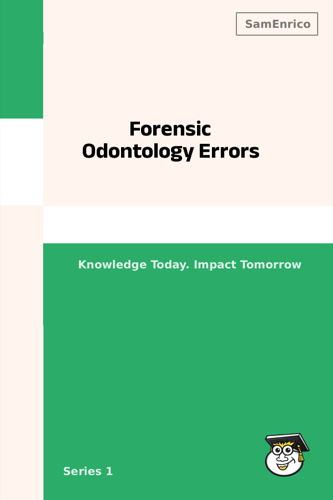
Forensic Odontology Errors eBook
undefined
by Jones Muriel
undefined
Formats
Free sample
Chapter 1: The Dentist’s Certainty...--–- In the summer of 1975, a jury in Los Angeles County did something that would echo through American courtrooms for four decades. They convicted a man named Walter Marx of murder based largely on the testimony of a dentist who claimed he could match bite marks on a victim’s skin to Marx’s teeth. The dentist, Dr. Norman Sperber, had no population studies to back his claims. He had no error rates.
He had no blind testing. What he had was absolute certainty. And that certainty, delivered in a calm, professional voice from the witness stand, was enough to send a man to prison.The case was People v. Marx, and it became the legal foundation upon which an entire forensic discipline was built. Before 1975, bite mark evidence was a curiosity—mentioned in a handful of trials, never as the primary evidence.
After Marx, it became a prosecution superweapon. Dentists who had spent their careers filling cavities and pulling molars suddenly found themselves as expert witnesses in murder trials, their opinions carrying the weight of life and death.The story of how bite mark analysis gained a courtroom foothold is not a story of scientific breakthrough. It is a story of legal happenstance, charismatic experts, and a justice system desperate for tools to catch killers. It is also a story of what happens when certainty outruns evidence. This chapter traces that history, from the first tentative bite mark cases of the nineteenth century to the explosive growth of forensic odontology in the 1970s and 1980s.
Along the way, we will see how a discipline with no empirical foundation convinced judges, juries, and prosecutors that a dentist could look at a bruise on human skin and identify a single human being as its maker.The Curious Case of the Paris Morgue The idea that teeth could identify a person is ancient. In 66 AD, the Roman emperor Nero’s mistress, Poppaea Sabina, is said to have identified her murdered lover by a distinctive discolored tooth. But the use of bite marks to identify a perpetrator—rather than a victim—is a much more recent invention.The first recorded use of bite mark evidence in a criminal trial occurred in 1870 in France. A man named Joseph Vacher, known as the “French Ripper,” had been arrested for the murder of a young woman. On the victim’s body were marks that prosecutors argued matched Vacher’s teeth.
The expert who testified was a dentist, and his opinion was simple: the marks looked like they could have been made by Vacher. The jury convicted him. There was no discussion of uniqueness, no statistical probability, no peer-reviewed research. Just a dentist looking at a wound and saying, “This could be his.”For the next century, bite mark evidence remained a rarity. When it appeared, it was treated as a form of circumstantial corroboration—something that might help confirm other evidence but could not stand alone.
That changed in the 1970s, when a convergence of legal rulings, cultural shifts, and ambitious experts transformed bite marks from a footnote to a headline.The Pre-CSI Effect: Why Juries Believed Dentists Before there was CSI: Crime Scene Investigation, before DNA testing captured the public imagination, there was a simpler kind of forensic hero: the doctor who could see what others could not. Television shows like Quincy, M.E. and Perry Mason had familiarized American audiences with the idea that medical experts possessed almost supernatural powers of observation. A pathologist could read a body like a book. A dentist could look at a bruise and reconstruct an entire face.This “pre-CSI effect” meant that juries entered courtrooms already predisposed to trust expert witnesses, especially those with medical credentials.
Dentists, in particular, occupied a strange middle ground in the public imagination. They were doctors—or at least doctor-adjacent—and they spent their careers making fine distinctions between teeth, filling cavities, fitting crowns. If anyone could tell two sets of teeth apart, surely it was a dentist.What juries did not know—and what prosecutors did not volunteer—was that no one had ever proven that human dentition is unique. The claim was an assumption, repeated so often that it had become a fact in the minds of experts and judges alike. But an assumption is not data.
And in the 1970s, when bite mark evidence first began appearing regularly in courtrooms, there were exactly zero population studies examining whether two people could have indistinguishable dental patterns. The entire discipline rested on a guess.The 1975 Turning Point: People v. Marx The case that changed everything involved the murder of a young woman named Kathleen “Kathy” Murphy. She had been stabbed to death in her Los Angeles apartment, and her body bore several marks that prosecutors believed were bite marks. The prime suspect was Walter Marx, a man who had been seen near the victim’s apartment around the time of the murder.The prosecution called Dr.
Norman Sperber, a forensic dentist who would later become one of the most influential figures in the field. Sperber examined photographs of the marks on Murphy’s body and compared them to a plaster cast of Marx’s teeth. He concluded that the marks were “consistent with” Marx’s dentition. Under cross-examination, Sperber went further. He testified that in his opinion, the bite marks could only have been made by Marx.There was no science behind this opinion.
Sperber had no statistical model, no blind comparison, no validation study. He was relying on his own eyes and his own experience. But the judge allowed the testimony, and the jury convicted Marx. The California Court of Appeal upheld the conviction, ruling that bite mark evidence was admissible because it was “generally accepted” in the forensic community.That phrase—“generally accepted”—came from a 1923 case called Frye v. United States, which established that scientific evidence could be admitted if it was “sufficiently established to have gained general acceptance in the particular field to which it belongs.” In Frye, polygraph evidence had been excluded because it was not yet accepted.
In Marx, bite marks were admitted because a handful of dentists said the technique worked.The circular logic is worth pausing over. Bite mark evidence was admissible because dentists said it was reliable. And dentists said it was reliable because courts kept admitting it. There was no external standard, no independent validation, no research that did not come from the very people who stood to gain from the technique’s acceptance. The field of forensic odontology had essentially certified itself.The Proliferation of Experts After Marx, bite mark evidence spread rapidly.
By 1980, nearly every state had admitted some form of bite mark testimony. The American Board of Forensic Odontology (ABFO) was founded in 1976, just one year after Marx, and began certifying dentists as “diplomates” in the field. Certification required passing an examination, but the examination tested knowledge of ABFO protocols—not the underlying validity of the technique itself.The 1980s saw a explosion of bite mark cases. In 1984 alone, bite mark evidence was used in over 50 murder trials across the United States. Most of these cases involved child victims, often in…
This is the end of the free sample. Get the eBook to keep going. Buy now
About this book
Details
- Author
- Jones Muriel
- Publisher
- SamEnrico
- Language
- English
- Genre
- Non-Fiction, True Crime / Wrongful Conviction
- Released
- 2026-06-07
- Pages (approx.)
- 114
- Available as
- eBook, Audiobook

Read better in the ZLOADR app
Your eBooks on your phone or tablet. Sign in with your SamEnrico account and start reading.
More by Jones Muriel
 Anticipatory Grief And TraumaJones Muriel$11.99
 Reiki Symbols ExplainedJones Muriel$11.99
 LBO Mezzanine Debt GuideJones Muriel$11.99
 Make Habits Easy GuideJones Muriel$11.99
 Emotional Validation for TherapistsJones Muriel$11.99
 Stippling Pattern AnalysisJones Muriel$11.99
 Self Hypnosis Sleep GuideJones Muriel$11.99
 The Beast of the Ural Mountains: The Soviet Union's Most Prolific Serial KillerJones Muriel$11.99
 Archimedes' Eureka: The Birth of Mathematical ReasoningJones Muriel$11.99
 Ultimate Handbook Guide to Yixing : (China) Travel GuideJones Muriel$11.99
 How to Produce PET Combs and BrushesJones Muriel$11.99
 A Collector's Handbook to the Veritas ScorpionJones Muriel$11.99