
Non-FictionInformativeEducational
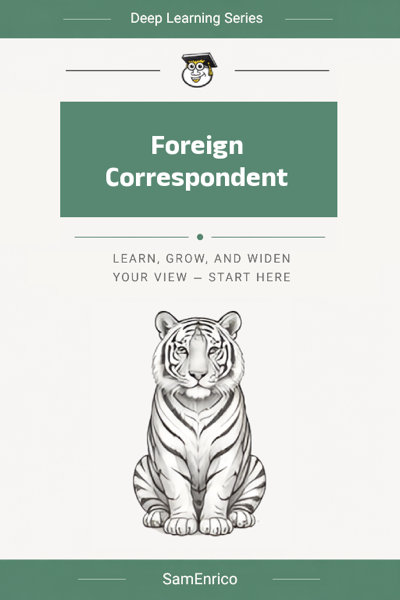
Foreign Correspondent eBook
A Coursebook on Foreign Correspondent
by Bond Ka
A Coursebook on Foreign Correspondent
Formats
Free sample
Chapter 1: The Network Beneath--The first time my fixer saved my life, I didn’t even know I was in danger.It was my second week as a freelance correspondent in Cairo, six months after the Arab Spring had toppled Hosni Mubarak. I was twenty-four years old, fresh out of graduate school, and convinced that I was about to become the next great foreign correspondent. I had read all the memoirs—Herr, Sheean, Colvin—and I had internalized their solitary heroism. I imagined myself filing dispatches from rooftop cafes, typing with one hand while holding a whiskey in the other, a lone voice of truth in a chaotic world.My fixer’s name was Omar. He was forty-seven, a former journalist who had been fired from the state newspaper for participating in the protests.
He drove a beat-up Peugeot that smelled of cigarette smoke and jasmine air freshener. He had a wife, three children, and a network of contacts that stretched from the presidential palace to the garbage slums of Manshiyat Naser. He knew every checkpoint, every back alley, every café where it was safe to talk and every street corner where it was not.On that second week, Omar and I were driving to meet a source—a low-level military officer who had agreed to talk about the Supreme Council of the Armed Forces’ secret detention centers. The officer had chosen a café in a neighborhood I had never heard of. I had the address punched into my phone, and I was so focused on my list of questions that I didn’t notice Omar slow the car, glance in the rearview mirror, and make a sudden left turn onto a side street.“Where are you going?” I asked.
“The café is straight ahead.”Omar did not answer. He drove for another two blocks, turned right, then right again, and pulled into a parking garage. He killed the engine and sat in silence for thirty seconds, watching the street behind us.“Two men in a white sedan,” he said finally. “They have been following us since we left the hotel.”I turned to look. “I didn’t see anyone.”“No,” Omar said.
“You were looking at your phone.”He explained that the white sedan had pulled out of a side street when we left the hotel, matched our speed through three turns, and stopped when we stopped. He had noticed because the driver was wearing sunglasses—at night—and because the license plate was from a military district. He had lost them in the parking garage by driving through the back exit onto a parallel street.“The meeting is off,” Omar said. “We go back to the hotel. We do not use the same route.”I wanted to argue.
I had spent three weeks cultivating that source. I had promised him anonymity and a thousand dollars. But Omar was already starting the engine, and I realized, with a sudden clarity, that I had no idea how to get back to the hotel without him. I didn’t know the street names. I didn’t know which neighborhoods were safe.
I didn’t know the difference between a military police checkpoint and a regular police checkpoint. I was, in every meaningful sense, a passenger.That was the moment I understood the first and most important lesson of foreign correspondence: the lone wolf is a myth. The trench-coated hero working alone in a dangerous capital never existed, except in the movies and the memoirs that journalists write to make themselves look brave. The reality of foreign reporting is collaboration. It is fixers and drivers and translators and local journalists and citizen stringers who feed information from the ground.
It is a network of relationships that the correspondent builds, maintains, and depends on for survival.The Myth of the Lone Wolf Let us begin by naming the myth we are about to destroy. The lone wolf foreign correspondent appears in countless films, novels, and memoirs. He—and it is almost always a he—is a hard-drinking, chain-smoking figure in a trench coat who arrives in a dangerous capital with nothing but a notebook and a courage that borders on recklessness. He speaks the language fluently (somehow), knows his way around the back alleys (without ever looking at a map), and charms his way past checkpoints with a combination of wit and moral authority. He files dispatches that change the course of history, then disappears into the night, alone.This archetype was popularized by Hollywood films like The Year of Living Dangerously (1982) and Salvador (1986), and by memoirs like Vincent Sheean’s Personal History (1935) and Michael Herr’s Dispatches (1977).
It persists in journalism education, where professors tell stories of legendary correspondents—Ernest Hemingway in Spain, Edward R. Murrow in London, Martha Gellhorn in Dachau—without always noting that these figures traveled with fixers, translators, drivers, and local guides whose names never made it into the dispatches.Hemingway did not find his way to the front lines of the Spanish Civil War alone. He was driven there by local guides who knew the roads and the checkpoints. Murrow did not wander into bombed-out London neighborhoods unaccompanied; he was taken there by fixers who had lived in those neighborhoods for decades. Gellhorn did not speak German; she relied on translators to interview survivors of Dachau.
The lone wolf is not a journalist. The lone wolf is a character in a story that journalists tell about themselves.The persistence of this myth matters because it shapes how aspiring correspondents imagine their work. Young reporters arrive in foreign capitals believing that they must be self-sufficient to the point of isolation. They think that relying on fixers is a sign of weakness. They think that paying translators is an admission of inadequacy.
They think that they should be able to navigate a city they have never visited, understand a culture they have never studied, and build relationships with sources who have every reason to distrust them—all without help.This is not bravery. This is stupidity. And it gets people killed.The Reality of the Backpack Journalist The reality of modern foreign correspondence is the “backpack journalist”—a reporter who carries their own equipment, manages their own logistics, and operates within a complex, collaborative network. The term emerged in the 1990s as news organizations began eliminating support staff. Where a network correspondent in the 1980s might have traveled with a producer, a cameraperson, a sound technician, and a driver, the backpack journalist does everything alone—except they are not really alone.The backpack journalist depends on a diverse cast of local collaborators, each essential in their own way.
Fixers arrange logistics, navigate bureaucracy, and provide security. They know which neighborhoods are safe and which are not. They know which officials can be bribed and which cannot. They know the difference between a military checkpoint that requires a bribe and a military checkpoint that requires silence. A good fixer is worth more than a flak jacket, because a good fixer keeps you out of situations where you would need a flak jacket.Drivers, in many countries, are not a luxury but a necessity.
Local drivers know the roads, the traffic patterns, and the shortcuts. More importantly, they know how to spot a tail…
This is the end of the free sample. Get the eBook to keep going. Buy now
About this book
Details
- Author
- Bond Ka
- Publisher
- SamEnrico
- Language
- English
- Genre
- Non-Fiction, Informative, Educational
- Released
- 2026-06-02
- Pages (approx.)
- 147
- Available as
- eBook, Audiobook

Read better in the ZLOADR app
Your eBooks on your phone or tablet. Sign in with your SamEnrico account and start reading.
More by Bond Ka
 Parental Anger And Sibling FightsBond Ka$11.99
 Product Manager Priority GuideBond Ka$11.99
 Cognitive Restructuring CourseBond Ka$11.99
 Mindfulness for Anxiety BeginnersBond Ka$11.99
 The Ballot Box Rebellion: How a Third-Party Candidate Almost Upended American PoliticsBond Ka$11.99
 The Mathematician Who Counted the Stars: Paul Erdős and the Hidden Patterns of AfricaBond Ka$11.99
 W2 Filing For Nonprofit StaffBond Ka$12.99
 Community Launch Week PlanBond Ka$12.99
 Understanding Deafness Hyperuricemia Neurologic AtaxiaBond Ka$17.99
 How to Start a Hobby in MashupsBond Ka$11.99
You may also like
 Hong Kong Handover 1997Dunn Johnnie$11.99
 Zumba For Postnatal Recovery CourseNeal Christian$11.99
 Zumba for BeginnersLadner Nikia$11.99
 YouTube Comment Mining GuideHumes Pandora$12.99
 Worry Box MeditationCarlin Rudy$11.99
 Workplace Stress MeditationNguyen Lynn$11.99
 Workplace Stress and Sleep RepairHawley Ivory$11.99
 Workplace Perfectionism CureDelaney Jeffry$11.99
 Workplace Injustice Anger GuideWallen Isabelle$11.99
 Work Addiction and Burnout LinkGreenwood Ester$11.99
 Women in Yoga and WellnessBeattie Galina$11.99
 Women in Stand Up ComedyChun Evangeline$11.99