
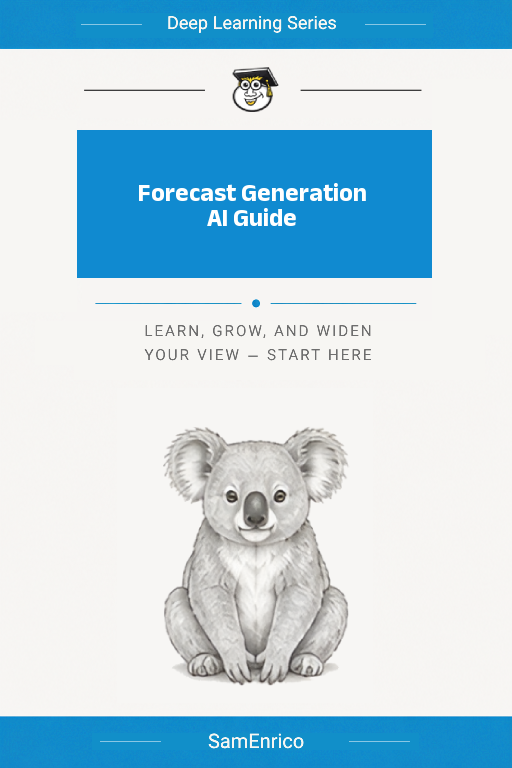
Non-FictionAI OperatorForecasting
Forecast Generation AI Guide eBook
Implement AI workflows that generate operational f
Implement AI workflows that generate operational forecasts based on historical data and trends.
Formats
Free sample
Chapter 1: The Monday Morning Massacre...-- The email arrived at 8:47 AM on a Monday. Subject line: "Forecast vs. Actuals – September Closing." The CEO was copied. So was the CFO. And the head of supply chain.
Your heart didn't just sink; it ejected from your chest and rolled under your desk.The numbers were brutal. You had predicted 12,400 units. The actual sales came in at 7,800. A 37 percent miss. The inventory team had already ordered raw materials based on your forecast.
The warehouse had hired temporary staff. The logistics provider had booked trucks. Now, twelve trucks would arrive nearly empty. Seventeen thousand units of packaging material would sit in a corner, useless. And somewhere in the finance department, someone was recalculating quarterly earnings with a red pen.This wasn't your first miss.
It was your third in five months. And the worst part? You had done everything by the book. You had cleaned the data. You had tested three statistical models.
You had even built a simple neural network that looked promising on paper. But when the real world threw a curveball—a sudden competitor discount, an unseasonal weather pattern, a social media trend that exploded overnight—your models stood there like deer in headlights, utterly oblivious.Welcome to the quiet crisis of modern forecasting.For decades, organizations have treated forecasting as a technical nuisance—something you do because you have to, not because you want to. You pull last year's numbers, apply a growth factor, maybe run an ARIMA model if someone on the team knows what that means, and send the numbers upstairs. The forecast lands in a spreadsheet. The spreadsheet lands in an inbox.
The inbox lands in a meeting. And the meeting concludes that the forecast is probably wrong, but no one knows by how much, and anyway, the quarter is almost over.This book exists because that world is ending.Not slowly, with polite retirement parties for legacy systems. It is ending like a cargo ship hitting a bridge—abruptly, expensively, and with plenty of witnesses. Generative AI has cracked forecasting open, and the pieces are still flying through the air. Foundation models trained on millions of time series can now produce accurate forecasts from as few as fifty historical observations—something ARIMA could never dream of.
Large language models, originally built to write poetry and answer trivia questions, can be reprogrammed to predict electricity demand and retail sales, with the added ability to read text prompts like "there's a hurricane approaching" and adjust their numbers accordingly.But here is the dirty secret that no vendor's landing page will tell you: these generative models are not magic. They are not drop-in replacements for your existing workflows. They come with their own failure modes, their own data requirements, their own operational headaches. They can hallucinate trends that never existed. They can leak future information into training if you are not careful.
They can cost you a fortune in API fees if you deploy them thoughtlessly. And worst of all, they can give you a false sense of certainty—smooth, beautiful prediction intervals that look authoritative but are completely miscalibrated.This chapter is the story of how we got here, why your Monday morning massacres are not your fault, and what "Forecast Generation" actually means in a world where AI can now generate entire probabilistic futures from scratch. By the time you finish this chapter, you will understand why the old rules no longer apply and why the hybrid approach—classical benchmarks plus generative AI—is the only path forward that does not end with another humiliating email.The Hidden History of Forecasting: From Moving Averages to Transformers To understand where forecasting is going, you need to understand where it has been. Not because history is inherently noble, but because every modern method carries the DNA of the struggles that came before it. The mistakes of the past are encoded in the architecture of the present.Phase One: The Age of Innocence (1920s–1970s)Forecasting began as a manual craft.
A supply chain manager would look at last year's sales for the same month, add a percentage based on "gut feel," and write the number on a whiteboard. The methods were simple: moving averages (average of the last k periods), exponential smoothing (weighted average that gives more importance to recent observations), and naive forecasts ("tomorrow will be the same as today").These methods worked reasonably well in stable environments. If you were forecasting demand for canned soup in a suburb with predictable seasons and no major disruptions, a simple exponential smoothing model could get you to within 10 percent accuracy. The models had almost no parameters to tune. They were interpretable.
A businessperson could understand why the forecast was going up or down.But they had a fatal flaw: they could not see patterns that spanned more than a few time steps. They had no concept of "every November, this happens, but every fourth November, something else happens because of the election cycle." They treated the world as a slightly wobbly straight line.Phase Two: The Statistical Revolution (1970s–2010s)The 1970s brought ARIMA—Auto Regressive Integrated Moving Average—and its seasonal sibling SARIMA. For the first time, forecasters had a rigorous mathematical framework for modeling autocorrelation (how today's value relates to yesterday's), trend (long-term direction), and seasonality (repeating cycles). The Box-Jenkins methodology gave practitioners a step-by-step ritual: identify the model order using ACF and PACF plots, estimate the parameters, diagnose the residuals, and iterate.ARIMA was a genuine breakthrough. It could capture complex temporal dependencies that simple smoothing methods missed.
It became the gold standard for decades, and in many industries, it still is. If you work in a regulated environment that demands explainability—pharmaceuticals, insurance, government—you are probably still using ARIMA or its cousins (ETS, Theta, BATS).But ARIMA had limitations that were baked into its assumptions. It required stationarity: your time series needed to have constant mean and variance over time, or you had to difference it (subtract each value from the next) until it became stationary. It struggled with long seasonal periods (e.g., daily data with yearly seasonality of 365 days). It could not automatically incorporate external factors like promotions, weather, or competitor actions unless you built elaborate transfer function models that few practitioners understood.
And it was fundamentally a linear model. If your data had non-linear patterns—a sudden cliff, a hockey-stick growth curve, a volatility cluster—ARIMA would smooth right over them and give you an average that satisfied no one.Phase Three: The Deep Learning Interregnum (2015–2022)Around 2015, deep learning arrived at forecasting's doorstep. Recurrent neural networks (RNNs) and their more sophisticated cousins, LSTMs (Long Short-Term Memory networks), promised to solve the problems that had plagued classical methods. They could learn non-linear patterns. They could handle long-range dependencies without explicit stationarity transformations.
They could ingest multiple time series simultaneously, learning from related products or stores to improve forecasts for each individual one.Amazon's Deep AR, introduced in 2017, was a landmark. It combined LSTM-based sequence modeling with probabilistic likelihood outputs, meaning it produced a distribution of possible futures rather than a single point. For the first time, a forecast could tell you not just…
This is the end of the free sample. Get the eBook to keep going. Buy now
About this book
Details
- Author
- Seward Hester
- Publisher
- SamEnrico
- Language
- English
- Genre
- Non-Fiction, AI Operator, Forecasting
- Released
- 2026-05-30
- Pages (approx.)
- 160
- Available as
- eBook, Audiobook

Read better in the ZLOADR app
Your eBooks on your phone or tablet. Sign in with your SamEnrico account and start reading.
More by Seward Hester
 Mindfulness For Real Estate AgentsSeward Hester$11.99
 Ayurvedic Elder Care GuideSeward Hester$11.99
 Mindful Transitions MBSR WorkbookSeward Hester$11.99
 Teen Self Esteem and PerfectionismSeward Hester$11.99
 The Australian Skills Shortage ImportSeward Hester$11.99
 The Battle of Kadesh: The Hittites Strike Back (1274 BC)Seward Hester$11.99
 ValuerSeward Hester$11.99
 How to Become a Clerical-methods AnalystSeward Hester$11.99
 Ghana Dropshipping Marketing on FacebookSeward Hester$12.99
 Understanding Micrencephaly Corpus Callosum AgenesisSeward Hester$17.99
You may also like
 Hong Kong Handover 1997Dunn Johnnie$11.99
 Zumba For Postnatal Recovery CourseNeal Christian$11.99
 Zumba for BeginnersLadner Nikia$11.99
 YouTube Comment Mining GuideHumes Pandora$12.99
 Worry Box MeditationCarlin Rudy$11.99
 Workplace Stress MeditationNguyen Lynn$11.99
 Workplace Stress and Sleep RepairHawley Ivory$11.99
 Workplace Perfectionism CureDelaney Jeffry$11.99
 Workplace Injustice Anger GuideWallen Isabelle$11.99
 Work Addiction and Burnout LinkGreenwood Ester$11.99
 Women in Yoga and WellnessBeattie Galina$11.99
 Women in Stand Up ComedyChun Evangeline$11.99